| Amazon revealed that as many as 25 out of 100 of its best-selling titles in 2012 were from indie publishers. This should serve as a measure of the growing clout that the indie publishers and authors have come to wield. Also, lest anyone have any doubt about what exactly “indie” refers to or whether it would include publishing via any of those other than the big six publishing house in the US, an Amazon spokeswoman clarified by saying: “This figure is referring to Kindle books on Amazon.com in 2012, with ‘indie’ meaning books self-published via Kindle Direct Publishing (KDP). So a quarter of the top 100 bestselling Kindle books on Amazon.com in 2012 were self-published via KDP.” Experts believe the share of authors preferring to publish their own books is fast catching on, so the percentage of indie authors is expected to rise further in the coming years. As Orna Ross, director of the UK Alliance of Independent Authors, which is a representative body of self-published authors, said: “We are in the middle of a major change. I wouldn’t be at all surprised if we reached a situation where the majority of the top books are author-published. I don’t see what would stop that.” Another trend is self-published authors who make it big ending up landing lucrative deals with conventional publishers. Paul Pilkington, a lecturer in a university in the UK, signed up with the UK-based publisher Hodder & Stoughton after two of his novels went on to sell more than 150,000 copies, other indie authors who got picked up by conventional publishers include the likes of Kerry Wilkinson and Beth Reeks. Kerry Wilkinson signed up with Pan Macmillan after success with his crime series which he had initially self-published. Beth Reeks, the nineteen-year-old student of physics, has been picked up by Random House after her romantic fiction, The Kissing Booth, which she had published at the storytelling site Wattpad, created a fan following of over 19 million. However, not everyone is impressed with the development. As independent publisher Colin Robinson of Or Books cautioned: “It’s possible that some of the publishers I’ve never heard of are in fact imprints set up by the author of the book but, especially as several appeared with books by more than one author (or at least one author’s name), it seems unlikely that more than a few are. Disney and Little Brown are doing great. So are joke books.” There has been a recent furor when erotic or adult themed novels ended up being listed alongside children's titles, pointing fingers at self-published authors of those works. The booksellers blamed this on the rampant increase in indie authors who often would publish such stories to gain publicity or earn money.
One Quarter of Top 100 Amazon Kindle Titles in the US Are Self-Published is a post from: E-Reader News |
Thursday, December 5, 2013
One Quarter of Top 100 Amazon Kindle Titles in the US Are Self-Published


Wednesday, December 4, 2013
Captain America 2 – Who is the Winter Solider?
| The Captain America sequel “The Winter Soldier” is poised to hit movie theaters March 26 2014. The movie will be about Steve Rogers after the first Avengers movie and his role in the Marvel cinematic universe. What digital graphic novels are essential reading and who exactly is the Winter Soldier? We dive deep into the issue and give you the low-down. The Marvel cinematic universe is quite different from the other timelines for digital comics published on a monthly basis. Marvel comics, the Ultimates and other franchises all do a different spin on the same major characters and story lines. When it comes to the line of movies like The Avengers, Iron Man, Thor and others, it is officially dubbed Earth-199999. In the Captain America movie his good buddy James Buchanan “Bucky” Barnes was one of Steve Rogers old friends, whom was recruited into his strike force to go after the Red Skull. Rogers and his team successfully sabotage various HYDRA operations. The team later assaults a train carrying Zola, the main scientist. Zola is captured, but Barnes falls from the train to his apparent death. The Winter Solider will tell the tale of General Vasily Karpov finding Bucky’s cold-preserved body missing one arm. Bucky is revived in Moscow, but suffers brain damage with amnesia as a result of the explosion. Scientists then attach a bionic arm to him to give him added strength. He is programmed to be a Soviet assassin for Department X, under the code name the Winter Soldier, he is sent on covert wetworks missions, i.e., missions involving assassination, becoming increasingly ruthless and efficient as he kills in the name of the state. While a Soviet agent, he also has a brief relationship with The Black Widow, who was also mind programmed to be an assassin at the time. In the recent Avengers film Hawkeye makes reference to having his mind torn asunder by Loki and Black Window mentioned she knows how he feels. In order to have his loyalty the Winter Soldier was kept in cryostasis, so between missions he is kept from aging. He does various missions over the years, leading to the terrorist attack that puts him back on Shields radar. If you want to get a firm understanding of all the different events leading up to the movie, you want to get your hands on the digital or normal graphic novels. You would be hard pressed to find the original Avengers comic book #4, which is the first appearance of Captain America and Bucky. About the best you can do is buy the The Avengers Omnibus, Vol. 1, which has the first 100 issues of the Avengers. It is not available as a digital edition so you will have to spend around $72.00 on Amazon. The best comic you could find, written in the modern times was the retelling of the Winter Solider by luminary Ed Brubaker, entitled Captain America, Vol. 1: Winter Soldier Ultimate Collection. There are three different graphic novels in the collection and even goes into The Black Window, essential stuff. Comixology has the later editions you can purchase for around $10.00 each, so it is fairly economical. Comixology has Winter Soldier Vol. 1: The Longest Winter, Winter Soldier Vol. 2: Broken Arrow and Winter Soldier Vol. 3: Black Widow Hunt. In an interesting trivia note, Bucky’s death has also been used to explain why the Marvel Universe has very few kid sidekicks, as no responsible hero wanted to endanger a minor in similar fashion. Stan Lee also harbored a well-known dislike for boy sidekicks in general. So, it could be posited that when Captain America was revived in the Silver Age, Stan Lee chose not to bring back Bucky. It was not until the last decade that he was brought back as a recurring character. Captain America 2 – Who is the Winter Solider? is a post from: E-Reader News |

Japanese Publishers and eBook Retailers Protesting Consumption Tax Hike, Demand Foreign Vendors be Taxed Too
| Publishers and distributors of e-books in Japan have voiced concern over the proposed hike in consumption tax from the current 5 percent to 8 percent by April 2014. However, while the taxation would apply to ebook publishers and distributors in Japan, the same when sourced from overseas vendors enjoy immunity from the tax net. As such, retailers such as Amazon or Rakuten's Canadian arm Kobo are not required to pay consumption tax in Japan. This as per the local players are allowing the overseas vendors undue benefit vis-à-vis their domestic counterparts. As per the current legal system, ebooks purchased and downloaded from servers outside of Japan are deemed transactions, and are hence considered to be outside the purview of consumption tax. It is only the items and services purchased in Japan that are subject to paying consumption tax. “Online shoppers are sensitive to prices. One of the reasons that foreign vendors gained a large share in the Japanese market was the unfair environment regarding the consumption tax,” said an executive with bookstore operator Kinokuniya Co. This, as per Daiwa Institute of Research Holdings Ltd. is also leading to the Japanese government losing out billions of yen in revenue every year. The loss is pegged at a substantial 25 billion yen in 2012 alone. The domestic players are urging the government to come up with a quick solution though anything of that sort seems unlikely to emerge before spring 2014 when the higher rate structure will come in place. Government sources have assured local publishers and ebook retailers they are investigating the matter and have assured a level playing field for all though that is not expected to happen anytime soon. “At the time the consumption tax was introduced (in the late 1980s), few imagined that the Internet would develop this much. The Finance Ministry should start upgrading legislation to create a fair environment,” said Yoshikazu Miki, a law professor at Aoyama Gakuin University.
Japanese Publishers and eBook Retailers Protesting Consumption Tax Hike, Demand Foreign Vendors be Taxed Too is a post from: E-Reader News |

Want Your Kids to Read More? Leave Them Alone.
| In-depth details on what motivates reading in children have come out in a new book, published by the world’s leading publisher of children’s content, Scholastic. In Reading Unbound: Why Kids Need to Read What They Want – and Why We Should Let Them, authors Jeffrey D. Wilhelm (Boise State University) and Michael W. Smith (Temple University), explain that there has to be more to books for young people than just the typical academic requirements. The results of the professors’ findings have led to an awe-inspiring but earth-shattering conclusion: school-based reading instruction should focus even more on self-selected texts for pleasure reading, and less on rote instruction from corporate lessons. "At a time when the Common Core Stare Standards and high-stakes assessments turn the eyes of parents, teachers, and policy-makers to what reading can do for you, we should not lose sight of the deep and manifold pleasures it can bring to you," Smith said in a press release. "Those pleasures are what motivate reading in the here and now and what make it likely that young people will read in the future." "Never underestimate the power of pleasure in motivating and sustaining reading and improvement in reading," continued Wilhelm. "And never underestimate the deep psychological work, psychological satisfaction, and human development that is occurring for readers of freely chosen texts. Books that are often marginalized by educators or parents are often the best choice for the readers at any given point in their own human developmental journeys." As one of the leaders in curricular publishing, too, Scholastic’s release of Wilhelm and Smith’s title will hopefully hold some level of sway over administrative decision making at the local and state government school boards, allowing more time during the school day to be spent on individualized reading for pleasure rather than simply reading for the sake of the curriculum. Reading Unbound is available from the Scholastic Teacher store for pre-order, and will ship in January. Free samples of the content are available for download now.
Want Your Kids to Read More? Leave Them Alone. is a post from: E-Reader News |

Windows Tablet Segment to Grow to 39.3 Million by 2017: IDC
| Market research firm IDC has projected the Windows-based tablet segment to grow to 39.3 million units by 2017. This will include both stand alone tablet devices as well as hybrid tablets, devices that come with a detachable keyboard and can be operated as either a tablet or a notebook device. This rise is expected to fill the void created by the shrinking PC sales, at least to some extent, which has been steadily declining since the advent of the tablet device. IDC pegged the PC segment to stabilize at around 300 million units by 2017, claiming these might have lost relevance to some extent, even though they cannot be replaced by portable devices yet. It is only the emergence of Windows 8.1 along with low power consuming Intel Bay Trail chips that has led to some degree of acceptability to Windows tablets. Windows based tablets accounted for less than 1 million units in 2011, though it is expected to grow to a bit more respectable 7.5 million by end of 2013. In contrast, Apple has sold 14.1 million of its iPad devices in the third quarter of 2013 alone, while the Android tablet segment reached 16.8 million devices in Q3, 2013. IDC has stated that the entire tablet segment itself is registering slower growth of late and has been forced to revise its estimates for 2013 to 221.2 million, down from the originally estimated 227 million units. The research firm also stated the segment could end up registering just single digit growth rate by 2017, from the present 53.3 percent. IDC analyst Tom Mainelli attributed the lower demand for tablets to the emergence of big screen smartphone devices. “In some markets consumers are already making the choice to buy a large smartphone rather than buying a small tablet, and as a result we’ve lowered our long-term forecast,’ said Tom Mainelli. “Meanwhile, in mature markets like the US where tablets have been shipping in large volumes since 2010 and are already well established, we’re less concerned about big phones cannibalising shipments and more worried about market saturation.” Meanwhile, there have been a slew of tablet launches running Windows 8.1, which includes the Dell Venue 8 Pro, Dell Venue 11 Pro, Lenovo Miix 2, Toshiba Encore, Asus Transformer Book T100, and others. All of these have had positive reviews so far and are expected to fare well in the market, though it remains to be seen if these can unsettle both Apple and Android’s tablet market share by a significant margin just yet.
Windows Tablet Segment to Grow to 39.3 Million by 2017: IDC is a post from: E-Reader News |

Holiday Events Part II: Gift Box Giveaway
| We are right in the middle of the holiday season, wrapping up Hanukkah this week and quickly nearing Kwanzaa and Christmas. This is a great time to ramp up marketing efforts for your digital collection and to help your patrons prepare for the influx of shopping and gift giving.
Holiday Device Showcase Tablets and eReaders are hot gifts but which one is right for you or your loved ones? At your library, you can host a Holiday Device Showcase to display popular devices and give your patrons a chance to get some hands-on experience with the gadgets. Read more about the Holiday Device Showcase in our Holiday Events Part I: Device Mania blog!
Gift Box Giveaway
Fa-la-la-la-Facebook Make sure to use social media to publicize events and to remind users that even during the holidays if the library branch is closed, your virtual branch is always open! We've created some fun images that can be posted to Facebook for season's greetings and helpful reminders. You can download these free graphics in the Social Media section of the Partner Portal.
Keep an eye on the blog – we'll be sharing event ideas and promotional tips throughout this season. Feel free to let us know what you're doing around your library or school to market your digital titles as we wrap up 2013!
Melissa Marin is a Marketing Specialist at OverDrive.
 |

Amazon drones, hax0r3d
| Have you seen all that stuff in the news about Amazon’s proposed new delivery method? At first glance, it looked like an April Fool’s joke – but then I remembered it was December. My money’s on it being a project that nobody intends to come to fruition; but a very clever bit of marketing for a month when Amazon sees more business than it does in any other month of the year. The idea here is that orders under five pounds weight will be delivered to your doorstep in 30 minutes by one of these little drones from 2015. Let’s put aside objectionable thoughts about getting civil aviation licences for thousands of drones at one time; about scalability; about range; and about the way people in certain of Amazon’s markets have a habit of keeping guns in the house and shooting things. It’s a nice bit of PR and it made me smile. But I was particularly tickled to find several people email me Samy Kamkar’s other objection to the drone idea: namely that they’d be very simple to subvert if you happen to be the no-moral-compass type who wants to get their hands on other people’s shopping. And (astonishingly quickly, given that Amazon broke the news three days ago), he’s built a demonstration of just how you’d go about doing that. Samy’s SkyJack is an autonomous drone that seeks other drones within range of its WiFi and hacks them, turning them into zombies under its control. Samy says: Using a Parrot AR.Drone 2, a Raspberry Pi, a USB battery, an Alfa AWUS036H wireless transmitter, aircrack-ng, node-ar-drone, node.js, and my SkyJack software, I developed a drone that flies around, seeks the wireless signal of any other drone in the area, forcefully disconnects the wireless connection of the true owner of the target drone, then authenticates with the target drone pretending to be its owner, then feeds commands to it and all other possessed zombie drones at my will. We at Pi Towers are full of raucous glee. You can read more about SkyJack and Samy’s exploits, and find out how he did it, at his website. |

Amazon Launches New Short Story Publishing Imprint StoryFront
| One of the most potentially useful features of digital publishing was the ability of authors to publish their short stories without the tedious process of anthology selection. In the past, authors who pen short stories had to submit their stories to collections publishers, and those anthologies are typically only published periodically; barring that, the author could try to submit a full collection of his own works, of which few are traditionally published and almost never from a debut author. Digital publishing and self-publishing threw open the doors to short story publication, and a resurgence in the genre has been enjoyed by readers of short form literature. Companies like Vook, Atavist, and Now & Then Reader have contributed to the renewed interest in the essay or pamphlet publishing of centuries ago, and today, Amazon Publishing announced its effort to bring short stories to the forefront of publishing. StoryFront, the company’s short story imprint, not only will focus on publishing high quality short fiction, but will also be the source of a weekly digital literary journal that will specifically feature short stories and poetry from new and veteran authors. "Based on the continued success of short fiction on Kindle as well as the enthusiastic response to Day One—we received thousands of subscriptions in the first week—we know readers are hungry for short stories and excited about exploring new genres," said Daphne Durham, Publisher of Adult Trade and Children's Group. "With StoryFront, we're feeding that enthusiasm by offering a wide range of stories curated by a team of editors who are committed to the craft." StoryFront already has a number of stories ready for publication from several bestselling authors, including works that are closely tied to existing novels but that didn’t require another full-length novel in order to share with readers. The platform is also bringing translations of well-known international short stories to US reading audiences.
Amazon Launches New Short Story Publishing Imprint StoryFront is a post from: E-Reader News |

Rapid Growth of Internet in Africa Leading to Digital Publishing Boom
| Africa has long been referred to as the dark continent, which means there is ample scope for the light to shine; and that is exactly what is happening in that part of the world. Focusing on just one measure of development, internet usage in Africa has hit the fast lane. Even this can be termed an understatement given the astounding 3,606 percent growth rate that internet usage has reached in the continent achieved since the beginning of the new millennium. Of course this has led to a ripple effect as this has spurred the demand for internet based service, with digital publishing being just one of them. “The proliferation of smartphones across Africa, combined with the inevitable burst into e-commerce, means that we would be foolish to ignore what is about to happen with publishing in Africa,” said Jeremy Weate, associated with Abuja-based Cassava Republic, a Nigeria based e-publishing firm that publishes fiction, non-fiction and children’s books. The obvious reference here has been to the more than 160 million Africans that connect to the internet, with it being smartphones that has emerged as the most preferred device to get online. “Moving to e-books addresses some of our most significant challenges with print books,” Weate further added. “In Nigeria, it is a tough ask to find a printer that can offer reliable services, a wide range of paper and guaranteed product quality. “We don't have to worry about printing, warehousing, distribution or engaging in fruitless marathons across the continent for payments that will never come,” said Weate. A higher access to internet is also seen by publishers as a means of drawing the Africans to read more books, a trend that has been lacking sorely among the masses. Such an endeavor is getting further impetus with the efforts of Worldreader, a non profit organization that has been distributing e-readers among school children in the continent with the aim to dram them to read ebooks. Statistics depicting Worldreader’s efforts too are commendable, having delivered more than 70,000 ebooks among 13,000 children in nine countries in the African continent. Meanwhile, Weate also stressed on promoting reading ebooks via smartphones given the wide reach these have already achieved. “Many young Africans are already comfortable reading on mobile devices and we think this trend will continue as the price of smartphones gets cheaper,” said Mr Weate. With this being the trend, it could just be a matter of time before major ebook publishers and device manufacturers such as Amazon, B&N, Kobo and such make a beeline for the African market.
Rapid Growth of Internet in Africa Leading to Digital Publishing Boom is a post from: E-Reader News |

Tuesday, December 3, 2013
Sony 13.3 inch e-Reader will not see a Retail Release in Japan
| The Sony 13.3 Inch e-Reader (DPT-S1) has been well received by the reading community because of its large and lightweight screen technology. Few e-readers ever produced have garnered such buzz and people are visibly excited about a wide-spread commercial release in May of 2014 in North America. Starting December 8th it will be available in Japan for around $1200 US or 98,000 yen. The sad part is that it will not be available in a retail environment. Instead, it will only be available for business customers via Sony’s own website and obviously through the grey market, such as Rakuten. Many people were hoping that they could pick one of these readers at the big electronic stores like Edion or Bicamera. Unfortunately Sony is making the call to sell it only to business customers, which for the most part are schools. It is not really a product designed for the casual reading audience because it can only read PDF files. So for example, the Sony Reader Store would not be bundled on it, obviously leading to confusion if a newbie reader got their hands on one. Sony 13.3 inch e-Reader will not see a Retail Release in Japan is a post from: E-Reader News |

ImcoV6L eReader Delayed until Early 2014
| A few months ago ImCoSys announced a new e-reader and they demoed it off at the Frankfurt Book Fair. The ImcoV6L e-Reader is being billed as the first e-reader with an open version of Android and it will allow users to install the e-reading app of their choice. Instead of being locked into dealing with one bookseller on an e Ink based device, you can install Kindle, Nook, Kobo or an indie app like Aldiko. We have official confirmation today that the e-reader is delayed and will be shipping out in February of March of 2014. The US government shutdown in October prevented a number of FCC applications from being processed or approved. ImCoSys was unable to procure the necessary certification to sell the e-reader in North America. This is very unfortunate as they will be missing out on the critical holiday season. The imcoV6L features a six inch e-Ink Pearl HD display screen with a resolution of 1024×758 pixels. It also has a front-lit display, to allow you to read in the dark. Underneath the hood, it is powered by a Rockchip 1 GHZ CPU processor and 256 MB of RAM. There is 4 GB of internal memory and has an SD Card slot to enhance it up to 32 GB. It will retail for around $119.99, which makes it a compelling device. One of the most interesting aspects of this device is external speakers and 3.5mm headphone jack. This will allow you to listen to audiobooks and music right on the device. Since it is running Android, you will be able to install apps such as Audible, to buy and listen to them right on your e-reader. Another great feature is the physical page turn buttons working in conjunction with the touchscreen. You can turn the pages by gestures or with the click of a button on the left/right hand side. ImcoV6L eReader Delayed until Early 2014 is a post from: E-Reader News |

Kobo Launches their Digital Magazine Shop
| At a product launch event in New York City Canadian based Kobo announced their intention of launching a digital magazine store. It took a number of months to work out the logistics and build a store interface on their new line of tablets, but it seems to have paid off. Starting today customers will have the ability to buy hundreds of magazines from major publishers and read them on their PC or via the Arc 7, Arc 7 HD or Kobo Arc 10 HD. The new magazine store from Kobo offers titles from top publishers including American Media, Bauer Publishing Group, Condé Nast, Hearst Corporation, Time Inc., Mansueto, Rogers Publishing Limited, Reader's Digest, and Wenner Media, with more being added every day. Instead of relying on the traditional pinch and zoom feature to read magazine articles, Kobo has developed their Guided Reading View. It has a simple tap interface that intelligently moves from one column of text to the next. Guided Reading removes the need for toolbars creating a clear interface free from distractions. Kobo Launches their Digital Magazine Shop is a post from: E-Reader News |

Jolla Sailfish OS to be Made Available on Android Smartphones
| Jolla, the Finland based company that developed the Sailfish operating system has stated they wish to see the operating system being installed on Android smartphone devices now being used. The company further stated Sailfish is compliant with Android apps which should provide the impetus for individuals to port Sailfish on their devices, which again, as per the Company CEO Tomi Pienimäki is fairly easy to accomplish. Jolla as a company came into being only in 2011 and was set up by a group of ex-Nokia employees with the aim of further developing the MeeGo mobile software that Nokia has been working on before switching over to Windows full time. It's good to see all of the efforts that has gone into the development of the MeeGo mobile platform not going to waste and has culminated into what has come to be known as the Sailfish. However, with Jolla yet to strike deals with existing smartphone makers into developing a device based on Sailfish, the best way for the operating system to be provided mass proliferation is to allow it to be ported on existing Android hardware dotting the world mobile landscape. However, Sailfish right now is only available developed for use in a smartphone device though the company behind it has stated they wish to see the platform transcend to other areas of computing as well. This should include tablet devices though not specifically mention by Jolla; neither do we know when the platform could be seen invading the tablet scene. Meanwhile, the company has just come up with its own hardware running the Sailfish OS. The device was handed out to 450 people who had pre-ordered the device. Zdnet's Jo Best got to spend some time with the new device running the new OS and came out with mixed feelings. The OS does seem to hold a lot of promise though there also are just too many bugs and other deficiencies out there for the OS to be deemed as half baked as of now. Understandably, app store is still in the early stages of its development while the apps too seem to be not yet ready for prime time action. However, the platform itself comes with some inherent qualities though it can be a topic of debate if those can be termed positive or otherwise. For instance the OS requires few tabs to be operated while there isn’t a back button either. The latter can be sorely missed if someone ends up in a situation that wasn’t intended and needs to back out. Also, the home screen houses a set of icons along the top left which intimates the user of any notifications such as missed calls or unread messages. However, none of these can be reached directly from the home screen and the user will have to navigate further to attend to these. A few tabs saved in the home screen but several more needed in the end. However, a positive aspect of the OS is the ‘peek’ functionality that it provides which allows the user to swipe up from the bottom to keep themselves abreast of any recent notifications. This can be invoked even while working on any app while lifting the thumb will let go of the notification zone. Also, another interesting aspect of the smartphone Jolla has come up with is the interchangeable ‘other half’ casing that can be snapped on to the set. However, it’s far from being of just cosmetic value to the user even though it’s going to be available in several exciting color options. Instead, they can also be used to add specific or distinct functionality to the device using NFC. Jolla believes the concept can be picked up by third party players such as an 'other half' inspired by a football team or a particular company for their employees and so on. These in turn will add the desired ‘look and feel’ to the device. However, what can be said in the end is that both the hardware as well as the platform still needs some serious polishing efforts to make them shine in the already crowded smartphone segment. The hardware costs a quite high $399 while fielding mid-range specs and a below average camera while the Sailfish still needs more work to make it look and feel sophisticated.
Jolla Sailfish OS to be Made Available on Android Smartphones is a post from: E-Reader News |

OverDrive Search gets a makeover
|
Regular users will have noticed some big changes to search.overdrive.com last week. Search has tens of thousands of visitors every day but the old site was getting a bit out of date. The new design is just the start of a big effort to modernize and improve the utility of one of our most important destinations. To begin with, we've focused on two key things: speed and usability on mobile devices. We've also retired 'classic' search and replaced it with a more intuitive and familiar faceted search interface – you can start with general searches and use the filters on the left nav. bar to narrow them down quickly and accurately.
As with all such initiatives, we appreciate that change can be disruptive – if there's something you can't find, or are having trouble with, please reach out to us at blogs@overdrive.com. We're listening and happy to help!
Over the coming months we'll be rolling out new features – alongside the inevitable bug-fixes – that will make it even easier to find your nearest library, or your next favorite book.
Adam Sockel is a Marketing Communications Specialist with OverDrive
 |

Why Grammar-Phobes Can Now Heave a Collective Sigh of Relief
Our latest set of videos clears up common grammatical mistakes |
Amazon Launches 12 Days of Deals
| Amazon has relaunched its reader-centric promotion from last year’s holiday season, Twelve Days of Deals. Each day, different titles will be steeply discounted in both ebook and print editions. The promotion kicks off each day at 12:01 PST, and runs for twenty-four hours. Today’s deals are titles that were selected from Amazon’s Best Books of 2013, so features the following titles: • Donna Tartt's The Goldfinch—$2.99 (80% off the list price) • Philipp Meyer's The Son—$2.99 (82% off the list price) • Hannah Kent's Burial Rites—$2.99 (77% off the list price) Print book deals will be discounted throughout the day (8 am PST – 8 pm PST) in four hour increments. Today's deals in print books are: • Donna Tartt's The Goldfinch—$8.99 (70% off the list price) • Philipp Meyer's The Son—$12.99 (53% off the list price) • Robert Galbraith's The Cuckoo's Calling—$11.99 (54% off the list price) "We're so excited to include our pick for the best book of the year, Donna Tartt's The Goldfinch, in 12 Days of Deals, and we have many great books lined up for every day of this promotion," said Sara Nelson, Editorial Director of Books & Kindle at Amazon, in a press release today. "We think giving the gift of reading is always thoughtful, whether you're wrapping a book for under the tree or gifting a Kindle book." For more information on the specials, click HERE.
Amazon Launches 12 Days of Deals is a post from: E-Reader News |

Amazon Australia a Source of Concern to Booksellers, Publishers
|
Certainly, booksellers in any region–an Amazon host or not–should have reason for concern. Amazon has the size to undersell, the ability to provide incentives like free shipping, and now drones for immediate delivery, if the reports can ever come to fruition. So what can the next Amazon market do to prepare, instead of waiting for customers to support the retailer and sitting idly in shock at the lost revenue and lost power over the publishing industry? First, independent booksellers can begin now with a push to digitize and encourage web-based sales from their existing customers. Too many booksellers wait until the rest of the business has gone to e-commerce, then scramble to create a blog and a website; by the time they have adapted, consumers have already grown accustomed to clicking on their Amazon apps. Also, one feature that is driving traffic to Amazon in nearly every market is self-publishing. When authors who cannot find support from local or chain bookstores are able to sell their content through Amazon, of course they’re going to drive traffic to the retailer. Independent and chain bookstores alike have got to do more to embrace self-published authors if they want to keep these consumers. Finally, if the industry would stop taking an Amazon-against-the-world stance to book publishing and selling, more cooperative efforts could happen, which will benefit everyone from the publishers down to the average reader. Instead of dividing into two camps, if small retailers would seek out ways to benefit from Amazon’s global advancement, more book awareness could happen, resulting in more book sales.
Amazon Australia a Source of Concern to Booksellers, Publishers is a post from: E-Reader News |

Linux Voice
| I had mail yesterday from Andrew Gregory, a Linux journalist we’ve really enjoyed working with over the last few years. Andrew was already writing about Raspberry Pi before we had even started selling them, and it was good luck for us and for him that on the day we announced our launch, he already had a life-sized image of the Raspberry Pi squarely positioned on the front cover of Linux Format Magazine in shops across the UK. We like Andrew. He’s good people. Andrew and much of the rest of the editorial team has since departed Linux Format, and they’re working on setting up a new magazine – one with a business model which we think will resonate incredibly well with the FOSS community; it’s a business model which is completely new in the magazine sector. Linux Voice, which is currently raising money via IndieGogo for its launch, has got us all aquiver. 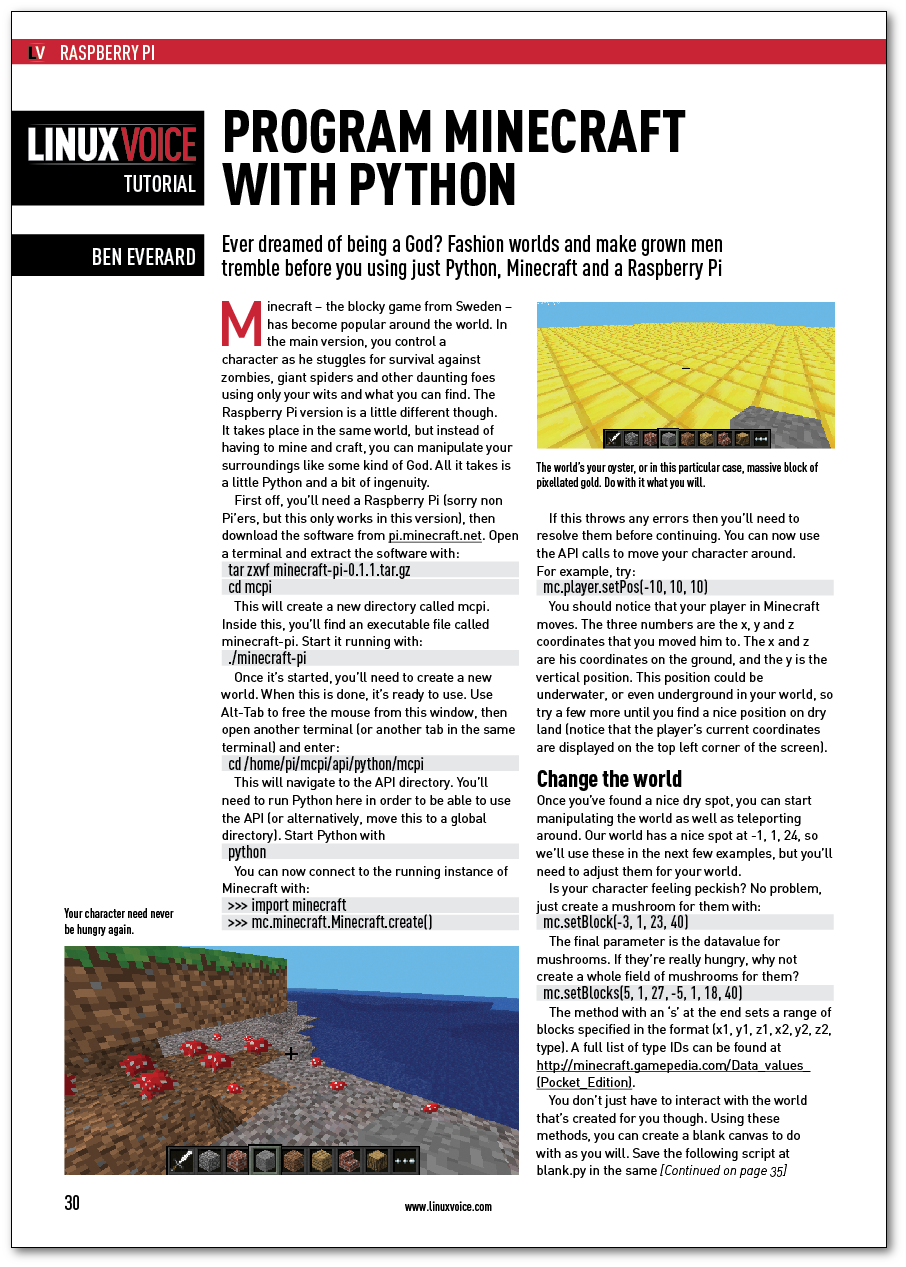 Sample content: part of a Minecraft Pi tutorial. Click to embiggen. What makes Linux Voice unusual? It’s that business model. Fifty percent of profits will go straight back to FOSS and Linux communities, with readers given the ability to nominate which projects, devs and events are sponsored. And after each issue of the magazine has been out for nine months, all of its content will be made available for free under a CC BY-SA licence. This is not something I’m aware of any other paid-for magazine doing, and it has enormous implications for teachers, after-school groups – and for the rest of us. We’re very excited about this project. We know the team, and they’ve got some great writers and editors on board with a huge breadth and depth of domain knowledge and experience. These are the people who first put an article about Raspberry Pi on newsstands. I asked Andrew if he had a few words for readers of this website, and this is what he sent me: Under traditional licensing systems, the copyright owner can print and reprint content as often as they see fit, often charging several times for the same old copy. We don’t want to exploit our readers by charging them several times for the same old content, but we also don’t want our old content mouldering away on some server somewhere. Instead, we’d rather it were put to use. Things move on so quickly in free software that a lot of our old content will be worthless to us commercially, but it will have value to teachers, students, maker groups and code clubs. Releasing Linux Voice’s material under the CC-BY-SA licence means that anyone will be able to take what we’ve done and update it, so it doesn’t go stale; incorporate it into larger works, such as school or university worksheets; or just download it and use it as it is. What this means is that once we’ve created something, it will (we hope) be out there, and be useful to somebody, for ever. Learning is about sharing knowledge, and we want to help make our contribution to the shift in computer science teaching that’s been kicked off by the Raspberry Pi. We’re proud to support Linux Voice, and we’re watching their IndieGogo like a hawk. Please head along and sign up to support them by buying a print or digital subscription. We’ll be signing up alongside you. |
Microsoft Student Advantage Launched, Offers Free Access to Office 365 ProPlus
| Microsoft announced free access to its Student Advantage program for all school and educational institutes that already have subscribed to Office 365. This makes the program to be available in over 35,000 schools which will now be eligible to use Office Professional Plus for free. Microsoft explained the move as a means to enhance the student's prospect of landing up a job, claiming those having proficiency with MS Office tools stand a greater chance in the job market. Microsoft also took the opportunity to take a dig at Google claiming in its blog: "Microsoft Office skills were sought after five times more than any other productivity tools. Even Google’s own job postings require competency with Microsoft Office tools." Of course there are other reasons for Microsoft to make special mention of Google as the latter's free productivity services such as Google Drive has proved to be a cause of worry for Microsoft. Under the circumstances, its best for Microsoft to offer its Office Pro Plus software tool for free which in turn will help it retain their contracts with the schools. The MS 365 Office Pro Plus suite comprises of Word, Excel, PowerPoint, Outlook, OneNote, Publisher, Access, and Lync.
Microsoft Student Advantage Launched, Offers Free Access to Office 365 ProPlus is a post from: E-Reader News |

HP Launches 4 New Android Tablets in the Budget to Mid-Range
| HP is quietly building up its tablet strength that has been recently reinforced with the launch of 4 new models. After having launched the rudimentary Slate that failed to make much of a mark, the company has now come up with 4 new offerings that will help it field a contender across a wider spectrum of the tablet market. Interestingly, all the four tablets run Android Jelly Bean, version 4.2 with the company yet to come up with a tablet running Windows 8.1. Several manufacturers such as Dell, Lenovo and so on have come up with affordable 8 inch tablets based on the new Intel Bay Trail chips and running Windows 8.1. However, the one big positive aspect with the new HP tablets is that that all of them include quad core chips, which means performance is not compromised even with the cheapest tablet. Coming back to the latest HP tablets, the range starts with the HP Slate7 Plus which is the cheapest of the lot at $149.99. The 7 inch display is lit up by 1280 x 800 pixels and includes a 1.3 and 5 megapixel front and rear camera and a 4000 mAh battery pack. Powering the device is a 1.3 GHz quad core Tegra 4 chip that works in association with a gig of RAM and 8 GB of storage. Next in line is the Slate7 Extreme which though belies its naming with just a slight increment in specs over the base Slate 7 Plus. The Extreme shares the same display as the Plus but gets a slightly uprated 1.8 Ghz quad core Tegra 4 chip, 1 GB of RAM and a higher 16 GB of storage. The Extreme also shares the same 0.3 and 5 megapixel front and rear comera setup as the Plus but is powered by a bigger 4100 mAh battery. Next up is the 8 inch HP Slate8 Pro which also is the most expensive of the lot at $329.99. However, the higher price tag notwithstanding, the Slate8 Pro shares several of its internal make-up with the Slate7 Extreme though there are enhancements elsewhere to justify the higher price tag. Among the similarities include the same 1.8 Ghz Nvidia Tegra 4 quad core processor, 1 GB of RAM and 16 GB of internal storage. The Pro however benefits from a better 8 megapixel shooter at the rear and a front facing 720p HD enabled camera at the front. Up front, it is a 1600 × 1200 pixel 8 inch display. Thereafter, it is the Slate10 HD which is the biggest of the lot while being priced $299.99. Specs read a 10 inch 1280 × 800 pixel display, 1.2 GHz dual core Marvell PXA968 chip, 1 GB of RAM, 16 GB of internal storage and 2 and 5 megapixel front and rear webcams. The tablet also hosts the biggest battery rated at 7000mAh. All the four tablets are now listed at the HP online site though the Slate7 Extreme is currently listed at out of stock.
HP Launches 4 New Android Tablets in the Budget to Mid-Range is a post from: E-Reader News |
