| News that Amazon’s catalog has reached 3.4 million records sounds like a good thing, for the retailer as much as for the customers searching for their next good read. Unfortunately, this may not be the case: when a new book is added every 5 minutes (an average of 12 titles per hour), how do you manage to get yours noticed? These rapid increases run the risk or burying existing titles, which should be a concern to mainstream publishers –with so many indie titles popping up, thousands of which being the product of robots, getting discovered is very difficult. Positive reviews may help increase the visibility of your book, but even still it doesn’t take long before you’ve dipper below the top 100. What this really means is that the face of book sales is changing. Relying on Amazon to recommend something may not be wise –meaning dedicated readers will have to use alternative search methods to locate what they want before using Amazon to complete the purchase.
Amazon Has 3.4M Titles… And Counting is a post from: Good e-Reader |
Thursday, August 21, 2014
Amazon Has 3.4M Titles… And Counting


Flappy Bird Sequel Swing Copters Available Now
| If Flappy Birds wasn’t driving you crazy or taking up enough of your free time, Gears Studio has the answer with their sequel to the popular mobile game: Swing Copters. Best described as a cross between impossibly difficult and increasingly addictive, Swing Copters is the easiest game you will never master. If you want to successfully complete this game, the goal is simple: take control of a small character wearing a propeller hat as he travels skyward –but don’t mind the swinging pendulum-style hammers. Being reminiscent of classic video game styling is a large part of the charm in this game, but have no fear, I assure you that the game is fully modernized (and the physics is quite precise). If you are curious enough to give it a try, and have an immense amount of patience, download Swing Copters for your Android device now.
Flappy Bird Sequel Swing Copters Available Now is a post from: Good e-Reader |

Dutch eBook Market Increases by 18% in Q2 2014
| The Dutch eBook market has seen excellent growth in the last two years and recent Q2 financial figures from the publishing industry has seen it increase by 18%. We now see eBooks accounting for 26% of all sales, but print books are still strong with 74%. The Netherlands has a different dichotomy than North America in regards to the way encryption is handled. Only 1 eBook in 50 has the standard DRM, with the vast majority relying on digital watermarks. In North America, the trends are basically reversed with publishers exclusively relying on DRM to safegurd against piracy. Ditch publishers are certainly seeing eBooks as being viable, despite the fact they only account for 4.7% of book sales. In the first half of 2013, the Dutch eBook market had three million titles digitized and at the midpoint of 2014 there are over five million. Dutch eBook Market Increases by 18% in Q2 2014 is a post from: Good e-Reader |

HarperCollins Experiments with a Humble Bundle eBook Campaign
| HarperCollins has been one of the most forward thinking publishers of 2014. They have not only supported Vancouver startup BitLit, which gives you a discounted eBook if you prove you own the print edition, but also Bookshout. Today, HarperCollins has announced a massive new campaign that is running in conjunction with Humble Bundle. The essence of the Humble Bundle campaign with Harpercollins is that customers can pay what they want for a collection of digital literary works from bestselling authors, like Neil Gaiman and James Rollins, while helping support the Science Fiction & Fantasy Writers of America Emergency Medical Fund, a non-profit organization for authors of science fiction and related genres, and the Comic Book Legal Defense Fund, dedicated to the protection of the First Amendment rights of the comics art form and its community. Humble Bundle allows for multiple tiers of donations, normally you can get a number of great titles for any amount you want to pay and gives incentives, where if a donation threshold is met, readers get additional titles. Pay whatever you want and get the following eBooks; – The Curse of Chalion by Lois McMaster Bujold Customers who pay more than the average price will also receive: – Angel's Ink by Jocelynn Drake Customers who pay $10 or more will receive all of the above, as well as: HarperCollins Experiments with a Humble Bundle eBook Campaign is a post from: Good e-Reader |

Get to Know the GCFLearnFree.org Team
Ever wonder about the team behind the scenes at GCFLearnFree.org? |
eHighlights: AUDIO Edition

Click here to view the Marketplace cart of these titles and many more.
The Usual Suspects: Guaranteed Bestsellers
Fiction
Amy Bloom – Lucky Us Books on Tape, read by Alicyn Packard By the author of Away, which was called a literary triumph by the New York Times. Two young half-sisters in 1940s America travel between Hollywood, Long Island, and London, as one dreams of becoming an actress. Bloom is a National Book Award and National Book Critics Circle Award nominee. 125,000 print run. An Amazon Best Book of the Month. Booklist starred review.
Charles Cumming – A Colder War Macmillan Audio – read by Jot Davies A spy thriller in the vein of John Le Carré. Agent Tom Kell must dig out a mole when three recent recruits by Western intelligence all meet unfortunate fates. 100,000 print run.
Lev Grossman – The Magician's Land Penguin Audio, read by Mark Bramhall Critics agree that this final book in Grossman's trilogy is the best of all. The series has been called Harry Potter for adults, but it's more than that. It follows the adventures of a richly drawn young group of magicians as they grow from adolescence into adulthood and deal with the questions of humanity and identity. Best Fantasy Books Blog Most Anticipated Books of 2014. io9: All the Essential Science Fiction and Fantasy Books Coming in 2014. 150,000 print run. Booklist & Kirkus starred reviews.
Emma Healey – Elizabeth Is Missing Harper Audio, read by Davina Porter Maud Horsham knows that she is slipping into dementia, but when a moving van takes away her best friend's belongings and Maud can't contact her, she is forced into the role of detective because no one will listen to her insistence that something has happened to her friend. Flavorwire: 25 Women Poised to Lead the Culture in 2014. An Amazon Best Mystery, Thriller and Suspense Book of the Month. BookPage Best Books of the Month. Booklist starred review.
Colleen McCullough – Bittersweet Blackstone Audio, read by Cat Gould McCullough's first epic romantic novel since The Thorn Birds. Set in 1920s and 30s Australia. Four sisters—two sets of twins—enroll in a training program to become nurses at a time when most women were limited to the role of wives, and mothers.
Jamie McGuire – Beautiful Oblivion Simon & Schuster Audio, read by Phoebe Strole Third in the bestselling new adult Maddox Brothers series. Trenton Maddox, the king of Eastern State University, comes home after a tragic accident to try to come to grips with his guilt. Fiercely independent Camille Camlin is sure she can keep their relationship platonic, since after all, she grew up as the baby sister of four rowdy boys and knows how to handle men. 600,000 print run. An Amazon Best Romance of the Month. The beautiful cover will help this book.
Haruki Murakami – Colorless Tsukuru Tazaki and His Years of Pilgrimage Books on Tape, read by Bruce Locke Tsukuru Tazaki is one of a group of university friends who get together at every holiday. Suddenly, the others say they never want to see him again and he knows why. But Tsukuru doesn't know why. Over the years he tries to make new friends and wonders what happened, but he finally decides to seek the truth when he turns 35. The Millions’ Great 2014 Preview. Sold a million copies in Japan in its first week. The Atlantic: Books to Read in 2014. Huffington Post: 30 Books You Need to Read in 2014. 250,000 print run. Kirkus starred review.
Susan Elizabeth Phillips – Heroes Are My Weakness Harper Audio, read by Erin Bennett A down-on-her-luck actress arrives at cottage on a secluded island in the middle of a snowstorm only to find that the occupant of the main house which overlooks the cottage is the writer of horror fiction who betrayed her when she was just a teenager. He knows a dozen ways to kill people with his bare hands. Can she trust him? Has he changed? 200,000 print run. Romantic Times: Book Hankering 2014 – Romance. Publishers Weekly, Kirkus, Booklist & Library Journal starred reviews.
Susan Vreeland – Lisette's List Books on Tape, read by Kim Bubbs By the author of The Girl in Hyacinth Blue, this is the story of Lisette Roux, who along with her husband, move from Paris to a village in Provence to care for his grandfather. Lisette regrets giving up the chance to be an art gallery apprentice in Paris, but discovers the beauty of provincial life. She begins a list of vows to herself, and when war breaks out, she hides paintings to keep them from the Nazis.
Nonfiction
John W. Dean – The Nixon Defense: What He Knew and When He Knew It Penguin Audio, read by Joe Barrett Just in time for the 40th anniversary of Nixon's resignation,John Dean, Nixon's legal counsel who testified against him at the Watergate hearings, puts together a chronology to show what Nixon knew and when—and says he has the answer to what was on the eighteen and a half minutes of missing tape recordings. 100,000 print run.
Roxane Gay – Bad Feminist: Essays Harper Audio, read by Bahni Turpin Gay, author of the acclaimed novel An Untamed State, is an up and coming young cultural critic. Here, in a collection of essays, she takes on topics like the trivialization of literature written by women, her love/hate reaction to Fifty Shades of Grey, and the complexities of race and gender in pop culture.
Kirsten Gillibrand – Off the Sidelines: Raise Your Voice, Change the World Books on Tape, read by the author Senator Kirsten Gillibrand of New York has made a name for herself ever since replacing Hilary Clinton as senator when Clinton became Secretary of State. The daughter and granddaughter of two trailblazing feminists, Gillibrand believes that if women's voices were heard in the political arena we would shift our national priorities.
Ronald Kessler – The First Family Detail: Secret Service Agents Reveal the Hidden Lives of the Presidents Books on Tape, read by Michael Bybee
Nicholas D. Kristof & Sheryl WuDunn – A Path Appears: Enriching the Lives of Others—and Ourselves Books on Tape, read by Olivia Wilde This acclaimed husband and wife team wrote the bestselling Half the Sky, and are now back with scrupulous research and on-the-ground reporting to show us how particular people have made a difference in the world, evaluate the efficiency and impact of specific approaches and charities, and what we can do to support the best of them.
Ben Macintyre – A Spy Among Friends: Kim Philby and the Great Betrayal Books on Tape, read by John Lee 2013 marked the 50th anniversary of British spy Kim Philby's defection to Moscow, and resulted in the release of many new documents. Macintyre made good use of those newly available files to tell the story of Philby, a brilliant and charming man who rose to head Britain's counterintelligence against the Soviet Union during the height of the Cold War—while he was secretly working for the enemy. An Amazon Best Biography & Memoir of the Month. 250,000 print run.
Paul Ryan – The Way Forward Hachette Audio, read by the author Ryan, the Republican candidate for Vice President in the last election, outlines his political vision for 2014 and beyond, beginning with an analysis of the 2012 election and dissecting the challenges faced by the Republican Party in the future. Also includes a critique of President Obama and the progressive movement as a whole. 150,000 print run.
Hampton Sides – In the Kingdom of Ice: The Grand and Terrible Polar Voyage of the USS Jeannette Books on Tape, read by Arthur Morey In 1879, the steamship USS Jeannette, on an attempt to reach the North Pole, became trapped in ice for two years, and then when it was suddenly released, it was crushed by the ice pack and sank. George W. De Long and his crew quickly abandoned ship and began a horrible 1,000 mile trek over the ice toward Siberia. Highlighted in a USA Today article asking booksellers for great books of summer. 150,000 print run. Kirkus & Publishers Weekly starred reviews.
Oprah Winfrey – What I Know for Sure Macmillan Audio, read by the author Don't miss this blockbuster! These essays written by Oprah Winfrey herself offer a glimpse into the mind of one of the world's most extraordinary and successful women. Taken from columns that were originally written for O Magazine, this collection has been revised and updated, and offers inspiring words of wisdom.
Click here to view the Marketplace cart of these titles and many more.
*Geographical rights may vary by title.  |
What does a good computing classroom look like?
Space mattersIn September 2014 (as in a couple of weeks) the new Computing curriculum will come into play in schools in England. Basically this means that ICT as a subject will be replaced by Computing and that students from the age of five will have the opportunity to learn an exciting and powerful new subject. There has been a lot of discussion on how to prepare for this in terms of teacher training. It’s vitally important and it’s why we run Picademy for example. But as the subject matures we also need to start thinking about what an effective computing classroom looks like and how to set it up so that students can get the most from the subject. Teaching and learning spacesMy primary school was not like others. Pupils were free to roam about and do what they wanted. It was an interesting educational experiment. I now know what happens when pupils are responsible for their own education: they smear their faces with woad (well, Crayola indigo warmed up on the radiator) and then scuttle up trees. (Student voice, I'm looking at you.)  Next lesson I will independently investigate the physics of boomerang precession There were no classrooms in this school of the future, just "bays"—quasi-rooms with no walls, opening onto a central area. It was a terrible environment for most subjects: it’s tricky to concentrate on improper fractions or 'How come the moon doesn't fly off into space?' when the bay across the way is thrashing a class set of percussion instruments like a colony of chimps pummelling the corpse of dead hyena. So I've never been a fan of "learning spaces". Even typing the phrase makes me start rocking gently and keening. And yet learning spaces are exactly what the new English Computing programme of study needs. Walk into a standard ICT suite in any secondary school in the land and you will be stared down by banks of unblinking monitors lining the walls and the central reservations. This is not a learning room, it's a teaching room. It's set out so that teachers can monitor the monitors (and monitor the monitor monitors if they are lucky enough to have them) and control what the students are doing with their hermetically sealed PCs. What they are typically doing, given the closed nature of hardware and software in most of these suites, is usually pretty anodyne. It should come as no surprise that the word “suite” comes from the old French meaning "a group of identically clad followers".  Even Orwell wouldn’t have gone this far This new-fangled ICT thing: it’s a slippery slope and no mistakeSo what the typical student is doing in the typical ICT suite is … ICT. Which is great! Good teachers are running rich and exciting and useful ICT lessons under the old programme of study (PoS). Outstanding teachers have been including elements of computing into their lessons for years (contrary to the belief of those who had never actually read it, the old PoS was pretty flexible and adaptable). But all too often a school’s ICT policy is that the subject should be safe. Not inspiring or useful or thought provoking. Just safe. Which would be lovely if this meant ‘safe’ for the kids, but more often than not it means ‘safe’ for the senior management. ICT isn’t to be trusted: kids obviously needed watching because they might do bad things. Like play games. Or watch games on YouTube. Or write games and pretend to be testing them. Students have even been known to flip screens upside down using hot-keys; or draw rude pictures in Paint and set them as the desktop of their neighbour’s machine; or stick a Post-it on the bottom of the teacher’s mouse; or Google "funny gifs of cats with glok’s and a bom lol!" Hence this urge, especially amongst techno-wary management, to constantly monitor and repress and interfere. Technology that enlightens and frees and encourages experimentation is the same technology that is potentially seditious and disruptive and encourages hacking (hurrah!). So it’s sad but unsurprising that in the current climate schools lock down PCs and stop students from messing about. A more open environment doesn’t require lots of time and money (two big barriers to change in schools) but it does need thoughtful policies and a desire to change. Would you like a handful of magic beans with that interactive whiteboard sir? All together now: “Marie France est dans le jardin.” Beeeeeep. Of course, if all you want to do is to create things on a screen, then a bank of proprietary PCs does the job (though installing some open source software like Inkscape, Audacity, LibreOffice, Firefox and GIMP wouldn't hurt). But things have changed since the late 90s when IT quietly became ICT and a new curriculum came in: prescribed hardware and proscribed software just aren't good enough now that Computing is back (in retrospect, they weren’t even fit for purpose then). A generic classroom stifles creativity and if Computing is one thing, it’s creative. Looking back at my ten years in an ICT classroom it’s clear to me that most ICT suites are the 21st century equivalent of the shiny new language labs that popcorned into secondary schools in the late 70s: shiny and exciting but ultimately a bit rubbish. My old stock cupboard is full of unused smoke-and-mirrors ICT kit that was sold as the next big thing but turned out to be technology for technology’s sake. (We’re very fond of the old magic beans thing in education, but that’s another blog post entirely.) Technology by itself rarely improves learning. Good teachers in stimulating environments always do. A new classroom for the new programme of studyFor the new Computing programme of study let's give the students the freedom to tinker and to hack and to experiment and to collaborate. And let’s give them the space and the tools to do this. PCs still have a place of course, but ideally there will be a central table(s) full of electronics, robots, sensors, computers, projects kits, stuff you’ve found in skips, printers, bits and bobs, cutters and a runcible spoon. (And, of course, Raspberry Pis!) Let anyone who wants to play come in at break, lunchtime and after school to mess around. Encourage other subjects to use computing as a creative tool, one they can use in their lessons, and to look at Computing and not say "Whatever" but "Hmmm, that's interesting…" (Because if Computing is not used across the whole curriculum then we are missing both the point and a huge learning opportunity.) For this we are going to have to change our ICT rooms from teaching rooms to learning spaces. It’s not a trivial thing and it won’t happen overnight. But if you are offered a new room in which to teach Computing this September, or you get the chance to re-purpose an existing ICT suite, please make it the first thing on your agenda. In fact, make a space like this: In time, ten years perhaps, computing in schools will be a normal tool for problem solving and creativity. Just a tool to do things in the same way that, on a much smaller scale, a calculator is used today in Maths (although the things you can do are very much cooler and more useful than telling your mate to type in ’5318008′ and hand it, upside down, to your teacher). In the meantime, let’s get the learning spaces right. The rest will drop into place. How you can helpWe’re currently writing materials on how to set up a computing classroom and we’d like your help. What would your ideal computing space look like and why? What would you like to see in there, how would it be set up and how could the Raspberry Pi Foundation help you with this? We’d love to hear your thoughts on this and the final materials will be published in our resources area. Comments below would be lovely, thanks! |

Wednesday, August 20, 2014
Kindle Owners Tend Not to Remember Key Plot Points
| A new European study has found that Kindle owners have a harder time recalling key plot points than paperback readers. The study, presented in Italy at a conference last month gave 50 readers the same short story by Elizabeth George to read. Half read the 28-page story on a Kindle, and half in a paperback, with readers then tested on aspects of the story including objects, characters and settings. Anne Mangen of Norway’s Stavanger University, a lead researcher on the study said “The Kindle readers performed significantly worse on the plot reconstruction measure.” The readers struggled to make sense of the key 14 plot aspects. The researchers suggest that “the haptic and tactile feedback of a Kindle does not provide the same support for mental reconstruction of a story as a print pocket book does”. “When you read on paper you can sense with your fingers a pile of pages on the left growing, and shrinking on the right,” said Mangen. “You have the tactile sense of progress, in addition to the visual … [The differences for Kindle readers] might have something to do with the fact that the fixity of a text on paper, and this very gradual unfolding of paper as you progress through a story, is some kind of sensory offload, supporting the visual sense of progress when you’re reading. Perhaps this somehow aids the reader, providing more fixity and solidity to the reader’s sense of unfolding and progress of the text, and hence the story.” “We need to provide research and evidence-based knowledge to publishers on what kind of devices (iPad, Kindle, print) should be used for what kind of content; what kinds of texts are likely to be less hampered by being read digitally, and which might require the support of paper,” said Mangen. “I’m thinking it might make a difference if a novel is a page-turner or light read, when you don’t necessarily have to pay attention to every word, compared to a 500-page, more complex literary novel, something like Ulysses, which is challenging reading that really requires sustained focus. That will be very interesting to explore.” This report makes a lot of sense when it comes to the mental processing of reading digitally vs reading the print edition. You get a sense of accomplishment when you are making significant headway in the paperback, you can see the tangible progress. Kindle Owners Tend Not to Remember Key Plot Points is a post from: Good e-Reader |

Major Celebrities Lend their Voices for The Legend of Drizzt Audiobook
| World War Z, by Max Brooks had an all-star cast loaning out their voices for the audiobook that came out at the same time as the movie. No audiobook in history has had as many voices chronicling the zombie apocalypse, until now. The Legend of Drizzt will be hitting Audible very soon and a slew of actors will be contributing their own voices to the tale of our favorite Dark Elf. The Legend of Drizzt: The Collected Stories features twelve novels in the collection about the iconic Dungeons & Dragons dark elf Drizzt Do'Urden.Each one is narrated by a different actor; the eclectic group of performers includes Sean Astin, Michael Chiklis, Felicia Day, David Duchovny, Tom Felton, Greg Grunberg, Dan Harmon, Ice-T, Danny Pudi, Melissa Rauch, Wil Wheaton and Al Yankovic. The production is part of a partnership between Audible and Dungeons & Dragons publisher Wizards of the Coast, through which Salvatore's entire Drizzt catalog will be recorded in audio. Salvatore's first published novel, The Crystal Shard, introduced the world to the dark elf Drizzt; since then, his books have sold more than 15 million copies in the U.S. and have been translated into 14 languages. So what is the deal with Drizzt? He is a Dark Elf that has a moral code, amidst a matriarchal civilization that promotes backstabbing and treachery. Instead of resigning himself to this life, he transcends the Underdark to the Surface world. Many adventures ensue, and some of the most notable characters from the Forgotten Realms game setting make appearances.
Major Celebrities Lend their Voices for The Legend of Drizzt Audiobook is a post from: Good e-Reader |

Amazon Offers $20 Discount on the Paperwhite 2
| Amazon is hoping to steal a bit of the limelight off of the brand new Samsung Galaxy 4 Nook tablet by offering a $20.00 discount on the second generation Kindle Paperwhite. Starting today, the main Amazon website is discounting the WIFI only version to $139 and the 3G model for $189. Within the next month it is believed that Amazon will be releasing two new e-readers and three new tablets They are intending on refreshing their entire hardware lineup with new technology. The discount to the Paperwhite serves to give an incentive to people on the fence about going over to Barnes and Noble. Since the Paperwhite 2 originally came out, it has received a number of firmware updates and hardware enhancements. Some of the more notable software features include the social book discovery site, GoodReads and a more stable PDF experience with a new preview window. On the hardware front, customers in the UK and Canada are seeing an increased amount of Kindle Storage, from 4GB to 8GB. Amazon Offers $20 Discount on the Paperwhite 2 is a post from: Good e-Reader |

First Look at Samsung Galaxy Tab 4 Nook (Videos)
| Earlier today Barnes & Noble unveiled their new co-branded tablet with Samsung, called the Samsung Galaxy Tab 4 Nook. Ever since the partnership was first announced, we knew that B&N would be using Samsung’s Galaxy Tab 4 hardware, the big question was what would B&N do to customize the software. After watching some hands-on YouTube […] |
Barnes and Noble Hypes Free Content on Samsung Galaxy Tab 4 Nook
| Barnes and Noble has just launched a brand new tablet in conjunction with Samsung. It costs $179 with a $20 mail in rebate, but the bookseller is hyping the fact you get an extra $200 worth of free content. What free stuff are they actually giving out? When you pick up a new Samsung Galaxy Tab 4 Nook you get three free eBooks. Freakonomics: A Rogue Economist Explores the Hidden Side of Everything by Stephen Dubner and Steven Levitt, The Wanderer by Sharon Creech and I am Number Four by Pittacus Lore. Customers can also pick 4 digital magazines from a pool of 12 for a free two week trial. There is a ton of great content, including Cosmopolitan, Sports Illustrated, and US Weekly. Back issues are also available for your selected magazines at no extra cost. Nook Video is giving free content to the hit HBO Series Veep, Hannibal, and Orphan Black. New Barnes and Noble customers are also automatically given $5.00 in free credit when they buy the new tablet, giving them the ability to either get an eBook for free or use the money to subsidize a new mainstream bestseller. Barnes and Noble is really hyping the free content as a way to lure existing customers to upgrade and offer a big incentive to new people looking for a tablet billed as an e-reader. Barnes and Noble Hypes Free Content on Samsung Galaxy Tab 4 Nook is a post from: Good e-Reader |

Icarus Illumina HD PDF Review (+Video)
| I decided to go ahead and put together a PDF review for the Icarus Illumina HD because people are always asking about PDF support on E Ink ebook readers. I generally recommend getting a tablet for PDFs, or at least a large-screen ereader like the Onyx M96, and this case is no different. Unlike the […] |
Amazon Fire Phone review
|
A unique gimmick Amazon includes with the Fire Phone is four sensors on each corner of the front, called Dynamic Perspective sensors, allowing the device to perform interesting 3D effects when you tilt the phone. When viewing the selection of apps, the icons slightly rotate, and the lock screens are kind of stunning. Are these effects enough to really make this phone stand out above the dominant Android and iPhone models? Let's find out. When you get past the visual effects, you see that the biggest feature of the Amazon phone is Amazon itself. The left side of the phone boasts a button which activates the camera feature, augmented with an app called Firefly. When you're not taking pictures, you can scan barcodes to search for products on Amazon. I tested this out with a bottle of sports drink, and sure enough, Amazon had plenty in stock. Like Apple, Amazon isn't just selling you a portable device; they are inviting you into an ecosystem. Amazon is as deeply integrated into the Fire Phone as iTunes is with the iPhone. Need an app? Amazon's shop app is preinstalled, and you have instant access to many great apps, including the OverDrive app – offering access to titles available from your library's digital collections. Despite having Android at its core, the Fire Phone does not give you the Google experience. Amazon has clearly used Android as a foundation upon which to build an empire of their own. The question is: will you join? I think the biggest deciding factor is how invested in Amazon's ecosystem you already are, or would be willing to be. If you're a Prime member or you're interested in Kindle Unlimited, this might be the ideal phone for you. Personally, I think the phone has a visual hook with the 3D effects, and it performs about as well as my Droid Maxx, but the amount of battery life devoted to the 3D effect means you need to keep your charger handy. I don't know if this is an iPhone or Android killer, but I think the Fire Phone just might ignite its own niche.
Justin Noszek is a Support Services Specialist at OverDrive.  |
 After finding success with the Kindle Fire, Amazon has decided to dip their toes into the smartphone waters with the Fire Phone. Their newest offering is a phone running the Android-based Fire OS 3.5 on a 4.7 inch screen, with a 2.2 GHz Snapdragon processor, 2 GB of RAM, and 32 or 64 GB storage options.
Barnes and Noble Announces Samsung Galaxy Tab 4 Nook
|
The new Samsung Galaxy Tab for Nook features a seven inch display with a resolution of 1280 x 800 Pixels and 216 ppi. This is a bit of a downgrade in the resolution department, the Nook HD had 1600 X 900 resolution. Underneath the hood is a Quad-core 1.2 GHz and 1.5GB of RAM. It has 8B of internal memory and an MicroSD port for an extra 32GB. Unlike prior Nook tablets, this one has two cameras, which will insure apps like Vine and Snapchat will be relevant. It has a 3 MP rear facing camera and a 1 MP edition on the front. It is lighter and thinner than any previous color NOOK device at 9.74 ounces and .35 inches. The new Nook Tablet is running the most current version of Android 4.4 Kitkat. It does not feature the same TouchWiz UI that most Samsung tablets rock, instead Barnes and Noble has created their own custom UI. It also has access to Google Play, which will insure that hundreds of thousands of apps are available to download, no matter what country you live in. Barnes and Noble has designed the UI to focus primarily on readers. The ecosystem currently offers over 3 million books, comics, magazines and kids books. When it comes to your library, managing content it is broken up into video, books and magazines. During the unveiling event in New York, Barnes and Noble trumpeted the fact that many people prefer to use their tablets for e-reading, instead of playing games or watching videos. – Over three-quarters (77 percent) of U.S. adult respondents to a recent online study conducted by Harris Poll for Barnes & Noble agree with the statement that "Reading has always been an important part of my life." - Over two-thirds (67 percent) say reading puts them in a better mood. - Seventy-six percent of U.S. adults state their reading habits have increased over the past three years, and nearly half, over two in five (44 percent), attribute access to an eReader, tablet or smartphone as the reason. - Tablets have not only changed our reading habits, but what it even means to read – personal email (96 percent) is now the number-one item read, followed by social media (67 percent); Web sites, online articles or blogs (73 percent); work-related materials (46 percent); eBooks (31 percent); and digital magazines or newspapers (40 percent). The Samsung Galaxy Tab 4 NOOK is available starting today at over 660 Barnes and Noble stores in the US. It is retailing for $179, which is actually cheaper than the Samsung exclusive device which is $199. We will be getting our hands on this in the next few days, for a comprehensive hands on review and a ton of comparisons against the previous generation Nook HD tablet and also other e-reading first devices from Amazon and Kobo. Barnes and Noble Announces Samsung Galaxy Tab 4 Nook is a post from: Good e-Reader |


Galaxy Tab 4 Nook Released, Comes with $200 Free Content
| Today Barnes & Noble and Samsung introduced their new co-branded Galaxy Tab 4 Nook tablet. It’s basically a copy of the 7-inch Samsung Galaxy Tab 4 that I reviewed a few months ago, but with custom Nook software tweaks. The retail price is the same as the Galaxy Tab 4: the list price is $199 […] |
Getting hooked on programming with YRS project ‘Hook’
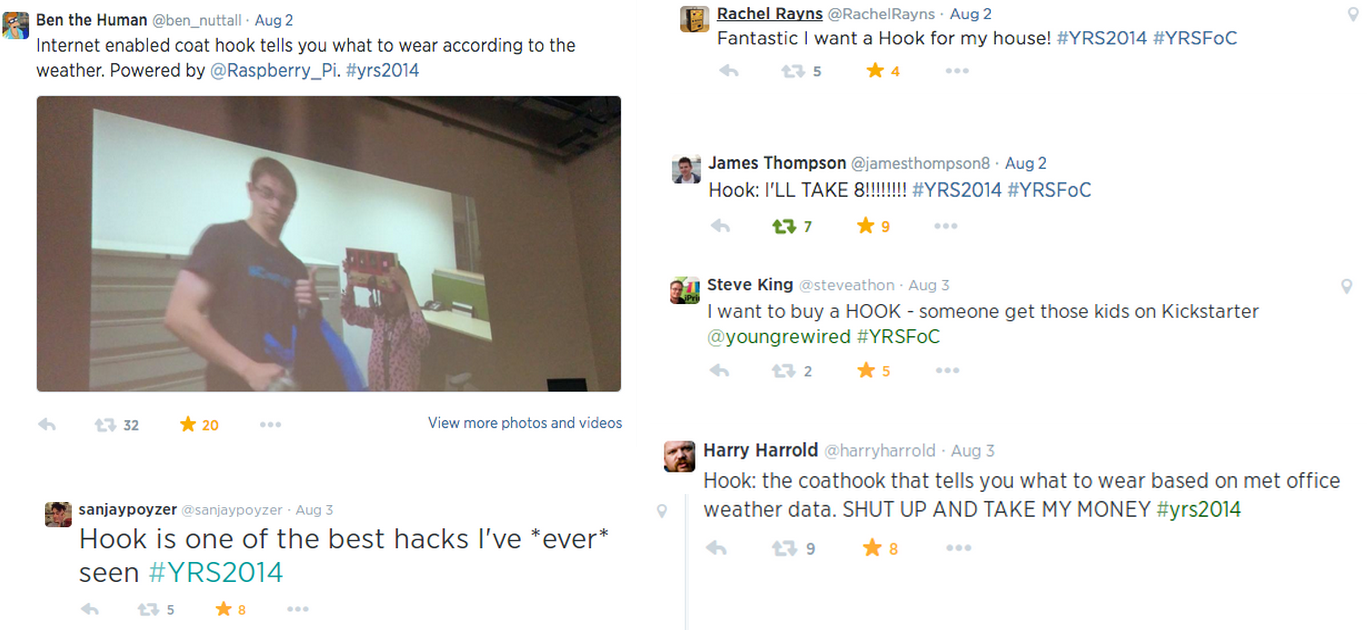
| Carrie Anne: A few weeks ago, Raspberry Pi hosted its first ever Young Rewired State centre and took part in the Festival of Code. We had a lot of fun. Our participants talked about their experience in this blog post. Whilst we were at the finals in Plymouth, our teams were competing against a group from BBC Birmingham mentored by our good friend Martin O’Hanlon, and their Raspberry Pi project blew us away. Here in their own words is a little more about it. 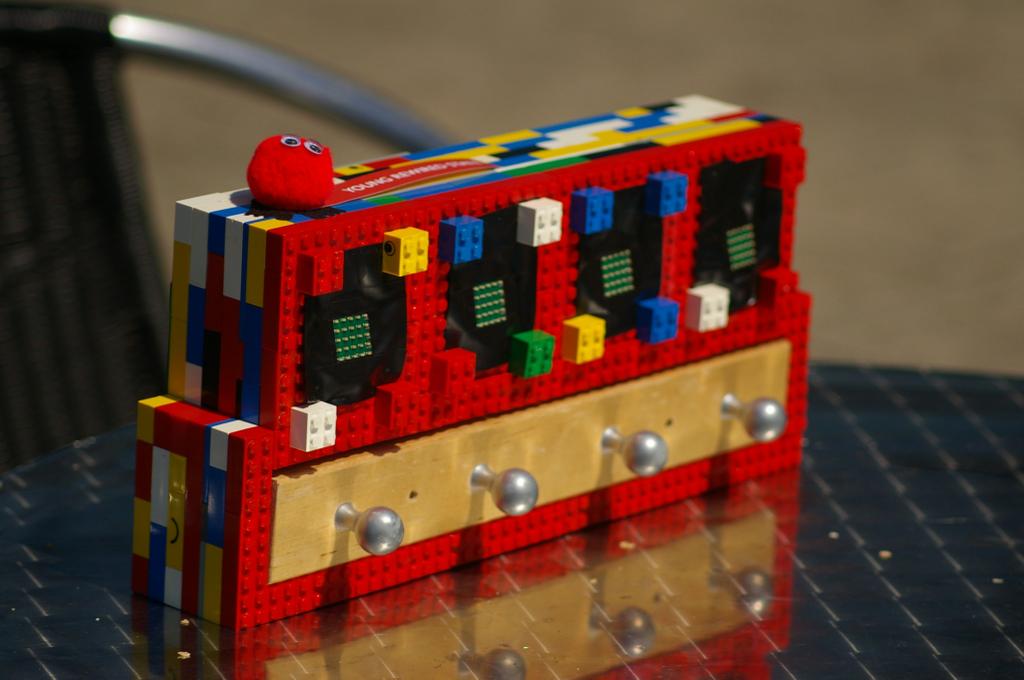 Not only functional, but stylish too! While taking part in the YRS Festival of Code at BBC Birmingham our team wanted to come up with something fun. The idea we finally settled on after much talk of boats and canals (thanks Martin!) was the internet enabled coat hook – a coat hook which would tell you what to wear that day based on the weather forecast. Fuelled by an endless supply of biscuits and coffee at BBC Birmingham and with the help of our mentors we set about creating our 'hack'. At the weekend down in Plymouth we were lucky enough to make it into the final three for the 'Best in Show' category, losing out to another team. However since we were runners up in the category we were rewarded with some limited edition Blue Raspberry Pis! Our idea was well received throughout the weekend in Plymouth, but what surprised us most was the reception that it received online. Seeing people we've never met before announce online that they'd buy our 'internet enabled coat hook' that we'd hastily constructed a few days prior was the craziest part of the weekend. We've each written a short paragraph about our contribution to the 'hack' and what we learnt during the week.
We built the Lego around the coat rack and then the LED chipboards to secure the whole thing together, originally using a breadboard to connect up the Raspberry Pi and the LEDs with crocodile clips, however we kept facing issues where the LEDs would not light up. We realised that this was because one of the clips wasn’t on properly or the pin in the breadboard was loose, so decided that it would be more secure and look better if we created an actual chipboard and soldered all the parts together: cue multiple expeditions down to the workshop and a lot of time bonding with the soldering iron (if you'll pardon the pun). The building of the Lego structure took around half a day, not including the numerous heated discussions about which colour bricks to use, and then completing the circuitry meant we had a working prototype design only a couple of hours later.
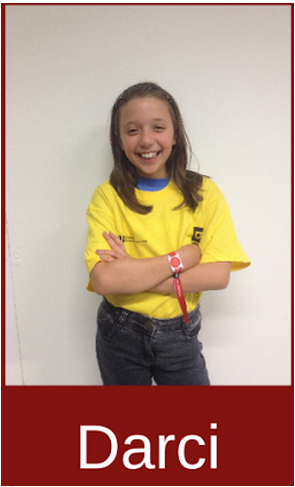
I started off figuring out how to control the LEDs using an Arduino, but then we all agreed that it would be better to use a Raspberry Pi rather than an Arduino because I find Python much easier to understand than Arduino, and we could also use the GPIO to hook up the LED devices to the Raspberry Pi. So, it seemed simpler to use the Raspberry Pi to control everything instead. I used Python and the RPi.GPIO library to write the code to allow the back end to control the LEDs.  Darci presents Hook
 YRS BBC Birmingham Team Hook Carrie Anne: Although this project did not win in its category, it could still win the public vote! If you are as impressed as we are with this project then head on over to the voting page to cast your vote for Hook! |



Tuesday, August 19, 2014
Icarus Illumina E653 vs Kobo Aura
| Welcome to another Good e-Reader Comparison Video! Today we take a look at the brand new Icarus Illumina second generation and the Kobo Aura. The premise of this comparison is to take a look at ePub eBooks and PDF documents. Both of these devices handle these formats in completely different ways. The Kobo Aura does a splendid job in handling PDF files, with their preview window pane and ability to pinch and zoom. The Icarus really stutters with large PDF files, but does have a neat ability to increase the darkness of an image, but manually adjusting the gray scale.
Icarus Illumina E653 vs Kobo Aura is a post from: Good e-Reader |

Microsoft Surface Pro 3 – Onenote Review
| The Microsoft Surface Pro Windows 8 is currently in the third generation and has some revisements with the way the digital pen works. Cased in aluminum, Surface Pen looks and feels more like a fountain pen than a traditional stylus for a natural writing experience. Today, we look at how the Pen is able to handle drawing via Onenote. Microsoft Onenote for Windows 8 allows users to write documents from scratch and save them to their Skydrive accounts. Whenever you click the top of the Stylus, it automatically opens Onenote. In the video below, we give you a quick overview of the day to day tasks that can be accomplished in OneNote and give you an in-depth look at the stylus.
Microsoft Surface Pro 3 – Onenote Review is a post from: Good e-Reader |

Google Photo Sphere 360-Panorama App Released for iOS
| Google has found themselves in Apple’s App Store once more by porting their popular Photo Sphere app to iOS. Having debuted on Android last year, Photo Sphere invites you to “look up, down, and all around to revisit the amazing places you've encountered.” Even if you aren’t interested in creating your own Spheres (described as being a series of photographs that, when combined, give you a 360-degree view of your surroundings), consider taking a look at a few that others have shared. While you may have seen many landmarks and locations in movies already, this feels different because they are recorded by real people not unlike you or me. It’s the ultimate form of ‘wish you were here’ to share with your friends and family when you find yourself someplace special. Of course, it isn’t a coincidence that a huge function of Photo Sphere is the ability to share your creations with Google Maps –basically making you into a content contributor, adding value to their system. When you consider the price of the app (free), it is definitely a win-win scenario. If you would like to try your hand at taking beautiful, 360-degree images, download Photo Sphere Camera for your iOS devices.
Google Photo Sphere 360-Panorama App Released for iOS is a post from: Good e-Reader |
