| Welcome to another Good e-Reader Daylight test. Today, we take a look at the entire lineup of Apple products to see how they perform under direct sunlight. iPad Air, iPad Mini with Retina and the iPhone 5 are all pitted head to head to see what one reigns supreme.
Daytime Tablet Test – iPad Air, iPad Mini with Retina and iPhone 5 is a post from: Good e-Reader |
Sunday, August 3, 2014
Daytime Tablet Test – iPad Air, iPad Mini with Retina and iPhone 5


Has Sony Discontinued Consumer e-Readers?
| Sony has been making e-readers since 2004 and was the first mainstream company to use e-ink technology. They pioneered many innovations such as a touchscreen and built in light. This prompted many competitors to jump into the field, such as Amazon, B&N and Kobo. Sony has found that their consumer efforts might be drawing to a close, as reps have confirmed that the company will no longer be making devices. Sony Europe gave an interview to a German tech blog and confirmed that they have no plans to release a Sony PRS-T4 or any other device aimed at the end user. Instead, they will continue to focus on the business segment, with the Sony Digital Paper leading the charge. The Digital Paper is the first 13.3 inch e-reader to employ Mobius technology. This makes it tremendously lightweight and has been firmly embraced by medical, legal and the entertainment industry.This device does not have an eBook store and doesn’t even read eBooks, in the conventional sense. Instead, it is a heavily optimized PDF reader and has a hefty price of $1,100. Digital Paper is marketed towards professionals and Sony deals with a few authorized partners to sell to niche markets. The demand actually caught Sony off-guard and they are now selling it directly. Sadly, they will only sell it to corporations or users that qualify via an extensive interview process. This is attributed to no official customer service and they want to insure the people using them will not be a pain to deal with. In 2014 Sony closed their official bookstore in Australia, Canada, Europe and the United Kingdom. The only market they actually still sell eBooks is in their home country of Japan. Sony told us in a prior interview that the majority of their users are reading books on their smartphones and tablets. This is prompting them to double down on their core app experience and nix making dedicated e-readers. Sony simply could not compete anymore in the cut-throat e-reader segment. They once had a premium price tag, but now its basically a race to the bottom. Who can sell them the cheapest and still make a bit of money doing it. Sony found out its a fools errand to compete on price alone and instead its better to scale down their market approach. We have reached out to Sony canada and Sony Europe for official confirmation. Has Sony Discontinued Consumer e-Readers? is a post from: Good e-Reader |

Saturday, August 2, 2014
Outdoor Reading Test – Kindle Paperwhite 2 vs Kindle Fire HDX 7
| When it comes to reading outdoors an e-reader often gives you a superior experience, due to the glare free screen. There is a lot of contention on what gives you the better eBook experience, a tablet or e-reader. Today, we give you a solid video comparison pitting the Amazon Kindle Fire HDX 7 Android tablet and the Kindle Paperwhite 2. This really should really solve the age old question, what device is better for outdoor reading?
Outdoor Reading Test – Kindle Paperwhite 2 vs Kindle Fire HDX 7 is a post from: Good e-Reader |

Outdoor Reading Test – Kindle Paperwhite 2 vs Kobo Aura
| One of the big advantages of an e-reader is the fact that you can have a glare free experience while reading in the sunlight. Unlike a smartphone or tablet, you don’t always need to be hunting around for shade. Today, Good e-Reader is proud to unveil our first daytime reading test so show you how the Amazon Kindle Paperwhite 2 and Kobo Aura perform. This video should give an indication on how these two devices perform head to head.
Outdoor Reading Test – Kindle Paperwhite 2 vs Kobo Aura is a post from: Good e-Reader |

Why is the Kindle DX Shipping Date So Far Away?
| As a few commenters have pointed out over the past couple of months, the international Kindle DX is no longer available for immediate shipment from Amazon—it now has an expected ship date 2 to 4 months away. For a device that has been seemingly discontinued (twice), that long of a shipping delay makes no sense […] |
Sony PRS-T2 Drop Test
| Sony is known for their high build quality when it comes to consumer electronics. Their e-readers have been wildly successful and despite the fact they closed the Reader Store, many people are still using them on a daily basis. Exactly how durable is the PRS product line when it comes to daily life? Today, we find out! The Sony PRS-T2 is very similar to the T1 and T3. This makes it a fairly effective benchmark to see if it sustains any damage through our drop tests. We test it from the 3 foot mark, to simulate the quintessential pocket miss. Then, we drop it from the five foot mark on its back, side and directly on its screen. Undoubtedly you have seen people rock broken iPhones in public, but seldom an e-reader. Does the Sony survive? As an added bonus we drop it from the 15 foot mark. Why? You might be slamdunking a basketball and decide you want to read or maybe you live on the second floor and drop it off your balcony. Finally, most of us have run stuff over in the yard with the car in the morning. Kids leave their toys out, the briefcase is on top of the car as you pull away. What happens to the Sony if it’s RUN over with a car?
Sony PRS-T2 Drop Test is a post from: Good e-Reader |

Kim Kardashian: Hollywood Brings Celebrity Fun to Android
| Even if you have no idea why she is famous, you would have to be living under a rock to to avoid hearing about Kim Kardashian. If you are dying to know how she became an A-list celebrity, playing the Kim Kardashian: Hollywood game for Android will guide you through all of the steps you need to succeed. There is no end to the cheese factor with this game. You begin by creating your star-to-be (male or female) and kustomize (misspelling intended) your hair, clothing, and makeup until you feel you are red carpet ready. From there you befriend Kim, who acts as your mentor as you try to impress her into giving you the advice you will need to take over cities like LA, New York City, and Miami. The interface is strangely addictive, but it’s also a little juvenile. The game tells you everything you need to do, moments before you do it –so there really isn’t any thought required in order to play. A young teenager is likely the ideal demographic for this title. If you are curious enough to give Kim Kardiasian: Hollywood a try, download it now for free.
Kim Kardashian: Hollywood Brings Celebrity Fun to Android is a post from: Good e-Reader |

Friday, August 1, 2014
The State of eBook Library Lending
| The Publishing industry has firmly embraced making the vast majority of their titles in the United States. The big 5 have either initiated a major pilot project or have committed themselves to a broad rollout. With all of the news primarily focused on the US, what does the landscape look like for the rest of the world? A new research report by the International Federation of Library Associations and Institutions seeks to address some of these queries. Australia and New Zealand Canada In Quebec, 71 public libraries belong to BIBLIOPRESTO.CA. Library users downloaded 661,598 eBooks in 2012/13 and it is projected that downloads will double in the next 12 months. Individual library data is indicative of strong growth in eBook availability and use Montreal Public Library downloads grew from 9,559 in 2012 to 31,708 in 2013 (+232%) Quebec City Public Library downloads grew from 27,417 in 2012 to 69,951 in 2013 (+155%). Europe As is the case with the publishing sector, libraries in the European Union have been slower to adopt eBooks, especially in non-English speaking countries. eBook availability in EU libraries varies significantly from country to country depending upon factors such as the funding available for library purchasing, indigenous publishing practice, library governance structure and preferred licensing regimes. Africa The International Publishers Association estimates that 90% of overall publishing revenue in Africa is derived from education markets. It is not a surprise that the availability of eBooks from African libraries is limited largely to university collections with an emphasis on streamed scholarly publishing content originating outside the continent. The 2013 South African Book Fair had as its focus "The future of eBooks: the impact of the digital eBook phenomenon" and the comments from publishing executives solely dealt with the education market and the potential for acceptance of digital textbooks. Asia eBook data reported from Asian countries indicates wide variations in library availability and use. Apabi Chinese eBooks are published in Mainland China and its content emphasises more scholarly rather than leisure reading content. Hong Kong public libraries report 186,497 eBook titles in their collections, 72,500 which are Apabi eBooks. The balance is made up of streamed bundle services including ebrary Academic Complete and EBSCOhost. The relatively low use of eBook collections (annual use of 1.1 per title) is attributed by library staff to the lack of leisure reading titles available and the confusing access requirements for the different databases. A large majority of Japanese public libraries do not provide eBooks at this time. Korean public libraries report over 3 million eBook titles available and annual expenditure of 3.6 million US dollars (2012). United States According to Library Journal's "2013 Report on E-Books in Public Libraries", where 89% of US public libraries offer eBooks, collection size and circulation have increased: 45% increase in median number of e-books between 2012 (5,080) and 2013 (7,380) 145% circulation increase from 2011 to 2012 (with anticipated 2013 increase of +38.9%) These numbers reflect all points of access, including those directly licensed or purchased by an individual library and those available through a consortium. 91% of library eBooks are accessed one user at a time comprising: 70% downloaded copies, 21% web based access copies 9% are unlimited, simultaneous access.Public demand for eBooks in the US public libraries has held steady at 6:1 holds to copy eBook ratio (unchanged from 2011 and 2013). The State of eBook Library Lending is a post from: Good e-Reader |

Udon Entertainment Announces New Macross Art Books
| Udon Entertainment has finally been able to reach out to readers outside of North American with a distribution deal with Comixology. They signed it back in early 2013 and the Canadian manga company has garnered tremendous success with their Street Fighter, Makeshift Miracle and Dark Stalkers comics. At the San Diego Comic con Harmony Gold and Udon have both announced a new licensing deal for a series of Art Books. Robotech is one of the most successful mecha franchises of all time. The 85 episode series first launched in 1985 and seamlessly crossed over into North America from Japan. The premise of the series involves a fallen battlecruiser landing on earth and sparks major scientific advances. With this technology, Earth developed robotic technologies, such as transformable mecha, to fight three successive extraterrestrial invasions against the likes of the Zentradi and Invid. The franchise has been going strong with different movies, OVA, manga, comics and television series. The more notable ones are Macross Frontier, Macross 7, Macross Plus, Macross Zero, The Shadow Chronicles. Overarching themes normally involve love, music and mecha based combat. The new licensing deal will see a number of new art books developed. They will have concept art, model sheets, early developmental designs and sketches covering Robotech and the original Japanese Macross, Southern Cross and Mospeada series. Udon will also be the publisher for the Kickstarter-exclusive Art of Robotech Academy book. Although an exact page count is not finalized, the target is for 96 pages and will feature the character and mecha designs for Robotech Academy. Udon does have past experience working on the Robotech franchise which likely helped them secure the exclusive contract for the art books. They helped produce the five issue comic series Prelude to the Shadow Chronicles. Most people in art book circles hold Udon in very high regard, so likely they will do very good work with the IP. Right now details are sparse on whether or not these will be books exclusively in print and sold via Amazon or will include digital editions sold on Comixology. Most of their prior art books were in paperback format exclusively, so it is unlikely that they will digitize it. Harmony Gold and Udon both would not comment for this story, but did say more news would surface towards the end of the year. Tommy Yune, Creative Director, Harmony Gold told Good e-Reader ” We've uncovered in our archives the original production model sheets for the Macross, Southern Cross, and Mospaeda, television series'. We have a ton of model sheets, and even early developmental designs that have never been seen or published anywhere. We're going to be working with UDON to collect this all, to have one of the most unique artwork collections ever made from Robotech. I'm extremely grateful for the energy that UDON has put into Robotech.” Meanwhile Erik Ko, Chief of Operations, UDON Entertainment told us ” I grew up watching Robotech, it was a big part of my childhood. We're thrilled to be involved in this project. In fact, since the founding of UDON we've been involved with Robotech through various comics and design projects. We're honoured and very thankful to have been chosen to work on this new art book project.”
Udon Entertainment Announces New Macross Art Books is a post from: Good e-Reader |

Sony Confirms There Won’t be a PRS-T4 or any New Sony Readers
| After Sony decided to close down their ebook stores in North America, Europe and Australia, the writing was on the wall that the Sony Reader line of ebook readers would be coming to an end as well. Personally I always figured that was a no-brainer—of course Sony isn’t going to spend time developing a new […] |
Mathematica 10 – now available for your Pi!
| Liz: If you use Raspbian, you’ll have noticed that Mathematica and the Wolfram Language come bundled for free with your Raspberry Pi. (A little boast here: we were only the second computer ever on which Mathematica has been included for free use as standard. The first? Steve Jobs's NeXT, back in 1988.) Earlier in July, Wolfram Research announced a big update to Mathematica, with the introduction of Mathematica 10. Here’s a guest post announcement from Arnoud Buzing at Wolfram about what the new Mathematica will offer those of you who use it on your Raspberry Pi. Over to you, Arnoud! In July, we released Mathematica 10, a major update to Wolfram’s flagship desktop product. It contains over 700 new functions, and improvements to just about every part of the system. Today I am happy to announce an update for Mathematica and the Wolfram Language for the Raspberry Pi, which bring many of those features to the Raspberry Pi. To get this new version of the Wolfram Language, simply run this command in a terminal on your Raspberry Pi:
This new version will also come pre-installed in the next release of NOOBS, the easy set-up system for the Raspberry Pi. If you have never used the Wolfram Language on the Raspberry Pi, then you should try our new fast introduction for programmers, which is a quick and easy way to learn to program in this language. This introduction covers everything from using the interactive user interface, basic evaluations and expressions, to more advanced topics such as natural language processing and cloud computation. You'll also find a great introduction to the Wolfram Language in the Raspberry Pi Learning Resources. This release of the Wolfram Language also includes integration with the newly released Wolfram Cloud. This technology allows you to do sophisticated computations on a remote server, using all of the knowledge from Wolfram|Alpha and the Wolfram Knowledgebase. It lets you define custom computations and deploy them as a “instant API” on the cloud. The Wolfram Cloud is available with a free starter account, and has additional non-free accounts which enable additional functionality. Check the Wolfram Community in the next couple of weeks for new examples which show you how to use the Wolfram Language with your Raspberry Pi. |

Amazon Reveals Interesting Kindle eBook Sales Statistics
| Amazon and Hachette have been having an ongoing dispute for several months over terms of a new contract. Negotiations haven’t gone well, and both companies have resorted to calling each other out publicly—to the point where the whole thing has turned into a huge spectacle. Amazon has stopped taking pre-orders for books published by Hachette, […] |
Kindle for iOS Software Updated to 4.4
| Earlier in the week Amazon issued a software update for their iPad and iPhone Kindle reading apps. The update adds some new features, and takes the software version up to 4.4. Amazon took several customer-requested features and made them a reality with this new update to improve syncing and navigation, along with the usual performance […] |
Weekly eHighlights: Best of the backlist
 We all naturally get excited by the brand new hot titles published every week, but I thought we might take a look at some of the newly available backlist titles that it's easy to overlook. Since these are all very well known books, we'll skip the annotations this time, but you'll be surprised at some of the GREAT content just recently made available digitally. Click to View the Marketplace cart of Best of the Backlist ADULT FICTION Click to View the Marketplace cart of Best of the Backlist ADULT NONFICTION Click to View the Marketplace cart of Best of the Backlist ADULT NONFICTION for KIDS & TEENS
Adult Fiction Backlist Selections Gwen Bristow – Calico Palace (Open Road) Rita Mae Brown – Rubyfruit Jungle (Random House) Michael Chabon – The Mysteries of Pittsburgh (Open Road) Pat Conroy – The Great Santini, The Lords of Discipline, and The Prince of Tides (Open Road) Dorothy Gilman – A Nun in the Closet (Random House) Arthur Hailey – Wheels (Open Road) Ernest Hemingway – The Sun Also Rises (Simon & Schuster) John Jakes – North and South trilogy (Open Road) Stephen King – Pet Sematary (Simon & Schuster) Judith Rossner – Looking for Mr. Goodbar (Simon & Schuster) Wilbur Smith – The Seventh Scroll (Macmillan)
Adult Nonfiction Backlist Selections Thomas Bulfinch – Bulfinch's Mythology (Penguin) Roger Angell – The Summer Game (Open Road) Mark Bowden – Black Hawk Down (Grove/Atlantic) Dee Brown – Bury My Heart at Wounded Knee (Open Road) Ron Chernow – The House of Morgan (Grove/Atlantic) George Crile – Charlie Wilson's War (Grove/Atlantic) P. J. O'Rourke – Parliament of Whores (Grove/Atlantic) J. B. West – Upstairs at the White House: My Life with the First Ladies (Open Road) Tobias Wolff – This Boy's Life (Grove/Atlantic)
Kids & Teens Backlist Selections David A. Adler – Young Cam Jansen and the Goldfish Mystery (Penguin) Richard Atwater – Mr. Popper's Penguins (Open Road) Roald Dahl – Dirty Beasts (Penguin) Paula Danziger – Amber Brown Goes Fourth (Penguin) Lois Duncan – The Twisted Window (Open Road) Betty Green – Summer of My German Soldier (Open Road) and Morning Is a Long Time Coming Gary Paulsen – Family Ties (Random House) Patricia Polacco – Mrs. Katz and Tush (Random House) Mildred D. Taylor – The Road to Memphis (Penguin) Jeanette Winter – Follow the Drinking Gourd (Random House) Jane Yolen – The Wizard of Washington Square(Open Road)
Click to View the Marketplace cart of Best of the Backlist ADULT FICTION Click to View the Marketplace cart of Best of the Backlist ADULT NONFICTION Click to View the Marketplace cart of Best of the Backlist ADULT NONFICTION for KIDS & TEENS *Geographical rights may vary by title.
 |
Thursday, July 31, 2014
What New e-readers Will Come Out Late 2014?
| Mainstream e-reader companies often do their product announcements in September and October. This year we are expecting new products from Amazon, Barnes and Noble, Icarus, Kobo, Pocketbook and Sony. What can we expect from these companies in terms of tech improvement and user experience? Amazon Amazon intends on releasing the 3rd generation Kindle Paperwhite and we can expect a ton of improvements. Techcrunch reported late last year that a prototype from Lab126 was floating around that had a 300 PPI screen, which should give us tremendous resolution. Amazon is also revising their default fonts, which should provide crystal clear clarity. The new Kindle is borrowing a page out of Kobos playbook with the screen being entirely flush with the bezel. This not only makes it easier to read with, but insures pinpoint accuracy with interacting with the touchscreen. The rear casing of the new Paperwhite will follow on with the industrial design of the current Kindle Fire HDX tablets, with a more angular shape and chamfer to the edges. Similar in look to the images of the HDX above. It will also feature a rear power button that looks similar to the new Kindle Fire tablets. I have heard credible rumors that the new Kindle will have an ambient light sensor. It will automatically adjust the frontlite, which allows you to read in the dark. The sensor will automatically adjust the screen brightness, similar to how Android performs these tasks on smartphones and tablets. Of course, Amazon intends on also announcing three new tablets, a low end Kindle Fire and more higher end 7 and 8.9 inch models. Sony Sony announced earlier today that they have officially discontinued the PRS-T3 e-reader, which is their latest version. It came out late last year and was notable for the higher resolution screen. Sony has abandoned their Reader Store, which has been around for over five years. Instead of dealing with publishers and selling books directly to customers they instead are using the Kobo ecosystem. Kobo is paying Sony a royalty for every book purchased on their e-readers, smartphones and tablets. Likely, Sony is working on a next generation e-reader that will not have Kobo branding on the box. Rumors circulated earlier in the year that Kobo and Sony were working on a co-branded e-reader, but now this is not the case. Instead, Sony will be releasing two versions of the PRS-T4. One for Canada, England, Europe and Australia, the second specifically for Japan. Japan is notable because the Reader Store is still alive and Sony wants to double down on that market. The other e-reader will have the Kobo app bundled on it and customers will be able to purchase eBooks that way. Sony tends to do very incremental updates to their e-readers and they have been steadfastly resistant to including any type of frontlight. Market research has led them to believe that this feature is not important to the average user and instead they can market their line of lighted cases or reading lights. I have heard reports that we will see Sony gravitate away from Neonode IR technology and will instead embrace capacitive touchscreen. Neonode will be having a conference call on August 5th 2014, where I will find out if Sony is still a customer. Barnes and Noble Barnes and Noble has confirmed that they have teamed up with Samsung for two new Nook Tablets. Samsung Galaxy for Nook will be a customized solution with Samsung providing the hardware and Barnes and Noble developing the custom software. I have seen some preview images of the new devices from a source and it looks really great. It is a stark departure from previous versions of the heavily skinned Android OS. Fresh, Modern and compelling are three terms heavily batted internally. They intend on having some sort of formal announcement in the first few weeks of August with a US and UK launch in September. There is currently no word on what they are doing with the Nook Glowlight, or if they are developing a next generation model. Likely, they will still market the Nook for another year and issue two new tablets, which is a gateway to their videos, magazines, newspapers and enhanced kids books. A dedicated e-ink reader does not really make a whole lot of revenue. Kobo Nothing I can disclose right now, but look for more information out at the end of next month. Icarus Icarus is refreshing their 6 inch Illumina and 9.7 inch Excel with more or less the same hardware, but instead are embracing the Open Android ecosystem. Instead of having a locked down version like Sony or Nook they are allowing customers to load in their own apps on pure e-Ink device. This will open up a wide realm of possible installs. One of the benefits Icarus has in this regard is a more modern version of Android OS, with version 4.2.2. Pocketbook Pocketbook has quietly pushed back the launch of their large screen CAD e-reader that is geared towards business. They are revising the screen technology and going with the more lightweight Mobius, as found on the Sony Digital Paper. There are two e-readers that are on the cusp of being available. The Pocketbook Aqua, which is the first certified waterproof e-reader. It will last under six feet of water more or less indefinitely. They also have the ULTRA coming out soon, which has a camera built into it, and was designed with scanlation in mind. All the Others Wexler had a great deal of success with their FLEX One e-reader that featured a flexible LG e-paper screen. The company has confirmed they are developing a next gen model, but few details are available. IMCOSYS has announced they have a next generation imcoV6L in the works, it failed to get FCC certification and was never available in North America. Details are scant on exactly what will go into this new model, but more should surface in the next month. ONYX Boox has failed hard in 2014 with its INKPHONE, which doesn’t make phone calls because they failed to reserve IMEI numbers. Their Onyx LYNX and 9.7 inch model but have open Android 2.3, which makes it incompatible with the vast majority of e-reading apps. This company has continued to make super shabby products and I would not be surprised if they want bankrupt. What New e-readers Will Come Out Late 2014? is a post from: Good e-Reader |

Android Represents 85% of the Smartphones Shipped in Q2
| Strategy Analytics has shared their research on global smartphone shipments in the second quarter of 2014, and the news is good for Android (but not so much for Apple). While overall shipments of smartphones grew by 27% (moving from 233M units in Q2 2013 to 295.2M units in Q2 2014), Android now enjoys having 85% of the total market share. Of course, it could be worse… Microsoft dropped down to only 8% of the smartphone market share while BlackBerry circles the drain at 1.9%. Details in the report also indicate that overall, fewer smartphones are being sold, regardless of platform. There are several speculations as to the reason, ranging from less disposable income to market saturation. Whatever the reason, the next quarter report should be interesting. Microsoft has moved to make Windows Phone free to license, Android One should push low cost Android phones in massive quantities, and Apple is expected to release a much-anticipated iPhone 6.
Android Represents 85% of the Smartphones Shipped in Q2 is a post from: Good e-Reader |

Sony PRS-T3 e-Reader is now Discontinued
| Sony Canada has confirmed with Good e-Reader that the Sony PRS-T3 is officially discontinued. It will no longer be available in retail settings once current stocks have depleted. Not only is it no longer available in Canada, but Sony Europe also confirmed its discontinued. The PRS-T3 was one of the best e-readers Sony ever produced. It was durable, had great resolution and the ability to read eBooks you borrowed from the library. One of the downsides of this model was the built in case that added to the bulk. You are actually unable to remove it, without the battery and motherboard being visible. The Sony PRS-T3S actually solved this issue by having the standard backplate, and this model is actually still available in limited quantities. 2014 was a big year for change in the Sony e-reader division. The company closed down their Reader Store in Canada, Europe and Australia. All digital books and customers were passed over to Kobo, where a recent firmware update allows you to buy books again, but not through Sony. Is the discontinuation of the Sony PRS-T3 a sign that the company will announce a new model in September? This is the time of year they generally have new products come out, but without a dedicated eBook store, is e-readers still viable for Sony? Sony PRS-T3 e-Reader is now Discontinued is a post from: Good e-Reader |

Creating Smart Playlists in iTunes
Smart Playlists are easy to create, and they automatically stay updated. Best of all, you can use them to ensure that your favorite music is always synced with your mobile devices. |
Introducing Raspberry Pi HATs
| Just over two weeks ago, we announced the new Raspberry Pi B+ with immediate availability. We’ve been very pleased at the response from the community and press about the B+, and most people seem to appreciate why we decided to evolve the Model B in the way we did – lots of you have been in touch to tell us how much you’re enjoying your new B+. There are many great new features built into the B+, but today we want to talk about one new feature we are particularly excited about. One of the brilliant things about the Raspberry Pi has always been the ability to attach physical hardware to the Raspberry Pi’s GPIO (General Purpose Input/Output) connector. There are so many third party add-on boards that attach to the raspberry Pi and extend its functionality: motor controllers, LEDs, buttons, sensors, microcontrollers, LCDs, ADCs and DACs; you name it, someone has almost certainly created an add-on board that makes it usable with the Raspberry Pi. 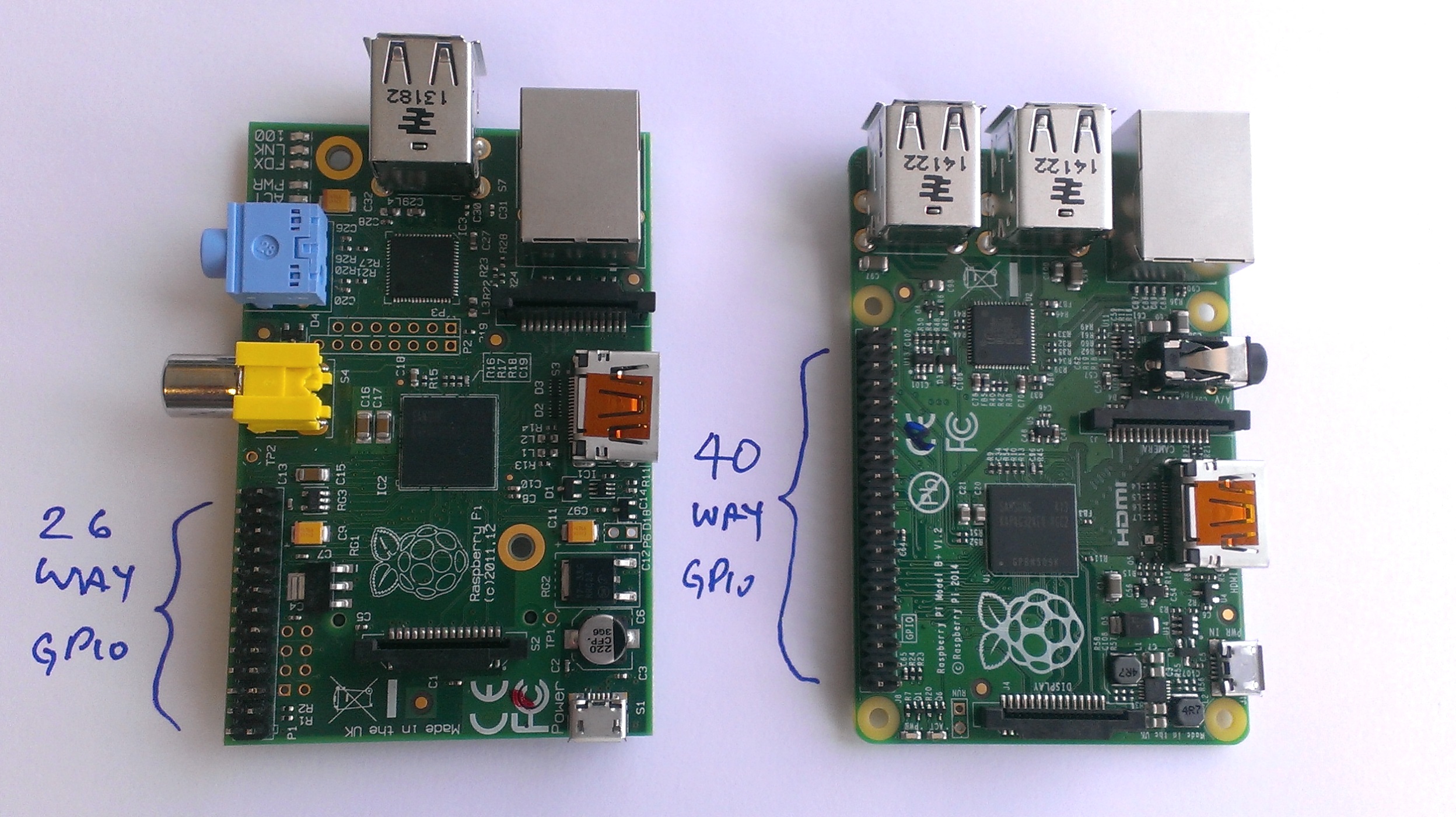 Model B’s 26W vs Model B+’s 40W GPIO connectors On the Raspberry Pi models A and B, the GPIO connector has 26 pins. Users attaching an add-board to the model A or B Pi usually have to work out which drivers are required for their specific board, and then edit the relevant Linux files to make them load at boot time before the board is usable (or load them by hand from the command line). The Raspberry Pi has no knowledge of whether it has a board attached or not, and the various drivers, when loaded, will simply assume that they can make exclusive use of the GPIO interface. Most of the time this all works OK, but it can be a bit challenging for new users. Linux drivers blindly assuming GPIO pins are available can also occasionally cause confusion. The Raspberry Pi B+ has been designed specifically with add-on boards in mind and today we are introducing ‘HATs’ (Hardware Attached on Top). A HAT is an add-on board for B+ that conforms to a specific set of rules that will make life easier for users. A significant feature of HATs is the inclusion of a system that allows the B+ to identify a connected HAT and automatically congifure the GPIOs and drivers for the board, making life for the end user much easier! Before we go any further, it is worth noting that there are obviously a lot of add-on boards designed for the original model A and B boards (which interface to the original 26 way GPIO header). The first 26 pins of the B+ GPIO header are identical to those of the original models, so most existing boards will still work. We are not breaking compatibility for existing boards; we’re creating a specification that B+ add-on board designers can follow (if they so wish), which is designed to make end users’ lives much easier. So what is a HAT? 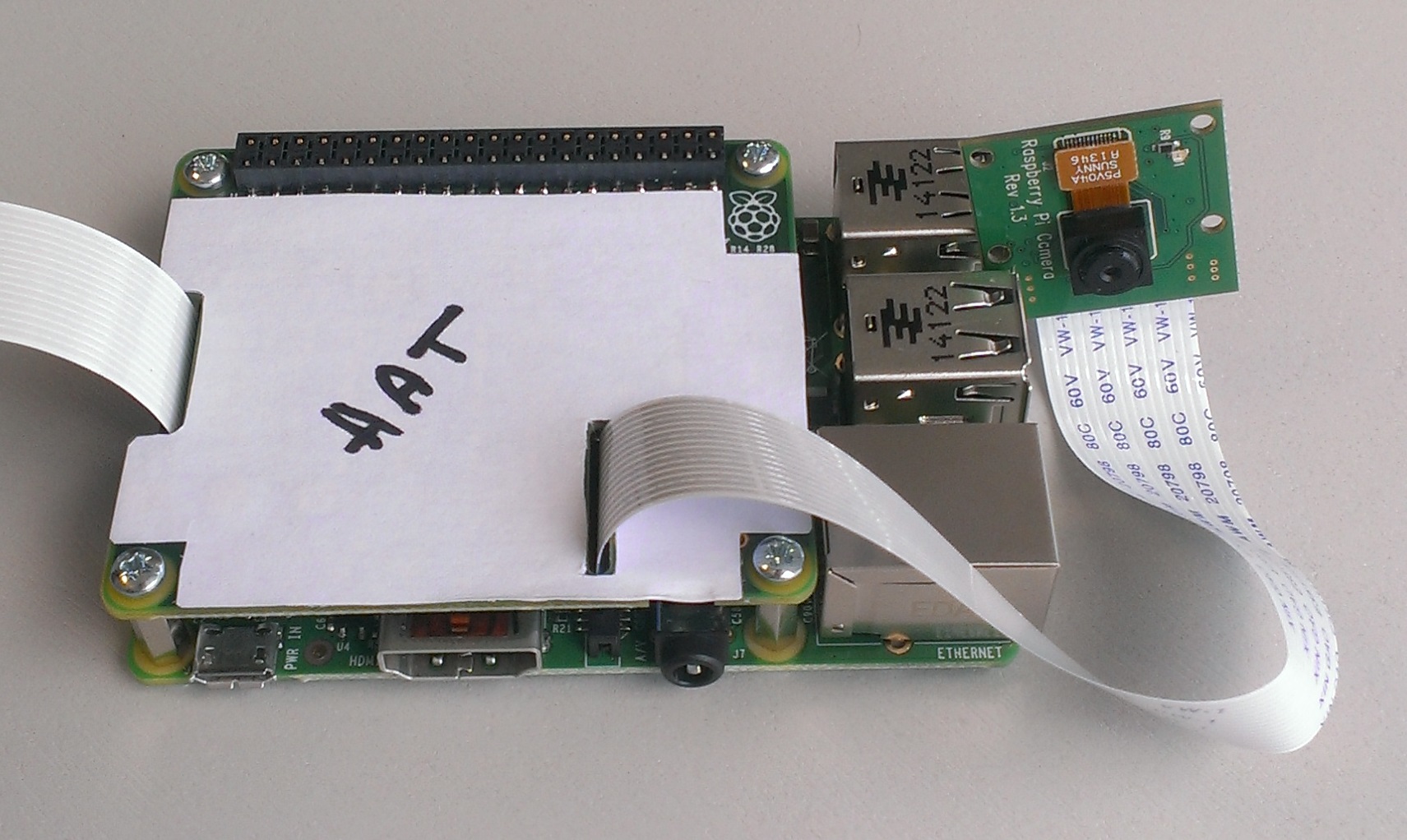 B+ sporting a (mehcanical sample of a) HAT and showing camera and display connections In a nutshell a HAT is a rectangular board (65x56mm) that has four mounting holes in the (nicely rounded) corners that align with the mounting holes on the B+, has a 40W GPIO header and supports the special autoconfiguration system that allows automatic GPIO setup and driver setup. The automatic configuration is achieved using 2 dedicated pins (ID_SD and ID_SC) on the 40W B+ GPIO header that are reserved for an I2C EEPROM. The EEPROM holds the board manufacturer information, GPIO setup and a thing called a ‘device tree‘ fragment – basically a description of the attached hardware that allows Linux to automatically load the required drivers. What we are not doing with HATs is forcing people to adopt our specification. But you can only call something a HAT if it follows the spec. So why are we bothering with all this? Basically, we want to ensure consistency and compatibility with future add-on boards, and to allow a much better end-user experience, especially for less technically aware users. The HAT specification is available on GitHub for those wishing to design add-on boards for the B+. As previously explained, there is no requirement to follow the HAT specification, but we encourage people to think about following it if possible, as it will make the world a better place for end users. One final bit of good news: we have used a surface mount connector on our internal prototype HAT which works very nicely. As you can see from the pictures it solders to the top of the board and then fits over an extension header (the extension header pins push through the HAT from underneath). As the extension headers push through like this it is possible to either use a short, flush mounting extension or a version with longer pins that poke out above the HAT and allow further access to the GPIO pins for debugging.  HAT using extender with longer pins For HAT designers wanting to use these connectors, we have secured discounted pricing through Toby Electronics. The connector part numbers are:
Toby tell us they are getting stock in now, which should arrive for the 5th August. Please post technical questions about the specification to the forum. |
Chinese Digital Publishing Industry Valued at $56 Billion
| The Chinese digital publishing industry is on the rise. Newspapers, magazines, comics and eBooks garnered 42 billion USD in 2012. This is a massive figure, but it only really accounted for 11.6% of the entire publishing industry. Chinese digital publishing has really grown up over the last two years with more companies focusing on smartphone delivery. New research has proclaimed that by the end of 2014, digital publishing will be valued at over 56 billion. The Chinese digital publishing industry is targeting smartphones in a big way. There is currently 700 million active phones running Android, Windows or iOS. This is prompting creative deals such as Xiamen Bluebird Cartoon Co. partnering with Trajectory to adopt its popular TV series Xingxing Fox and Close to the Great Society into digital books for children. One of the largest digital publishing websites is run by Cloudary, a website dedicated to contemporary Chinese literature. They provide a wide range of digital services, such as online eBook delivery and they also manage six online reading and writing communities, with a user popular of 1.6 million members. The thing I really like about the Chinese publishing industry is how innovative they are when compared to the way the North American scene is run. One of China’s oldest publishing houses, Zhonghua Book Co, entered the world of multimedia publishing by instigating a poetry contest that targeted mobile phone users. The format was simple: Applicants simply had to compose an ode using the rigid formulas of classical Chinese poetry and send the resulting poem to Zhonghua via a text message. Over a period of four months, 43 million aspiring poets texted their work, either as original content for the competition or as messages to friends, who in turn forwarded the poem to other recipients. By the end of the competition, the number of posts and reposts on mobile devices totaled 129 million, a huge number given that Zhonghua’s biggest-selling physical book, Thoughts on the Analects of Confucius sold 320,000 copies. There are thousands of startups tackling app development, new content delivery methods and cool ways to appeal to the mobile reader. All of this innovation is occurring due to Amazon, Apple and Google entering the market and fostering innovation. This is ruffling some political feathers, which prompted the Chinese Central Government to issue a series of guidelines to help traditional publishing enter the digital world and offered financial assistance to make it happen. China has a very deep rooted publishing industry and many are resistant about going digital. The average customer does not have a Android, Apple or iOS smartphone due to the costs and still rely on tangible books. The lack of technology is certainly the largest barrier, preventing the industry from reaching new heights. Still, 56 billion US is a ton of money and it is showing that customers are firmly embracing a wide array of media content and publishers are being savvy. Chinese Digital Publishing Industry Valued at $56 Billion is a post from: Good e-Reader |

Subscribe to:
Posts (Atom)