| June marks the official beginning of summer, which means long hours spent soaking up sun beside the pool, cutting the grass on warm evenings, and going on road trips to wondrous destinations. Why not spend these nostalgic summer activities enjoying a great audiobook?
June also is national audiobook month and to celebrate, we’re offering big discounts on thousands of audiobooks from some of our biggest publishers! With subjects like business, self-help, adult fiction, nonfiction, classics, juvenile fiction, and more to choose from, you're sure to find something you'll enjoy! We now have our largest collection of MP3 audiobooks ever, which means universal compatibility and ease of use for whatever gadget you have in your sun-tanned hands this summer.
Please look for these sales in your Content Reserve Marketplace:
However, the summer love is not just for audiobooks; we also have some great June sales on eBooks as well:
So before you hide your eyes behind a dark set of shades and permanently attach yourself to your beach chair, stop into Content Reserve and check out all these great deals! Because, like summer, they won't last long!
Rob Mooney is a Collection Development Analyst with OverDrive  |
Thursday, June 6, 2013
June is national audiobook month!

Kobo Writing Life’s International Reach, Indie Reach
|
“Some of our bestselling authors are selling regularly in over sixty different countries. They’re selling in markets they never even thought of. But from an author’s perspective, you might have a following in a local market, but to sell your book in a foreign country because you made it available globally is incredible.” “What is always fun is that typically an author’s first sales will be in the territory they live in, but what is exciting is the opportunity for cross-promotion.” Lefebvre explained that Kobo’s algorithms suggest titles based on previous purchases, like so many other online retailers, but with its truly global reach, readers who select a title are then offered similar suggestions that don’t necessarily have to come from that original book’s territory. Readers are discovering a wealth of new authors to read, and Kobo has the connection to help those readers discover international authors that they never would have read in the era of brick-and-mortar purchases. “We have one set of authors who are doing really well through Kobo.com, but we have a different set of authors and publishers who are doing really well through our partnership with the ABA [American Booksellers Association]. The sales that are coming through the independents is a list that is more on par with the types of books that sell really well in an independent store as opposed to a chain store. You’ll get more non-fiction, political science, higher end titles, literary titles, and those customers haven’t been trained to drive towards the 99-cent price point. Customers are already comfortable supporting independent bookstores and paying for quality.” This understanding that comes from supporting independent bookstores through the ABA has translated into an understanding that indie authors also need the same support and reader following. “When those books are available through the ABA stores, those customers haven’t been brainwashed into thinking the ebooks aren’t worth anything.”
Kobo Writing Life’s International Reach, Indie Reach is a post from: E-Reader News |

Superstars of Self-Publishing Meet with Good e-Reader at BookExpo
| GoodEReader had meetings with a number of well-known authors at last week’s BookExpo America event, such as CJ Lyons and Stephanie Bone, but one thing about these authors makes them standouts: their success. By standard definitions from the traditional publishing model, these authors would by all rights be considered bestselling, successful authors. But by the age-old preconceived notions about self-publishing, the audience reach and book sales from authors Hugh Howey, Bella Andre, Barbara Freethy would be considered nothing short of amazing. Both Andre and Howey were the first of what will hopefully be a long line of authors who made the semi-transition to traditional publishing. Other authors, like Amanda Hocking, gained notoriety for leaving a lucrative self-publishing career to become a traditionally published author, but Andre was the first to receive a substantial advance from a well-known major publisher for her existing titles; Howey was quickly able to follow suit. Both of these authors will retain the ebook and foreign language rights to their work, but were given an advance on the print-only rights to books that they had already published. Howey talked about the clamoring of the readers for new content, where fans will reach out to these authors immediately asking for updates. “We have this rapport between reader and writer, which is one of the best things to come out of this revolution. They know they can say, ‘When’s the next one coming out?’” Howey said. “We can write fast enough for these readers, so I recommend other reads from the authors that I love. I’ve just never felt like it’s a competition.” Howey mentioned that the real competition in the publishing industry is not between authors or genres, but with other forms of entertainment. Reading has to become an integral part of the audiences’ lives in order to hold their interest when there are so many other sources of entertainment vying for their attention. Freethy, who just passed the three million paid sales mark for her romance titles, is about to release the next title in series next month. Andre has sold more than 1.5 million paid downloads of her ebooks and her print titles have already been released, but her newest title will be released later this month and will be released simultaneously as ebook and print. All three of the authors had an interesting take on how their publishing journey has not forced them into a genre. Howey has a young adult title coming and has been working on a romance novel, while Freethy has incorporated elements of paranormal into her work. “I know my readers and I know what they want,” explained Freethy. “My fan base is still going to like it because it’s still my voice and it’s still my story. My readers are going to come along with me and I don’t have to be pigeon-holed into any kind of category, or what’s hot, or what’s selling now. It’s just going to be the latest Barbara Freethy book.” “I agree,” said Andre. “The amazing thing about indie publishing or self-publishing is you can connect with your readers and you can definitely write the kind of books that they want, but you can also branch out and try something new. Give it a whirl. You have to prioritize, but it’s exciting to know that I can reach readers directly.” Superstars of Self-Publishing Meet with Good e-Reader at BookExpo is a post from: E-Reader News |

ACX on What Audiobooks Can Do for Indie Authors
| GoodEReader sat down with audiobook creation platform ACX at last week’s BookExpo America event to talk about the popularity of audiobooks. More importantly, the discussion evolved into what their creation and marketing can do in terms of discovery, sales, and reader fan base for indie authors. What most indie authors may not be aware of is that platform’s like Amazon’s ACX and the opportunities to reach even more readers exist at all. “ACX is the Audiobook Creation Exchange,” said Jason Ojalvo, VP of Content Creation at ACX. “We are a marketplace where audio rights holders, like authors and publishers, can meet audio producers, like actors and recording studios. When they come together, they can meet one another and create their audiobook through the ACX system, upload it when its completed, and it goes for sale through our distribution network.” That network includes ACX’s portal, Audible, and iTunes. This distribution system to a broader reading audience can include exclusive or non-exclusive distribution. Under exclusive distribution, the royalty rate can be as high as 90%, while under non-exclusive it can still be distributed to those three major outlets but can also be pressed to CD, or sold through other websites or brick-and-mortar stores, but the royalty rate is significantly lower. But is this actually lucrative for the self-published authors? According to the variety of ways to create the audio file and the different methods of finding and compensating the voice talent, at the very least it stands to not be a risky investment, but many authors are finding the even more of their sales come from the audio version than from their print or ebook sales. “Indie authors are finding a lot of success, in fact, the majority of our books are from indie authors. We have a few Big Six publishers who use ACX, but the indie authors are really our bread-and-butter. They’re selling extremely well, and one of Audible’s bestsellers last year came through ACX, we had a couple of audio award nominees who came through ACX, and it’s becoming more mainstream. “That’s really our goal for ACX, to bring audiobooks more into the mainstream and have it be a form of entertainment along side film, TV, video games, newspapers, and audiobooks.” Ojalvo appreciates the comparison some people have made between ACX and Amazon’s other do-it-yourself platforms like Kindle Direct Publishing, as though it is the KDP of audiobooks, but it is especially the sentiment surrounding Amazon’s print-on-demand platform that he connected with. Much as with the idea that there’s no longer any reason an author should not make his indie title available in print, there’s no longer a reason not to create the audiobook edition. “I love that comparison. There’s no reason not to make an audiobook. That’s one of the reasons that ACX launched. We did the research and found that only about five percent of professionally published books were turned into audiobooks. What about the other 95%? They deserve to be heard. So we created ACX so that any author or publisher can turn their books into audiobooks. There’s no reason for any audio right to lie fallow.”
ACX on What Audiobooks Can Do for Indie Authors is a post from: E-Reader News |

Wednesday, June 5, 2013
Scholastic Discusses the Evolution of their Storia eBook Store
| Scholastic is the largest publishing company in the world that deals exclusively with kids books. To take advantage of the growing digital reading segment, they launched their Storia eBook store in March 2012. What does it take for a traditional publishing company to migrate away from their comfort zone and initiate shift to digital media? Today, we talk to Scholastic on the evolution of Storia and what the future may hold. Deborah Forte is President of Scholastic Media, and Executive Vice President of Scholastic Inc. She talked a bit about the formation of the Storia group and how the entire project came about. “We have a rich and well established realtiosnship with parents, teachers and kids. When looked at the market, we needed to be poised to deliver a solid e-reading experience to kids and we were looking for software to power and deliver content to our customer base. There was nothing currently on the market that suited our needs and we decided to bite the bullet and develop our own platform.” Storia officially launched in March 2012, but it was in development for a very long time before customers got their hands on it. Deborah elaborated “We started three years ago on Storia and we probably spent around nine months doing our research, looking at our library of books, creating our value proposition and gearing up operationally to be able to deliver on all of that. It was a very small team initially but we had the ability to tap into a very advanced network within our company and we were able to leverage the expertise from around the company. It was very important to use that we be platform agnostic and appeal to users on iOS and Android.” A year and a half before Storia launched to the world, they held a series of test groups, exclusively with kids. Deborah elaborated on the testing procedure – “The first group we tested the initial beta with, was a group of kids. If they did not like it, it would not work, if they weren't delighted and not engaged, we knew we wouldn't be able to roll it out. So we had a few kids testing sessions and it went extremely well. There were features that were validated, such as our pronouncing tool. This tool works by clicking on a specific word the user clicked on and they would hear an audio pronunciation. We found that with our Storia platform, even the most reluctant readers were turned on to reading.” Obviously Storia resonated well with children, but when they started showing it to teachers, they got a massive amount of feedback to take the eBook reading app in an entirely new direction. Deborah explained “When we originally developed Storia, it was designed to be an end-user application that allowed parents to buy books for their kids. After the beta and we started showing it to teachers in the classroom they all were clambering to use this system in the classroom. So, we developed a series of new tools for our reading manager. This allowed parents and teachers to track the children’s reading habits, how many page turns they made and the length of time it took to read a book. We feel very lucky at Scholastic that we can tap into the feedback of the teachers and have an immediate response from the development team.” When Storia first launched the platform mainly showcased their own eBooks, from their extensive library of traditional kids content. The success of the platform started to attract some of the largest publishing companies in the world, such as Harper Collin, Hachette and Little, Brown Books for Young Readers. These new relationships bolstered the sheer amount of eBooks Scholastic was able to offer and there is now over 650 digital titles available. One of the things that makes the Storia platform different, is the enhanced eBooks they offer. These include quizzes, interactive puzzles, and video for kids to interact with. There are also read aloud features that can narrate the book in its entirely for your youngster. Deborah drove home the point that “There is no arbitrary games that provide a distraction, but an enhancement to our eBooks.” What does the future of Storia hold? Deborah Forte finished up the interview by saying “Our plan right now is to by the beginning of September to have Storia available on MAC, PC, IPAD, Android Tablets and Kindle Fires. We really want to make sure our platform is available and accessible to the widest audience possible. We also intend on releasing more detailed reporting information for teachers and a new suite of enrichment tools. One thing we are putting a priority on is our new short reads program. Teachers want short form eBooks in their classroom because they don’t have a lot of time in the classroom. Often they have a paltry 15 minutes to engage in individual reading, and we want to be able to offer them very short books that can be read in ten or fifteen minutes. We also want to start producing shorter video clips.” Scholastic Discusses the Evolution of their Storia eBook Store is a post from: E-Reader News |

Osamu Tezuka Manga Now Available on eManga
| Digital Manga has landed a very nice digital license: Its eManga site now carries Weekly Astro Boy Magazine, which despite its title is a lot more than just Astro Boy: It is an anthology that includes chapters of several different manga by Osamu Tezuka. Tezuka is revered by many as the godfather of modern manga, and much of his work is available in English—but virtually none of it is available digitally. That’s not for want of trying: Tezuka Productions released a Weekly Astro Boy Magazine iPhone app in 2010 and an iPad app in 2011 that promised all sorts of delicious Tezuka content. The problem with both apps is that they didn’t work, and neither seems to be currently available in the iTunes store. What eManga offers is both bountiful and limited: They currently have the first ten issues of the magazine up on eManga with plans to add five more issues every week. The price is fairly reasonable, at $4.99 for over 100 pages of content—a little pricy for manga, but not out of line. And what’s there is good stuff: Jump right in with the first issue, and you get the first chapter of the Astro Boy story The Greatest Robot on Earth (which Naoki Urasawa adapted ingeniously into Pluto), as well as the first chapters of Phoenix, Dororo, and Black Jack. All are solid classics that make for fascinating reading. Unfortunately, they are not available for download but must be read in a web browser (with a live internet connection). And it’s small: the page size in eManga’s reader seems to be fixed; you can zoom in by double-tapping but you have to move the page around to see different parts of it—the window through which you are looking at it doesn’t get any bigger. One saving grace is that the Digital reader works on an iPad, which is a much more comfortable way to read. The other thing, which wasn’t a deal-breaker for me but might be for less experienced manga readers, is that some of the stories read left to right while others read right to left, Japanese style. Manga readers often have strong feelings as to whether or not the art should be flipped; I actually think it’s a good idea if the publisher is looking to bring in new readers. What’s confusing is to have one story read one way and the next story read the other way (although the page turns go in the same direction no matter what). I hope TezukaPro gives Digital more digital rights to Weekly Astro Boy, as I would love to be able to download it. Still, even the online reader is far, far better than what went before, and it provides an affordable way to read a lot of Tezuka manga—legally—online. Osamu Tezuka Manga Now Available on eManga is a post from: E-Reader News |

Sony Launches House of Fiction Family Trees on Reader Store
| Sony is aiding ebook discovery in its Reader Store with the new Fiction Family Trees program. It basically mashes two genres together and, via a heavy graphical aid, determines what you should read next. There is a ton of synergy between the way Sony presents this ebook discovery tool, blending it with the traditional infograph. Sony said in a statement, “To use the Family Tree, just trace the lineage to find out which new voices we’ve noticed have similarities to some of the greatest reads of our time. Each of the families combines our favorite attributes of bestselling books—voice, characters, setting, style, etc.—and guides readers to a new book they may not have otherwise found.” Every week Sony will launch a new Family Free, the next one will merge Romance and SCI-FI. I think this is a neat move by Sony to do something no other ebook store is really doing. The essence of the program is to take people out of their genre specific comfort zones and maybe introduce them to a brand new author. Sony Launches House of Fiction Family Trees on Reader Store is a post from: E-Reader News |

Random House Discusses Facebook Book Discovery Platform – BookScout
| BookScout is a Random House Book discovery platform and social media community that launched in January. It functions as a Facebook application that is easy to access to share ebooks you are reading with your friends and discover new books with the new Summer Reads Recommendations program. Last week, Random House pushed a new update that allowed users to access an optimized mobile version of BookScout. Today, we talked to Amanda Close, the SVP of Digital Marketplace Development at Random House, to learn more about the evolution of the service and get a sense of the future. Amanda talked about the origins of BookScout, saying, “BookScout for us has been a super interesting RND project that allowed us to do a few things, figure out ways to engage more closely on the platform around books. We developed BookScout mainly to look at the books your friends were sharing and share common libraries. We also wanted to get more Facebook experience under our belts and understand the platform a bit better.” She added that, “We started the development of BookScout six months before our public release. We did a ton of research before we even started, specifically for the Facebook platform. Internally we wanted to appeal to book clubs, consistent readers, and facilitate conversation. We did a few online surveys, and some of the feedback we got centered around, how do you decide on the next book you want to read. Hence, the advent of BookScout.” The one thing Random House did very well with the BookScout project was to be publisher agnostic. Many publishing companies tend to put an emphasis on their own titles and exclude everything else. Random House buckled the trend by including a wide array of Books from ALL major publishers. “We think books are in competition with other forms of media and us doing it this way makes sense, because we want the consumer experience to be whole and users will not sign up for only our titles. It was important to make sure we made a tool that covered all the books in the industry and we were able to facilitate that on a platform everyone knows really well, Facebook. It never even came intro our minds from the initial development of BookScout that we would exclusively focus on our own titles,” explained Amanda. Currently, the core BookScout team is very small and does not really have a dedicated team, in the conventional sense. Most of the people working on it have responsibilities in other departments, and there are no full time people exclusively working on the development of BookScout. It seems to be a cool pet project that people can contribute codes and designs to, while brainstorming new ideas in between their average workday. People tend to stop by within Random House and contribute interesting titles they want people to share under the Summer Reads BookScout campaign. In the future, the company is working on a number of new enhancements and features that should appeal to the social aspect of reading. It remains to be seen if BookScout will ultimately have a dedicated full-time team of engineers and designers who work on the platform full time. Really, it comes down to the popularity of social book discovery and if customers embrace it. Random House Discusses Facebook Book Discovery Platform – BookScout is a post from: E-Reader News |

Toshiba Unveils New Excite Pure and Pro Tablets
| No one would blame you for forgetting about the Excite tablet range. The tablet devices from Toshiba never could stir up the kind of excitement that the company hoped. Things could be different this time with the new Excite Pro, Excite Write, and Excite Pure devices that Toshiba has revealed at the ongoing Computex 2013 event. The Pure forms the entry level device, while the Pro and the Write come as a premium offering. All the three devices boast of a Tegra heart, with the Pure featuring a Tegra 3 chip while the Write and Pro versions come with a Tegra 4 chip. All the tablets run the latest Android 4.2 Jelly Bean and offer 10.1 inches of screen real estate. Coming to each tablet individually, the Excite Pure is the cheapest of the lot, priced as it is at $299.99. What you get for that much money is a tablet powered by a Tegra 3 CPU, 1 GB DDR3 RAM, and 16 GB of internal memory with a micro SD card slot should you need more storage space. The tablet comes with a rather sedate 1280 x 800 pixel display and a 3 megapixel camera at the rear. A micro HDMI slot, a micro USB port, and “stereo speakers with DTS Premium Voice Pro” pretty much round off the spec list. Next up is the Excite Pro, priced at $499.99 and featuring some exciting tech. That includes a PixelPure display that boasts of 2560 x 1600 pixels to light up the 10.1 inch screen. The tablet is powered by the NVIDIA Tegra 4 chip, along with 2 GB DDR3 RAM and 32 GB of internal storage. The tablet runs Android 4.2 Jelly Bean and comes with a micro HDMI, micro USB ports, and a micro SD card slot. A better 8 megapixel rear camera should keep the shutter bugs happy. For the music buffs, the pro has also been endowed with the “Harman Kardon stereo speakers with DTS Premium Voice Pro.” The Excite Write is the top of the line model, sporting a sticker price of $499.99. The biggest USP of the Excite Write is, as you might have already guessed, its ability to accept both touch and stylus based inputs. The tablet boasts of the same PixelPure display as its Pro brethren, though there is a layer of Corning Gorilla Glass 2 to ensure extra rigidity. Everything else is almost the same as the Excite Pro, though the Write package comes inclusive of the Toshiba TruPen, as well as the TruNote app, which will allow notes to be taken right on the display itself. The Samsung Galaxy Note 10.1 is the other device in this segment that allows a similar functionality and it will be interesting to see how the two match up. As for the tablet's availability, Toshiba has stated the new Excite range can be ordered from Toshiba Online starting June 25th. The tablet will also be available from the retailers by early July. Toshiba Unveils New Excite Pure and Pro Tablets is a post from: E-Reader News |

BBC Springwatch – and a Pi
| It’s 7.35pm here, and if you’re reading this now in the UK, put down the computer and turn to BBC2 – apparently, a Pi will be featuring on Springwatch this evening (it started about five minutes ago). See this link for more, and enjoy the show! If we’re able to, we’ll try to embed some video later. |
Readmill Aids eBook Discovery with New iOS Update and Secures New Partnerships
| Readmill, the popular German ebook reading app has just secured a slew of new content for its ecosystem. The company has signed off on deals that will bring over short fiction to its platform and make it easier for customers to buy the books and send them right to their Readmill account. The Atavist and Guardian Shorts are the two main companies that signed onto the platform, and when you buy the ebooks from their sites, you now have the option to read them within the Readmill platform. Never heard of Readmill before? Henrik Berggren, the CEO and cofounder explained the essence of his company’s vision. “The big problem indie publishers and online bookstores stores face is that the process is very complicated. In most cases you have to email the book to yourself or employ Adobe Digital Editions. This method is bulky and alienates the very users these stores are trying to appeal to. We have a program where ebook stores sell the content on their own site and then press the read on Readmill button and the books are instantly delivered to their accounts. We have been doing this for the last nine months now and continuously secure new partners to add great new content. As we grow as a company, more vendors express interest and come to us for the end solutions. The Atavist and Guardian shorts specialize in easy to read short fiction and non-fiction. These often are books that have a small word count and are not a full and complete novel, often they focus on the big news items and trends in worldwide news. The new deals took only a few weeks to put together, because Readmill already had a preexisting relationships with them. Henrik mentioned, “We have been huge fans of the Atavist for a really long time and the Guardian is one of the largest newspapers in the UK and Europe. These two companies wanted solutions aside from the walled garden of Amazon, Kobo, and other companies. There are very few companies in our space that have ‘Buy it Now’ buttons, that send books directly to your phone or tablet, and that’s us. Really, these two companies are willing to experiment and in their own different ways and are at the forefront and bringing new ideas to the market.” Readmill has not only secured two new content partners, but also signed up with the ebook gift card company, Livrada. This will allow patrons to buy ebooks from Atavist, Guardian, or any number of other partners to get free ebooks delivered to their account. Currently, Readmill has a 13 person development team that is mainly focused on engineering and design. It is based in Berlin, Germany, and has been doing brisk business since 2011. It received early on investment from Wellington Partners and Index Ventures, two London based VC companies. Henrik wrapped up the interview, “They are both interested in the future of publishing, distributing books to users and content, discovery in different ways and helped us very early on to be successful out of the gate.” Readmill Aids eBook Discovery with New iOS Update and Secures New Partnerships is a post from: E-Reader News |

Now Hear This! OverDrive Audiobook Staff Picks – Week One
|
June is Audiobook Month and we thought it would be fun to celebrate by sharing audiobook recommendations from Team OverDrive. With so many contributions, we'll be sharing select recommendations every week this month on the blog. Check back next week for more of our picks and share some of your favorite audiobooks in the comments!
Karen Jakubczak, Account Specialist (Library Partner Services) & Carrie Smith, Technical Writer (Knowledge Services) "Is Everyone Hanging Out Without Me? (And Other Concerns)" – Mindy Kaling
KJ: This audiobook is witty, light-hearted, and honest. If you've ever seen Mindy Kaling on The Office or The Mindy Project, you know she talks pretty quickly, which makes for a speedy (yet enjoyable) 'read.'
CS: Mindy Kaling's sincere, hilarious memoir about her career as a comedy writer and actress is an audiobook gem. There's nothing better than listening to a comedian narrate their own book—the humor is polished, the timing and delivery is perfect, and there's no laugh track!
Laura Ruttig, Account Executive (Educational and Library Sales) "Harry Potter and the Deathly Hallows" – J.K. Rowling
The Harry Potter audiobooks have become a family tradition for road trips because narrator Jim Dale does such an amazing job of bringing all of the characters to life. It's like listening to the movie, but better because you get all of the rich plot details and the wonderful cadence of J.K. Rowling's writing.
Melissa Marin, Marketing Specialist (Library Partner Services) "All There Is: Love Stories from StoryCorps" – Dave Isay
If you're like me and enjoy hearing about how people met and fell in love, this is a great collection of real couples sharing their love stories and it will make your heart melt. I may have gotten a little misty-eyed, in a good way.
Adam Sockel, Marketing Communications Specialist (Marketing) "The Cat in the Hat and other Dr. Seuss Favorites" – Dr. Seuss
With stories read by John Cleese, Walter Matthau, Billy Crystal and more, these stories are great for children learning to read and adults feeling nostalgic. Oh, and I just happen to have a thing for Dr. Seuss. J
Renee Lienhard, Analyst (Collection Development) "Graffiti Moon" – Cath Crowley
Cath Crowley is an ALA YA Amazing Audiobook recipient for 2013. Her story is fast paced with believable characters. It would be of interest to an art lover, with its references to drawing, painting and glass creation. "Graffiti Moon" is told from the perspectives of several characters, both male and female that alternated chapters. This approach to storytelling provided the reader a more thorough understanding of the plot and the depth of its characters.
Title availability may vary by geographic region. Some audiobooks are available in WMA format only.
To find these audiobooks and many more, including hundreds of MP3 titles marked 30% off, visit the Content Reserve Marketplace.
 |

Guest post: A Pi lab in rural Ghana
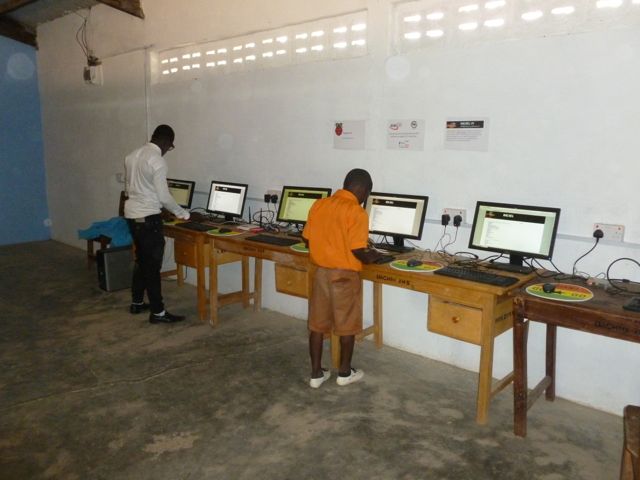
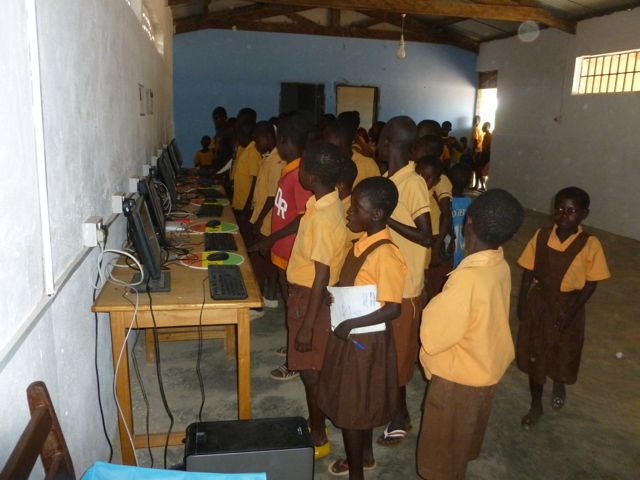
| Liz: This post comes from Heather and Trevor Grant, who work with a student-led charity called The Best of Both, based at the British School of Brussels. Thanks both! For the past five years The Best of Both initiative has worked with state-sector rural schools around Bolgatanga in the Upper East of Ghana to help improve access to water, food – through school gardens – and educational resources (books and access to ICT). Last year, computer labs based on NComputing technology were installed at two schools. This year a Raspberry Pi solution has been installed at Dachio Primary and JHS Schools. Three weeks ago the intended computer room looked like this: After meeting with the headmasters, parents association and Regional Assembly representatives, the room was rapidly transformed with electricity being installed, walls plastered and painted, and desks and chairs promised for the computer lab. Before the new computer desks arrived the teachers gave up their desks so that an initial installation of the system could take place. 6 Raspberry Pi’s have been installed and networked via a switch to a wireless router. One of the Raspberry Pi’s is a dedicated RACHEL educational server. [Liz: you can learn more about RACHEL, World Possible's Remote Area Community Hotspots for Education and Learning, here. World Possible are using Pis as servers for materials like textbooks, Khan Academy videos, health guides, world literature e-books, encyclopaedias and much more - we've been very excited to learn about what they're doing.] The initial feedback from both teachers and pupils on the RACHEL material has been great. They can see that they have access (on the Raspberry Pis, on Android tablets and even on the headmaster’s smart phone!) to a huge amount of content without having to rely on poor and expensive internet connectivity. Also attached to the switch is a Windows 7 desktop which will be used eventually as a gateway to 3G internet access as performance improves. The Raspberry Pi clients are using DVI monitors purchased in Accra together with HDMI to DVI cables, keyboards and mice. The monitors were not easy to find and further additions will probably be based on HDMI to VGA converters so that locally sourced cheap screens can be used. All the Cat5 cable crimping, keyboard configuration and user security set-up was done by Genesis Abaa, a young guy from Bolgatanga who spent every Sunday with me learning together about Raspberry Pis. Genesis is now looking for more projects where he can help install Raspberry Pis, RACHEL servers, and network with the Raspberry Pi community. The new ICT lab is all about access in a practical way that will work at this rural state school. Children can experience use of the computers whilst others watch until it is their turn. Parental support to help fund ongoing maintenance (electricity, light bulbs etc) is important and being able to get a group of parents in the room is important. The parents were amazed at the handover ceremony when they were shown the Raspberry Pi. A RACHEL Pi server has also been installed at the Bolgatanga Ghana Education Service so that other teachers can see what is possible and make use of RACHEL as a resource. A further RACHEL Pi server has been installed at TRAX, a local NGO that provides local support to the British School of Brussels. Trax is focused on rural community development, and it will be interesting to see how the healthcare material included with RACHEL can be used. Thanks to Norberto Mujica and Jeremy Schwartz for their help with RACHEL. Thanks to the Raspberry Pi Forum. Through this amazing support resource I made contact with Luis Jose Marmisa Gazo. Without the help and guidance from Luis we would probably have never found a way to get the Raspberry Pis onto the internet in Ghana using an XP laptop and 3g dongle. Thanks to Geert Maertens for sharing the learning from his team working with St Marcellin Comprehensive College in the Cameroon. Thanks to our friend Ben Laryea who showed us most of the ICT shops in Accra as we went in search of monitors. Thanks to Genesis Abaa for his help in setting up the system – building local capability to install, support and train is even more important than the physical provision of the computers. Thanks to Vincent Subbey from TRAX for allowing us to turn part of his house into a test lab before we installed at the school. Thanks to Nick Lavender and the students and staff from the British School of Brussels for their support throughout the project. |


Tuesday, June 4, 2013
Paywalls being Considered by Thousands of Newspapers
| Readers don’t mind paying for online news and many popular newspapers in North America are all abiding by this principle via Paywalls. The New York Times currently has over 640,000 digital subscribers and is growing by double digits every quarter. The essence of a paywall is giving 5-10 online articles away a month, for free, and then prompting them to subscribe digitally to read more. Thousands of Newspapers are evaluating buying into this new subscription model at the World Newspaper Congress in Bangkok. “The general impression was that it would be impossible to reverse the culture of free content, that people will never pay for it,” said Gilles Demptos of the World Association of Newspapers and News Publishers. Still, all major Canadian and American newspapers have all embraced this new structure and are doing well. Not that they have a choice, as advertising revenue has severely diminished by 42% since 2008. Unfortunately, newspapers keep their actual subscription figures close to the vest and tend never to publicly divulge the amount of money they are making. So its hard to get an accurate reading on their overall success. It remains to be seen if smaller and medium sized newspapers could even be relevant in an online environment, that charges for content. This is primary due to the decline of readership in North America, which has slumped by 13% and fell 25% in Western Europe; and 27% in Eastern Europe in the last year. The overall decline in readership is mainly allocated to the success of Flipboard, Pulse, Buzzfeed and Reddit. Often, these online communities are breaking news stories and are more engaging to talk about the major stories and issues. Jeff Jarvis, of the City University of New York said that the industries “infatuation with paywalls are encouraging it to replicate its old, industrial business models in a new, digital reality, and the real problem remains a lack of engagement with web communities.” The newspapers that really succeed in the digital space with Paywalls, tend to be the major National editions or ones that operate in large urban centers.They can afford to hire the best writers and employ a higher degree of journalistic integrity. They may not be able to match the breaking news that Twitter can, but can deeply analyze issues and dissect what it all means. Paywalls being Considered by Thousands of Newspapers is a post from: E-Reader News |

Amazon Opens up Merchant Solutions in India
| Amazon has opened up their e-Commerce marketplace today in India and will now allow for the sale of books, movies and television shows. This will also serve as a platform for merchants to sell their wares and setup a virtual shop. "This marketplace will provide Indian customers with a shopping destination to purchase products from third-party sellers. India represents Amazon's tenth marketplace launch," the company said in a statement. The move into India was an important step for Amazon due to rising competition in the e-commerce sector. Flipkart, Snapdeal and Infibeam have started providing online services for buying and selling and many businesses have been gravitating to those platforms. eBay actually helped finance Snapdeal and remains committed to the success of the platform. The one problem is none of these companies is profitable, but there is a large enough population to sustain them in the long term. Amazon, will not be selling any of their own inventory in their India store, but will basically function as a fulfillment center that does transaction processing for other merchants. "Our vision is to become a trusted and meaningful sales channel for retailers of all sizes across India, enabling them to succeed and efficiently grow their business online," Amit Agarwal, Amazon India's vice president and country manager, said in a statement. Amazon Opens up Merchant Solutions in India is a post from: E-Reader News |

DC Unveils Two New Digital Comics Lines
| The vast majority of digital comics still either start out as print comics or are destined to become print comics at some point in their lifetimes, but that’s likely to change as the medium matures. DC Comics pushed that maturation a step further this week with the announcement of two new digital comics lines that both use digital-friendly techniques. In fact, it’s hard to imagine any way to translate the DC2 comics into print: Rather than moving from panel to panel, readers will tap the screen to bring in the next storytelling element, which could be a word balloon, a pictorial element, or a whole new scene. As DC’s Jim Lee told Wired blogger Laura Hudson, "What's cool is that you really get to challenge the rules of traditional storytelling. You aren't beholden to a strict left to right western culture narrative. You can have elements that leap back and forth." Dropping in a new visual element with each swipe isn’t a totally novel idea—it’s a technique that Mark Waid has used in Thrillbent and Marvel’s Avengers vs. X-Men Infinite, and webcomickers have been using variations on it for years (the one that stands out in my mind is Dan Goldman’s Red Light Properties). The DC2 line will launch with Batman ’66, which is based on the classic 1960s-era Batman TV show, and it’s easy to imagine how the show would translate into a digital comic, with pop-up sound effects and goofy transitions. DC2 Multiverse, on the other hand, will basically be choose-your-own adventure comics for digital (which should be a lot easier to follow than paperbacks that constantly have you flipping to another page half a book away). The first series in this new line will be Batman: Arkham Origins, which ties in with the upcoming videogame. The appeal to gamers is obvious: Readers can change the story as they go, then return to a branching point to see how it would play out with a different set of decisions. But DC plans to take that interactivity a step further: “We get feedback based on how readers navigate through these stories, and what story branches are most appealing to them," said Lee. "That'll give us meaningful input as we create additional chapters for the multiverse storyline, to the point where you can have people vote on the fates of certain characters. The interactivity isn't just on the screen itself; it's between us as publishers and readers as fans." Indeed, Techhive’s Andy Ihnatko says that the comic will send data back to DC about the user’s choices, which is a little creepy (although the data will be aggregated and won’t be tracked back to the individual user). In announcing these new comics, Lee and DC Entertainment president Diane Nelson also mentioned the growing importance of digital comics to DC’s overall picture: "Now there are a million downloads a month of DC stories from our digital publishing. It's not an insignificant business anymore," Nelson told Wired, while DC’s press release quotes Lee as saying “since the onset of Same-Day-Digital our print and digital sales have both risen by double and triple digits, respectively.” DC Unveils Two New Digital Comics Lines is a post from: E-Reader News |

BookExpo America 13 Wrap Up
| This past week, Team OverDrive attended BookExpo America (BEA), as well as the annual Audiobook Publisher's Association Meeting, IDPF Digital Book 2013, and the LJ and SLJ Day of Dialogue meetings. During these conferences, OverDrive team members participated in panels and presentations to librarians and publishers from around the world. We also met with librarians and publishers at OverDrive's BEA booth, while sharing the latest information about OverDrive Media Station (OMS) and Big Library Read.
OverDrive's BEA booth attracted a lot of attention thanks to hands-on demonstrations of OMS. These demos showed how OMS displays top-selling titles and provides access to one million eBook and MP3 audiobook titles in every genre. OMS provides retailers and libraries unprecedented discoverability, connecting publishers and authors directly with users.
In the coming weeks, OverDrive will be at the American Library Association annual conference in Chicago, as well as the International Society for Technology in Education (ISTE) in San Antonio. Be sure to stop by our booths if you're attending!
Adam Sockel is a Marketing Communications Specialist at OverDrive  |


Top Five Math Fiction Titles For Girls
| Math has a reputation for being closed minded. While it’s true that math isn’t open to multiple perspectives or interpretation, such as English or history, it does involve studying relationships, scrutinizing symbols and shapes, and, of course, solving problems. These are three areas in which girls can excel.
Educational studies report a gender gap between girls and the STEM fields (Science, Technology, Engineering and Mathematics). However, researchers are finding that "improving girls' beliefs about their abilities could alter their choices and performance." So a good way to build mathematical confidence in your daughter, niece, or granddaughter would be to give her an opportunity to read about girls and boys who love math. Who knows - maybe she’ll be a little more hopeful and confident when she enters the math classroom in next fall!
Heroes and Heroines Who Live for Math
‘Do the Math’ is a two-book series by Wendy Lichtman. The first book, ‘Secrets, Lies, and Algebra,’ introduces the reader to Tess, an eighth grade math whiz. Tess is like other girls with friends and crushes, but is a little different in that she examines her teenage experiences through the lens of mathematics. Lichtman is creative with the chapter titles by naming them after math concepts, such as chapter 1: Inequalities. This would be a great summer read for any middle school student.
‘The Phantom Tollbooth,’ by Norton Juster is a modern classic. As Maurice Sendak, author of ‘Where the Wild Things Are,’ wrote: "Tollbooth is a product of time, and a place that fills me with fierce nostalgia. Tollbooth is pure gold." Discover for yourself the story of Milo and his adventures.
Renee Lienhard is a Collection Development Analyst with OverDrive  |


World’s First Firefox Tablet Launched
| If Firefox chose the MWC to launch its operating system for mobile devices, it was left for the Computex event to showcase the first tablet based on the Firefox OS. The launch was also accompanied by the announcement of a new strategic alliance between Firefox and Foxconn with the latter contracted to develop a host of devices based on the Firefox OS including the tablet. However, both declined to name the OEM for whom the devices are being assembled. The Firefox operating system that is based on HTML5, along with a host of other open web technologies, has already attracted the attention of several manufacturers who have committed themselves into developing hardware based on the OS. "At Mozilla we see the open Web as the biggest and the best platform for the mobile world. The Firefox OS initiative helps solidify open Web standards for mobile computing; it also encourages and enables more openness in system integration and device interoperation. This cooperation demonstrates the full potential of Firefox OS, the open Web mobile operating system, to enable not only the smartphone but also a wide range of mobile devices," said the SVP of Mobile Devices, President of Asia Operations, and CEO of Mozilla Taiwan, Dr. Li Gong. As per information currently available, at least 5 companies—Alcatel, TCL Communication Technology, LG Electronics, ZTE Corp, and Huawei Technologies—have confirmed they are developing devices running the Firefox OS. However, other top tier companies like Samsung has ruled out any devices running the Firefox OS so far though Sony Mobile has evinced interest in developing a Firefox OS based device in future. Dr. Li Gong was quoted saying, "The (major) operating systems in the market now are not doing good enough…the Mozilla solution will complement what other operating systems lack, such as Android in native mode. There is currently no solution based on HTML5 and open Web technologies." Firefox is a browser based operating system, which means the apps run on a browser foundation. What remains to be seen is how well it will be able to compete with the well established operating systems such as Android and iOS in the market. As for the tablet, neither Firefox or Foxconn revealed what the internals of the device will be like. Instead, it has been left to the OEM to revealed the specifications at a later date.
World’s First Firefox Tablet Launched is a post from: E-Reader News |

Google Play Downloads Poised to Topple Apple by October
| Google may not have had 50 billion apps downloaded from its Play Store, a feat that Apple reached in the recent past, though it may not be too far from such a milestone. Not when it is witnessing 500 million more apps downloaded than Apple. The trend is least surprising considering there are 900 million Android devices currently in service compared to 600 million from Apple. With more devices feeding from a single app store, the consumption rate will naturally be higher. Analysts are predicting downloads via the Apple App Store could soon be relegated to second place, and the Google Play Store is poised to take first by October. It is definitely expected that by the end of 2013, the Play Store will rise to the top. While the number of apps downloaded per Android device might still be low, it still has the numbers to its advantage. Interestingly, consumers have been found to spend much less on downloading apps from the Play Store compared to those who own Apple devices, a trend that doesn’t seem to be changing anytime soon. Still, about 2.5 billion apps are downloaded from the Google Play Store every month, while Apple records 2 billion app downloads. "The sheer weight of Android units will generate more downloads, but on a per device basis the iOS devices do seem to consume more apps and the gap is not narrowing. What would be valuable would be the revenue per app on Play (the figure for iOS is about $0.23). That, as far as I know, remains unknown," said Horace Dediu, an analyst with Asymco.
Google Play Downloads Poised to Topple Apple by October is a post from: E-Reader News |
