| If you are a fan of the Sunday Funnies, then you will want to install the new fleet of apps released by Uclick’s GoComics. Lots of comics are here, plus their older archives. You can find such things as Calvin and Hobbs, Peanuts, Garfield, Ziggy and a ton more! There are two membership options free and pro, both providing e-mail subscription and personalized online access to new and classic comics. GoComics is also home to Comics Sherpa, the site where aspiring cartoonists can showcase their work and receive feedback from the comic community. GoComics is might provide a departure from the heroes and capes that permeate Marvel and DC. GoComics Launches Windows Phone, Android and iOS Apps is a post from: E-Reader News |
Sunday, April 21, 2013
GoComics Launches Windows Phone, Android and iOS Apps


Kobo Aura HD Already Shipping to Customers
| The Kobo Aura HD has a street date of April 25 – April 29th, depending on who you talk to. We have a number of confirmed reports that some units have been shipped early, and a number of customers all over Canada have already received their new e-readers. Kobo ships all of its devices from Mississauga, Ontario and many people in that Province have received them first. We also have reports that customers in the United Kingdom have started receiving their tracking information on Friday, but it seems its only from orders placed at WH Smith. The Kobo Aura HD is the first 6.8 inch e-reader in the world and it also carries the highest resolution screen in the business. The front-lit display, in conjunction with the supremely excellent font augmentation options, make this a viable investment for newbie and advanced users alike. Already have your Kobo? Drop us a line what country you live in and where you purchased it from, and we’ll update this list. Kobo Aura HD Already Shipping to Customers is a post from: E-Reader News |

Penguin Brings Perseus eBooks to India
| This July, Penguin will begin distributing ebooks and books published by Perseus International to India. The Perseus Group's imprints include Avalon Travel, Basic Books, Basic Civitas, Da Capo Press, Da Capo Lifelong Books, PublicAffairs, Running Press, Seal Press, and Westview Press. Penguin has been operating out of India since 1985 and is hoping to capitalize on the growing digital trend by bringing a number of hot titles, such as Tom Rath's StrengthsFinder 2.0, Robert Kiyosaki's Rich Dad Poor Dad, Deepak Chopra's The Seven Spiritual Laws of Success, Shakti Gawain's Creative Visualization, and Kishore Mahbubani's The New Asian Hemisphere. Penguin India's CEO and president Andrew Phillips said, “Penguin India is delighted to be working with Perseus, and we look forward to expanding the range of books available in India and introducing great new authors to Indian readers.” Penguin Brings Perseus eBooks to India is a post from: E-Reader News |

Good e-Reader Radio Show – April 21 2013
| Welcome to another jam packed edition of the Good e-Reader Radio Show! Today we talk about the latest Amazon news, such as the new Comic Book Creator and also Amazon’s expansion of the App Store. We have the Kobo Aura HD in our gadget labs, and we dive into details on how these fair against the competition. Also, we get into the new Simon and Schuster pilot project with 3M and Baker & Taylor in New York. Finally, we talk self-publishing digital comics with the new initiative by DeviantArt and how rookie creators should tap into this to make connections and learn their craft. As always, I rant and rave about various issues, including my experiences as a Game Artist and Teacher in Vancouver, BC! If you love excellent music, I play all sorts of great tunes from the UK label Tru Thoughts, and also end the show with a few favorites from Kid Koala. A great show as always, so check it out. Good e-Reader Radio Show – April 21 2013 is a post from: E-Reader News |

Archie Comics Goes Same Day as Print on Google Play
| Archie Comics just added a new platform to their digital offerings—and they are celebrating with some bargains. You can already get Archie comics via comiXology, Comics Plus, the Archie app, and the Nook store, and the graphic novels are available via Kindle and iBooks as well. Now, both single-issue comics and graphic novels are available via Google Play. Archie launched with over 500 titles, and many of them are priced at just 99 cents until April 30. The best deal, in terms of pages per dollar, is the Sabrina the Teenage Witch 50th anniversary compilation, 354 pages of classic and modern Sabrina stories, including one that has never been published before. That’s a lot of value for your buck. If you like the characters, Sonic Super Special Magazine and Jughead: Slacker University are also good deals, at 124 and 100 pages, respectively. The Sabrina and Jughead books are digital exclusives; the Archie folks are certainly making good use of their massive back catalogue. At the same time, they are making new comics available on the service the same day they come out, as they do on the other platforms. The Google Play listings note that the Archie comics are scanned pages and not suitable for small devices. They looked pretty good on my Nexus 7, though, and when I enlarged them with a double-tap they still looked good. There doesn’t seem to be any panel-by-panel view available on this platform, though. Archie Comics Goes Same Day as Print on Google Play is a post from: E-Reader News |

Saturday, April 20, 2013
Madefire and DeviantArt Team Up for Full Motion Digital Comics
| Madefire has just created a new Motion Book Tool to bring sequential art to life, and digital art nexus DeviantArt just teamed up with them. The New Madefire browser app will allow artists to create full motion digital comics. DeviantArt remains one of the largest digital artist communities, with 26 million registered users and 150,000 daily submissions. Just about everyone in the game art, comic, 2d and 3d field has used this site at one point or another. Artists who want to take advantage of the new motion tools can apply on the website for it and the first round of 20 comics are LIVE now! Content creators will be able to sell their books both through DeviantArt's own premium content platform and Madefire's existing iOS apps and Flash based internet website. The revenue share program is poised to give the creators 20% of everything sold through all the various platforms. It remains to be seen if this self-published service can compete with other services on the market, such as Comixology Submit. Still, 1200 artists belong to the group and it only went live a few weeks ago. If anything, it could be used to connect up writers and artists to gain experience making comics, if they are looking to ultimately pursue careers in the field. Madefire and DeviantArt Team Up for Full Motion Digital Comics is a post from: E-Reader News |

Adafruit WebIDE – new alpha release available
| News from across the pond arrived last night, UK time. Our good friends at Adafruit have been working on their web-based integrated development environment (IDE) – hence WebIDE – for the Raspberry Pi, and have made a number of changes based on your requests. This is a big update (“Huge!” says PT), and if you’re already using the WebIDE you’ll notice some changes. We’re big fans of Adafruit’s WebIDE for the Pi. It offers a nicely structured, easy way to learn how to program, and there’s already lots of support for it (check out Adafruit’s materials or click on the picture above), even though it’s stil in alpha. Beginners should find the visualiser especially helpful; it’s a good way to work out how simple scripts really work, and allows you to see how objects are created, how processes are stacked and so on. We’ve found it’s a real aid to understanding how things fit together, and a great way to explain concepts to people who’ve only just started programming. Please be aware that because the WebIDE is still a product under development, you may encounter bugs. If you do, please report them using the tool in the editor; user feedback’s really valuable when developing this stuff, and LadyAda, PT, Justin, Tyler and the team want to hear about your experiences. PT says:
If you are already running v0.2.0 or higher, you will be able to upgrade (and may already have done) from inside the editor. If you’re running an earlier version, you’ll need to completely remove your old editor and reinstall again. You can find out more at Adafruit. Thanks so much for all your work on this, Adafruit folks – we continue to be bowled over by all the work you’ve been putting into the Pi platform, and we couldn’t be more grateful. We’re looking forward to seeing you when we’re next in NYC! |

My Kobo Glo has Become Too Glitchy To Function
| While I’m eagerly waiting for the new Kobo Aura HD to arrive at my door, I can only hope that it works better than my Kobo Glo. I noticed the other day at MobileRead that there is a new firmware update, version 2.5, for the Kobo Glo. So I charged mine up and tried to [...] |
Penguin and Random House Merger Approved in Canada
| Penguin and Random House intend to merge and have been submitting approval documents to regulatory authorities in all of the major countries they operate in. When the two companies join forces, they will account for 1/4 of all books published. It was announced late Friday that the Department of Canadian Heritage and the Canadian Competition Bureau have both approved the proposal "without conditions." A Canadian Press release on the subject said, “The two companies announced their agreement to combine Penguin and Random House in October 2012. To date, approval has been granted by the US Department of Justice in the US, the Australian Competition and Consumer Commission, and The New Zealand Commerce Commission. Pearson and Bertelsmann continue to expect the transaction to close in the second half of 2013, after all necessary approvals have been received.” The release went on to outline “Following completion of the merger, Bertelsmann will own 53% and Pearson 47% of Penguin Random House. It will encompass all of Random House and Penguin Group's publishing units in the U.S., Canada, the U.K., Australia, New Zealand, India and South Africa, as well as Penguin's operations in China and Random House's publishers in Spain and Latin America. Pearson and Bertelsmann believe that the combined organisation, the world's leading consumer publishing company, will have a stronger platform and greater resources to invest in rich content, new digital publishing models and high-growth emerging markets.” Penguin and Random House Merger Approved in Canada is a post from: E-Reader News |

Friday, April 19, 2013
Kobo Aura HD VS Amazon Kindle Paperwhite
| The Amazon Kindle Paperwhite and Kobo Aura HD are have reached the apex on what the current generation of e-Readers can do. These two devices are released by companies who both sell the hardware and digital content. The big hyping factor behind these two electronic readers is the ability to read in the dark via the front-lit display and the high resolution. Today, we pit these head to head in a video comparison, to give you a sense on what they both bring to the table. The Amazon Kindle Paperwhite features a six inch e-ink Pearl display with tremendous resolution. You are looking at a very solid 1024×768, which makes pictures looking very crisp. It runs on a 800 MHZ CPU processor and has 512 MB of RAM. There is 2 GB of internal storage and most purchases you make are stored in the cloud, one of the drawbacks is there is no expandable memory. Amazon has one of the deepest ecosystems in the world, and has over 1.2 million books that are mainstream bestsellers and thousands of self-published titles. The Kobo Aura HD features a 6.8 inch touchscreen with a resolution of 1440×1080 with 265 DPI. This e-reader is seriously the best in the business with its high-definition display. The Kindle Fire HD 7 has 1280×800 and the Nook HD has 1440×900. What this means is that as an e-reader, it actually has better image quality than the majority of mainstream tablets on the market. The Aura HD also has a built in comfort light, which allows you to read in the dark with a front-lit display. It is powered by a 1 GB processor and has 4 GB of internal memory, which can be expanded via a SD Card. People choose e-Readers because of their minimal distractions and is the closest you can get to reading a real book. The Aura edges out the Paperwhite in terms of screen resolution, screen size and brightness of the front-lit display. Pictures, text and UI elements tend to look better on the Aura, and the extra 1 inch screen size really enhances your experience. Over the course of this video comparison we check out the eBook reading experience with purchased books and also PDF files. You can get a sense on what type of augmentation options you can employ via fonts, linespacing, margins, highlights, dictionaries and annotations. We also dive deep into the core features both bring to the table and by the end of the video you should get a strong sense on what e-Reader is perfect for you. Kobo Aura HD VS Amazon Kindle Paperwhite is a post from: E-Reader News |

Amazon Expanding into Russia
| Amazon may be setting up shop in Russia in the near future. The company intends on opening up a new office and has filed for new Kindle patents. Former ABC-Atticus publishing head Arkady Vitrouk has been hired and will leading the Russian Kindle content division. Not only has Amazon hired Vitrouk to spearhead the entire program, but the company is actively hiring for three new positions for the Russian office. The listings are for a senior product manager for Kindle content pricing, and a principal for content acquisition for Kindle Russia, and another content acquisition manager position. Amazon has filed for a number of technology patents in Russia, which is a huge indication that it will begin selling e-readers and tablets. Amazon has recently filed the ability to storae and deliver goods; the storage of electronic texts and media files; and book publishing. This means that not only will Amazon be selling devices and ebooks in Russia, but also launch its self-publishing program, Kindle Direct Publishing. Russia is a very large untapped market with over 61 million online users. There are a bunch of e-reader companies, such as Wexler, Pocketbook, and Ectaco, which do well in that market, but are considered minor players. Amazon Expanding into Russia is a post from: E-Reader News |

Use your desktop or laptop screen and keyboard with your Pi
| Meltwater has come up with a nice little trick which allows you to use your laptop or desktop’s display and keyboard as the display and keyboard for your Pi. You won’t need to do any soldering or to buy any special equipment: all you need is a network cable. You’ll be using the network port to do this, so if you were relying on it to get internet connectivity you’ll need a wireless dongle too, but using another device’s keyboard and display means that you can cut right down on the kit you need to carry around if you’re bringing your Pi somewhere to show off your latest project. Meltwater has made an exhaustive guide to setup for beginners available, alongside a cut-down version for advanced users who don’t need quite so much help. |

Goodreads Almost Purchased by Apple
| Online digital book club Goodreads was to be purchased by Amazon a few weeks ago for $200 million dollars if performance goals are met. When the whole deal was going down, Apple was actually in negotiations to buy the company. Amazon insisted that Goodreads break off talks with all of their potential suitors, while a deal was being done. The Wall Street Journal is reporting that “Over the past year, Apple and Goodreads had begun discussing integrating Goodreads' service, which allows users to share and rate what they are reading, into Apple's iBookstore, which sells digital books, according to people familiar with the matter. Goodreads had proposed its reviews and ratings appear within iTunes when users searched for a title, one of the people said. ITunes has already integrated Rotten Tomatoes movie ratings in such a way. Apple was entertaining the idea, but talks didn't progress much, two of the people said.” Amazon promises to run Goodreads as an autonomous entity and still allow other companies to use its API to fetch book reviews and ratings. Kobo and Sony both currently use this system, instead of developing their own solution. This whole situation is a shot in the arm for many online booksellers that depend on the Goodreads API to fetch all of the book review data. Sony announced yesterday a new agreement with idreambooks to replace Goodreads on its site for ratings and book reviews. It is unclear on what Apple’s next gambit will be, as the company is competing with Amazon now more than ever. Goodreads Almost Purchased by Apple is a post from: E-Reader News |

Speakaboos Partners with Industry Leaders on Children’s Literacy Platform
| As digital entertainment becomes more accessible and mobile devices become more commonplace, a number of parents are taking advantage of the safety and the confidence that comes from a subscription to ebooks. Companies are beginning to take notice of a need in the marketplace for access to engaging, entertaining content that parents and educators don’t have to search through app stores to find. One such subscription-based company for children’s content that will launch its application next month is Speakaboos, a content developer whose titles are aimed specifically at the two- to six-year-old preschool student. Speakaboos has collaborated with a number of leaders in children’s education and entertainment to create one of the largest catalogs of titles available. The service is already at use by thousands of students internationally, and the user data demonstrates that students on average read around fifty titles per month, and an average of two and a half hours reading. "We're thrilled that so many industry leaders have joined with us to build the leading children's literacy platform. Our partners view Speakaboos as an opportunity to produce digital content and reach more readers while growing their revenues," said Neal Shenoy, CEO and Co-Founder of Speakaboos, in a press release on the collaborations. Speakaboos assembled a team of experts whose backgrounds brought them from Nick Jr, Hooked on Phonics, Nook Kids, Scholastic, and PBS, to name a few. Publishers like DK, ABRAMS, and Jim Henson and Company have already signed on to provide content for Speakaboos digital catalog. Speakboos is currently available for all web browsers and is offering a free trial of the service. Its iPad app will be available in May, with Android and iPhone apps coming out soon after.
Speakaboos Partners with Industry Leaders on Children’s Literacy Platform is a post from: E-Reader News |

Thursday, April 18, 2013
The Association of Magazine Media Moves Closer to Adopting Digital Standards
| Tablet computers and e-readers have been garnering mainstream attention over the course of the last few years, and many users are gravitating towards these devices. Apple has sold over 100 million iPads since first launching them two years ago and an Android tablet is activated almost every minute. Advertisers are keen to adapt to this new digital trend with something other than evasive adverts that permeate the internet. The magazine industry is trying to adopt standards for advertising and capturing big data in order to attract advertising dollars. A recent report by the Custom Content Council and ContentWise found that 39% of marketing budgets accounted for digital advertising. This 12% increase from 2011 certainly is a sign of the times. Still, digital advertising in general is thought to only be 3% of the industry magazine industry. The Association of Magazine Media and the Alliance for Audited Media is making in-roads to adopt a series of standardizations for capturing user metrics via Big Data and to implement a series of steps to attract advertisers. In order to facilitate a better road-map for digital publishers to produce more big data, the MPA has formed a new relationship with five analytics companies, including Google and Adobe, to take previously incomparable tablet reader data and present it in an easy to read fashion. “Our average publisher is seeing 85% growth in readership in the past six months,” said Lynly Schambers-Lenox, marketing manager of Adobe’s digital publishing suite of software. “We think the proliferation of devices is driving that increase.” The industry’s major publishers such as Hearst and Conde Nast will be participating in a new pilot, which is poised to start in October. This will begin the process of using the same streamlined process with the same analytics tools. If the pilot goes well, the next step would be to find a third party to audit the data, a challenge unto itself as a research firm would be betting big that the time and resources required to develop a new tool would pay off. The Alliance for Audited Media would like the job, but it’s unclear MPA wants to go in that direction. There are many conundrums when it comes to standardizing digital magazine usage for the end-users. If you look at the physical download, do you capture the information when it was initiated or when it has been completed? What do you do if someone buys a magazine but doesn’t open it for two weeks? What is the cutoff point? Publishers are facing these challenges in presenting a unified strategy and and appeal to advertisers. When it comes to the traditional print industry, it is obviously waning and companies are seeking advertisers to fill the void of the digital editions. Without a series of guidelines on how you present data to advertisers, you will have many publishers doing their own thing, which makes it very hard to do business. Also, it does not help that publicly, major publishers are not forthcoming about their sales and advertising figures, which makes it hard to track the trends of the industry in North America. The Association of Magazine Media Moves Closer to Adopting Digital Standards is a post from: E-Reader News |

The Slow Demise of the Japanese Electronics Industry. Here’s Why.
| There have been a silent but far reaching changes in the consumer electronic scene over the last few years. It’s the slow but steady decline of the once mighty Japanese electronics industry; what we see today can be considered just a shadow of what it once was. Unfortunately, the shadow is only growing longer, which implies the sun might well be setting in the Land of the Rising Sun. The likes of Sony, Sharp, Panasonic, Hitachi, and other popular Japanese brands are fast losing their grip on the electronics scene. In fact, the situation is so drastic that Hitachi has resigned completely from the electronics scene and has instead taken refuge in heavy engineering, once its forte. The company has washed its hands of making entities (read electronics business) and is instead into selling heavy machines as well as taking on the engineering aspect of its products. Hitachi’s current boss, Hiroaki Nakanishi, 66, has claimed the move is paying off as the company is already out of the red and has regained profits. Things aren’t near as rosy for the others, though Sony is still making a profit, albeit a marginal one by its own standards this year. Sharp, which has been bleeding profusely for the last few years, seems to have reached a terminal phase. It may even cease to exist, unless there is a big cash infusion soon to maintain the company. It might be slightly better for Panasonic, though it also is likely to report a huge loss, something to the tune of about $9 billion. So why the sudden and violent crash from the high flying 80s and 90s to almost a non-entity in the new millennium? Japanese economist Gerhard Fasol claims it’s the digital revolution that proved to be the too much for the Japan based electronic powerhouses to deal with. Sony, Sharp, and nearly all of its compatriots have excelled in the mechanical side, but found the going tough when computer chips came to take over the working of a device. Of equal importance is the software, again something that the Japanese have traditionally never developed in-house. “The Sony Walkman is a classic example,” said Gerhard Fasol. “It has no software in it. It is purely mechanical. Today you need to have software business models that are completely different.” No wonder, the once almost indispensable Sony walkman has been taken over by the likes of the iPhone or the iPod. The likes of Apple and Samsung are calling the shots in Sony’s own backyard. Apart from the devices themselves, the way they are put together is another area where the Japanese giants are counting their losses. The manufacturing base has almost exclusively shifted to China and Taiwan, owing to the economics involved. It costs a fraction of what it would be in Japan to manufacture a device in China and Taiwan. Also, it’s not the best technology that determines a product’s success these days. Instead, a solid sales and marketing strategy has assumed significant importance towards a product’s overall success in the market. Sony is ahead in the race among its domestic competitors, however, and has already made it known the company intends to be a significant player in the smartphone segment. Its recently launched Xperia Z is rumored to be doing well enough and Sony hopes to replicate the same with its Xperia based tablet offerings as well. It is also working hard to register a presence in the TV segment as well and has recently launched the 84 inch 4K TV, which will display it as leading the technology scene if not drive home huge sales. It will be interesting to note that Apple makes the bulk of its profit from the tablet and smartphone sales, as well as the ecosystem surrounding them. Sony also has a solid presence in the laptop or notebook segment with its Vaio series, though its survival here depends on what notebook/ultrabook/hybrid tablets it launches based on Microsoft’s latest platform, Windows 8. Sony has also stated its next gen PRS-T3 e-reader will be announced soon, another area where the Japanese giant does have a strong presence. As for Sharp, it’s shaping out to be the LCD panel maker of choice for both Apple and Samsung, both of whom have picked up stakes in the ailing company. Interestingly, Apple’s enmity with Samsung has proved to be a boost for Sharp, as the latter is now slated to supply the panels that Apple had been sourcing from Samsung. However, Japan still has a vast, extremely talented workforce that it can fall back on. Then the sheer number of highly educated men and women that it can deploy on a given task is another positive quality that can script the next turn around in the country’s favor. It will be interesting to see how things shape up in the next year or two.
The Slow Demise of the Japanese Electronics Industry. Here’s Why. is a post from: E-Reader News |

Kobo Aura HD Nighttime Reading Tests
| The Kobo Aura HD marks the company’s second iteration of a front-lit display on your traditional e-reader. No other company in the world has produced a second generation e-ink device that will allow you to read in the dark, and many people have questions on how it stacks up against the competition. Today, we compare the Kobo Aura HD against the Amazon Kindle Paperwhite, Nook Simple Touch with Glowlight, Kobo Glo, Kobo Arc, and the Bookeen Cybook Odyssey HD. These Nighttime Reading tests are very short videos and are conducted in our studio with all of the lights turned off. We show you how the front-lit displays compare against each other. Most of the tests take place on the main home menu and then within an ebook. Also, you can get a very good sense of how the screen technologies really function in real world conditions. Our last test compares the Aura HD against the Kobo Arc, an Android tablet. Many people often ask us the prime differences between a front-lit display and a back-lit one, so here we go into detail with the pros and cons of each. Kobo Aura HD Nighttime Reading Tests is a post from: E-Reader News |

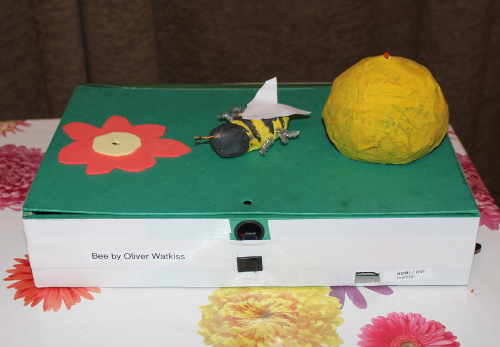
Oliver and Amelia make a bee box
| Oliver is five, and has produced this lovely bee box for school. He did the modelling, the painting and some of the soldering, and had lots of help from his very talented big sister Amelia, who is seven and did all the programming for this project in Scratch. The bee is made of clay, and has a magnet inside his body. His location is determined by some reed switches inside the box, which are connected to the GPIO pins on a Raspberry Pi, as are the LEDs in the flower and the hive. Amelia’s Scratch program, running on the Pi, then uses a TV to display what the bee’s up to (and, to a very enthusiastic Oliver’s great pleasure, emits a buzzing noise). I mean it about the enthusiasm. Seriously. If you could bottle this stuff you’d make a fortune. Full instructions on how to make your own bee box (it’s a really enjoyable project for parents to set up with their kids, and I’m sure you can think of a million ways to customise it) are available at Dad Stewart’s website, along with the Scratch code you’ll need, some GPIO instructions and a costed parts list. Thanks to Oliver and Amelia from all of us at the Foundation – we are flapping our arms and shouting “BUZZ” right along with you. |
Online Job Search Resources
Searching for a job online can be difficult. To help you find the perfect position, we've compiled a list of basic job search resources. |
Raspberry Pi colocation
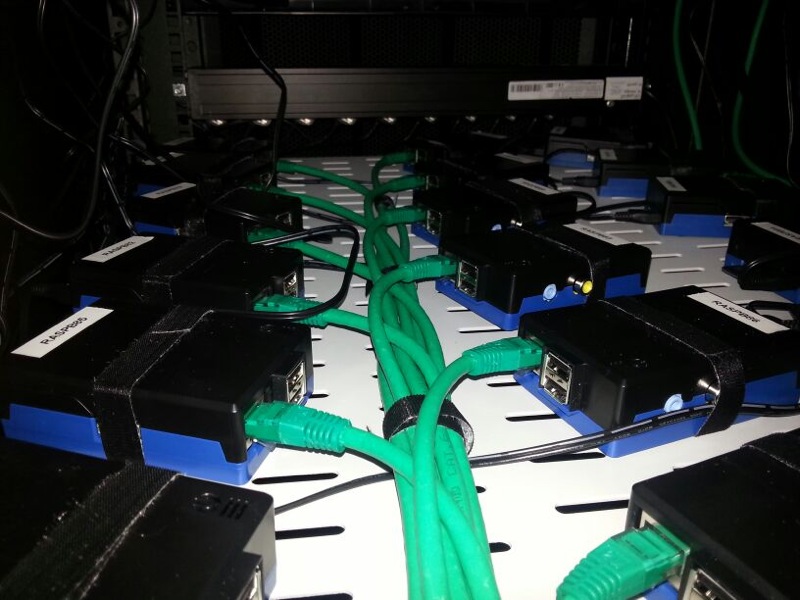
| Liz: Thor de Regt, from Amsterdam, emailed me back at the start of the month to tell me about the success his company has been having offering free Raspberry Pi colocation. There are a few companies around the world offering this service for free for Raspberry Pi users, and we were interested to find out how and why this was going on. Here’s what Thor had to say. Free Raspberry Pi colocation – How it all began, our success and our findings In late February we began giving people the opportunity to colocate their Raspberry Pi in our data center – for free. Now, almost two months later, we have over 400 people making use of the initiative with new signups still coming in daily. Of course this makes for a good story which we’re happy to share with you and the rest of the Raspberry Pi community! The beginning So, how did all this start? Well, it wasn’t a warm summer evening in ancient Greece (in fact it was a cold morning last winter in the Netherlands), when we thought it would be pretty cool to host a couple of Raspberry Pi’s in our data center. We were pretty confident that there would be at least some people interested. I remember getting excited by the thought of reaching enough people so we could end up hosting around 50 Raspberry Pi’s. Two days after the website went live that goal was quickly achieved though, but more on that later. Raspberrycolocation.com Before we could share the initiative with anyone we needed a platform, and thus raspberrycolocation.com was created. To keep our tone of voice in line with the Foundation we made the website as transparent as possible and people really seem to appreciate that. When people visit the website they can see for themselves that we have nothing to hide and that there is no hidden agenda. We believe this definitely contributed, in one way or another, to the popularity of the initiative so far. People just dig generous offers and our service is no different. I mean, where else can you get a 100 Mbit uplink, 500 GB bandwidth, power and the ability to boast about it to your friends for free?  One of the illustrations made for the website to give some pizazz to our applications page. In this illustration you can “clearly” see two raspberries chatting in fruit language. Success Just a few minutes after the website went live we knew we were in for something good. After having sent out a Facebook post and a tweet, we received close to 60 signups within two days. That amount more than tripled when we included the project in our not so monthly newsletter, and has been steadily increasing since. Every now and then the website gets shared on a popular forum or blog (like raspberrypi.org), usually resulting in a few thousand visitors for a day or two. At this moment we have received close to 450 signups, about 150 of which are currently operational. If we get all of them up and running we’re probably looking at three racks filled with Pi’s. Yum! 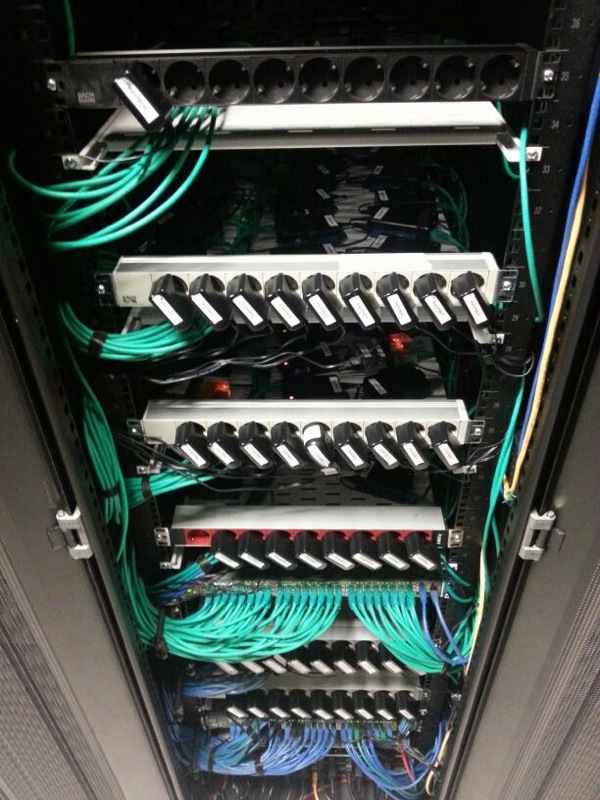 Our first rack, fully filled with Raspberry Pis. Quite a delicious sight! Setbacks The fact that the initiative has been so well received is great news of course, but also presented a few drawbacks. Because we had so many more signups than we first anticipated, our initial stock of Raspberry Pis and their necessary accessories were gone by the end of the first day. Thankfully, ModMyPi ships pretty fast (and their 5% profit donation is definitely a win), so getting new Raspberry Pis wasn’t that much of a problem. No: the real problem for us was the power adapters. For safety reasons, we wanted to supply the power adapters ourselves, but we quickly found out that the ones we had were no good and it took us quite a while to actually get a model we could trust. Ultimately, we went with the ones recommended by RS Components. Higher in price than we first set our sights on, but at least you can count on them! Our setup Currently we’re able to place 150 Raspberry Pi’s in a single rack. However, the method we use isn’t exactly the most efficient solution, as can be seen on the picture. For now it does get the job done though. In order to make better use of the space we have, we are working on a few custom designed boards that should make it possible to place close to 500 Raspberry Pi’s in a rack; this setup will also give us the opportunity to reboot them from a distance, but unfortunately is quite expensive to fabricate in its current state.  The prototype consists of 32 outlets connected to a power supply of 45 amps. We’re currently working on getting the cost per outlet down and maybe increase the outlets per board to 48. With the increase, we could house close to 500 Raspberry Pis in a single rack. Our findings When we first started, we thought only a few people would actually buy a Raspberry Pi through us. To our surprise this was not the case, as 62% of all signups bought Raspberry Pi’s (80% 16 GB version, 20% 8GB version). This amount is much higher than we originally thought it would be, but actually makes sense when you think about it. If I was colocating a Pi, I know I would buy a new one because there is just no way I’d want to send my current one away. The people that did send their own Pi probably had it as an extra just lying around the house. Another interesting thing is how they’re performing so far. Since we always monitor the power and bandwidth usage of our racks, monitoring the Raspberry Pi rack was pretty easy and gave us some great insights. As of 9 April 2013, a total of 150 Raspberry Pis steadily used 4.5 Amps on average and about 1 TB of bandwidth last month. Now, most of them were only placed a few days or weeks before, so this may not be the most accurate picture ever; however, it does give a general idea on how they perform. Oh well, I guess we’ll just have to follow up on this post in the future! 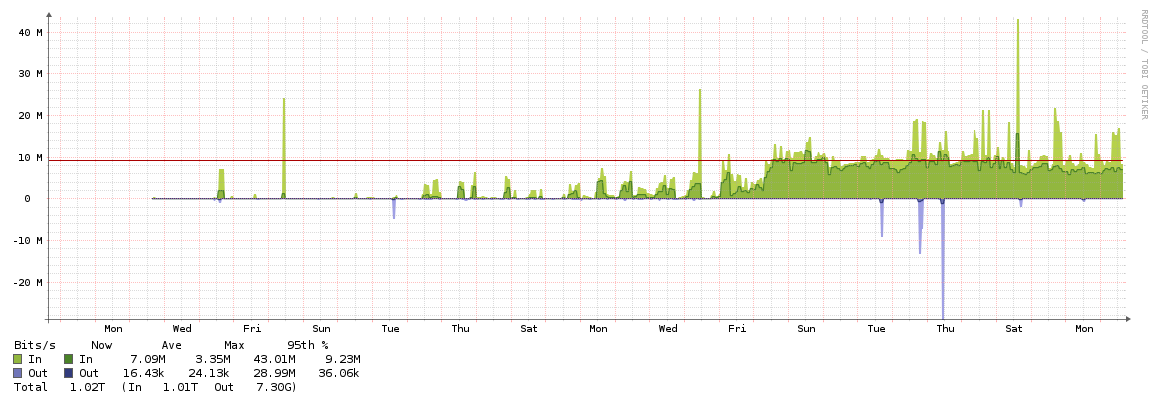 Click to enlarge. As you can see, only 1 TB of bandwidth has been used by 150 Raspberry Pis. This number is quite conservative in our opinion. The guys facilitating all this That’s pretty much the journey we have had so far regarding the project. For anyone interested in who we are and what we do (I’ll keep it short): we’re PCextreme, a webhosting company from the Netherlands offering a wide range of online services at competitive prices, such as domain name registration, colocation services, web- and soon cloudhosting. Should you want to help us out with the initiative, then feel free to share this post or the raspberrycolocation.com website with your friends so everyone can get in on the action. If you have any questions about us, the initiative or anything in general then feel free to ask them in the comments section. Thanks for reading! |
Subscribe to:
Posts (Atom)