| Barnes and Noble has officially discontinued the Nook Simple Touch and the Nook Simple Touch with Glowlight. These two e-readers are now a few years old and the company is now only actively selling the Nook Glowlight, Nook HD and Nook HD+. The Nook Simple Touch was the companies first e-reader that featured a single e-ink based screen. This was their most popular device and raised the bar on the digital reading experience. Barnes and Noble also used this model as an entryway to the United Kingdom, due to the fact of the low price point. The Nook Simple Touch with Glowlight was released a year later in 2012 and pioneered the front lit display. The Nook Simple Touch and Simple Touch with Glowlight are discontinued and the bookseller will not be making anymore. Select Barnes and Noble Bookstores in the USA may still have some in stock, but once they are sold out, they are gone forever. The same goes in the UK, they are still available at Foyles, John Lewis, Blackwell’s and others. Barnes and Noble Simple Touch Reader Discontinued is a post from: Good e-Reader |
Wednesday, February 19, 2014
Barnes and Noble Simple Touch Reader Discontinued


Readly Brings Subscription Based Magazine Service to the UK
| Digital magazine distribution is a growing business with players such as Zinio, PressReader, Magzster vying for market position. Readly is a growing force in Europe with a home base in Sweden and has now expanded into the UK for £9.99 per month. Readly first setup shop in Sweden in 2012 and has released apps for Windows 8, iOS and Android. The move into the UK comes at an opportune time as the Professional Publishers Association state that digital magazines only account for 2% of the industry. These are figures that should rapidly accelerate with more players entering the market. The United Kingdom initiative is being spearheaded by Ranj Begley who was the most logical choice for the job. She has an extensive network of contacts in the publishing industry and has spent the last month building a small team. She was the Client Services Director at Dovetail Fulfilment for eight years where she looked after major publishers and grew Dovetail’ client base by 60%. Readly basically hoped to leverage her connections and grow their business in the UK. Readly Brings Subscription Based Magazine Service to the UK is a post from: Good e-Reader |

Sony 13.3 inch e-reader On Sale in Japan
| The fabled Sony 13.3 inch e-reader, known as the DPT-S1 is now available in Japan. It is only for sale via the business unit of Sony and is seeing limited trials at 3 universities. Currently is available for 98,000 yen, which is fairly expensive. Sony will not divulge how many units were sold, but my sources have saying the sales are extremely limited. The Sony 13.3 inch e-reader is planned on hitting the USA within the next three months. It is set to have a price tag of $1100 to $1200 dollars, which puts it out of reach for most common folk. The plan is to bring it into Canada too, but only from the direct to business arm of Sony, it will not be marketed to customers. One of the barriers is the inability to read anything but PDF files, which limits the scope of who sees this as a viable option. This e-Reader is one of the most eagerly anticipated models of the year. It is perfect for schools or people involved in technical fields, where recharging a device when you’re out, is simply not an option.
Sony 13.3 inch e-reader On Sale in Japan is a post from: Good e-Reader |

Anti-Transparency: Why Are Book Sales a Secret?
|
But why isn’t anyone saying what we all want to hear: How many books did you sell? The answer is they can’t. It’s a little known fact that the terms of service for both Amazon and Barnes and Noble prohibit openly discussing exact sales figures, even for self-published authors; Kobo’s terms of service cannot be discussed as they pertain to this article because the Writing Life terms of service forbid even disclosing what’s contained in the terms of service. This disclosure for all companies apparently even extends to so much as a lowly blog or Facebook post, preventing a self-published author from even sharing with his own followers that he’s celebrating the sale of his 100th copy of his book, for exmaple. Author Susan Wingate found that out the hard way. After posting on her own blog in June of 2013 information that showed (in general numbers) that she was selling more titles on Barnes and Noble than Amazon, her account was blocked by Amazon. Their reason was for violating the terms of service, specifically relating to KDP Select. Rather than block access to the three titles enrolled in KDP Select, Amazon blocked the author’s access to her entire account, including the twenty-one other books that she had written and that were not part of Select. This begs the question, why is the industry so afraid of open transparency where book sales are concerned? Is there some fear of competition among publishers? Is it the perception that a heavily invested and industry-supported title must not be that good if the sales aren’t meeting public expectations? Is it simply a belief that control of data is the lifeblood of these companies? When JK Rowling published her first Robert Gilbraith novel, the sales were unimpressive at only 1,500 copies the first month; of course, the number skyrocketed when the author’s true identity was revealed, selling out the book in bookstores and requiring additional print runs. Obviously, the discovery that the book hadn’t sold enough copies to even pay for the printing wasn’t a deterrent to readers who wanted another title by a popular author, so guarding the information on sales figures didn’t matter in the minds of the readers. The surveys, while incomplete–and in once case, prohibitively expensive–do still serve to spark the discussion that authors like JA Konrath, HM Ward, and Hugh Howey have been igniting for some time. Transparency isn’t a threat to authors, and not to anyone else in the book industry. It actually serves to help authors understand which publishing decisions are right for them. The only people who stand to benefit from keeping a tight lid on data would be people who have something to hide, or worse, a means of making money off the backs of people who don’t have all of the information.
Anti-Transparency: Why Are Book Sales a Secret? is a post from: Good e-Reader |

New Layer Creator Update Takes Augmented Reality Based Interactivity to the Next Level
| Layar, the mobile app that has taken reading magazines or newspapers to a whole new level thanks to their incorporation of augmented reality technology, has announced an update for their software. The latest update applies to the Layar Creator tool, which allows users to create images which will exhibit interactive properties once it is tapped on in a mobile device. This opens up immense opportunities in digital publishing and advertising sectors, something that has led the company to badge its Layar Creator as an “interactive print publication platform.” The Layar app can be found in the Apple App Store and the Google Play Store, and already has a working relationship with Glamour, Elle, Cosmopolitan, Men’s Health, and 80,000 other publishers; still, the company is looking to expand to a much wider user base. The app will work in conjunction with magazine pages that can be scanned by smartphones to allow readers for a richer and fuller reader engagement with the publications. Interestingly, this comes at a time when many are counting the last days of print publications. As for the update, users will be treated to a new tab-based user interface which will allow for easy navigation “between editing, testing, collaborating and promoting campaigns…On the redesigned Campaign Overview screen, a bird’s-eye view of all of your campaigns helps provide the most information possible at a glance. A feed of info cards in this section displays personalized tips, suggestions and helpful information to make the Interactive Print creation process smooth and easy,” stated a press release. “These features and more continue to set the Layar Creator apart as the easiest, most user-friendly and professional Interactive Print publication platform on the market,” said Layar VP of Product Rags Vadali. The videos below will provide a healthy glimpse of what the new update is all about.
New Layer Creator Update Takes Augmented Reality Based Interactivity to the Next Level is a post from: Good e-Reader |

Self Publishing: C’mon, Everybody’s Doing It
|
According to an article by Toma Sukyte for Female First, as many as 28% of those surveyed claimed they were at least interested in self-publishing a book of some kind. The article narrowed that number down even further by saying that as many as one fifth of those would-be authors are interested in publishing a cookbook of some kind. Ten percent of the survey respondents have already published a full-color book of some kind, according to Blurb Books, who specializes in art, photography, and illustrated self-publishing. Other popular projects on the minds of those surveyed are family history books, which traditionally are frowned on by the US traditional publishing industry, as well as children’s books. But what is more interesting is not so much what Brits want to publish, but why. “It's the enjoyment factor of self-publishing that is Brits' primary reason to put pen to paper; half think it would be fun to self-publish (51%), one third (3%) think their lives have given them great content and they have a great story to tell and over a quarter (27%) long to do something more interesting than their day job. Making money is only the fourth most popular reason to self-publish (24%).” Unfortunately, nearly half of the respondents who stated they would like to self-publish a book went on to say that they wouldn’t know where to begin the process and doubt their own ability to do so. This makes authors easy targets for self-publishing companies that take advantage, both in terms of authors’ works and their wallets.
Self Publishing: C’mon, Everybody’s Doing It is a post from: Good e-Reader |

Flying aces and airborne races: A snapshot in aviation history
 Monday, February 10 was an important anniversary in aviation history. In 1908 (one hundred and six years ago) the Wright Brothers, bicycle shop owners turned airplane inventors, signed their first contract with the U.S. Army. But did you know that the Wright Brothers were not the only winners of this government contract? Their story became even more intriguing when I learned that the contract had a performance component, requiring the Wrights to show off the airplane's speed, agility and overall effectiveness of aircraft design to U.S. government officials. The flight trials occurred the following September at Fort Myer, Va., a military post near Washington D.C. Unfortunately, this exhibition did nothing to strengthen their cause. The casualties included a destroyed airplane, a severely injured pilot (Orville) and the death of Lt. Thomas Selfridge, the first ever airplane fatality. However, I appreciate Wilbur and Orville's gumption and perseverance. The Wrights went on to succeed in their second flight trial and as history illustrates, forever changed the fields of transportation and the military. This snapshot in history is not only a great story, but a reminder of the power of motivation and the maxim, "If at first you don't succeed, try try again". To read more about the Wright Brothers and other flying aces, peruse the aviator collection of eBooks and audiobooks available through OverDrive: Aviation Titles (4297) https://marketplace.overdrive.com/Marketplace/OneCopyOneUserAndMeteredAccess/SuggestedList/4297 Aviation Titles MA (4296) https://marketplace.overdrive.com/Marketplace/OneCopyOneUserAndMeteredAccess/SuggestedList/4296
*Some titles are metered access and may have limited regional or platform availability.
Renee Lienhard is a Collection Development Analyst at OverDrive.
 |
Daily Deals & Freebies – February 19
| Kindle Daily Deals Light of the World by James Lee Burke Louisiana Sherriff's Detective Dave Robicheaux and his longtime friend and partner Clete Purcel are vacationing in Montana's spectacular Big Sky country when a series of suspicious events leads them to believe their lives—and the lives of their families—are in danger. In contrast to the […] |
Get Carrie Anne’s book for six quid! (And a competition!)
| A lot of you have had huge success in the last few months using our very own Carrie Anne Philbin’s Adventures in Raspberry Pi as a resource for kids of all ages. It’s engaging, friendly and works really well in getting kids excited and confident about using their Raspberry Pi. So much so that we’ve found schools are ordering classroom sets; so are after-school clubs, and we’ve had amazing feedback from kids and their parents. Carrie Anne (whose job title here at Pi Towers is Education Pioneer) says:
We aren’t amazed at all – the book’s brilliant. 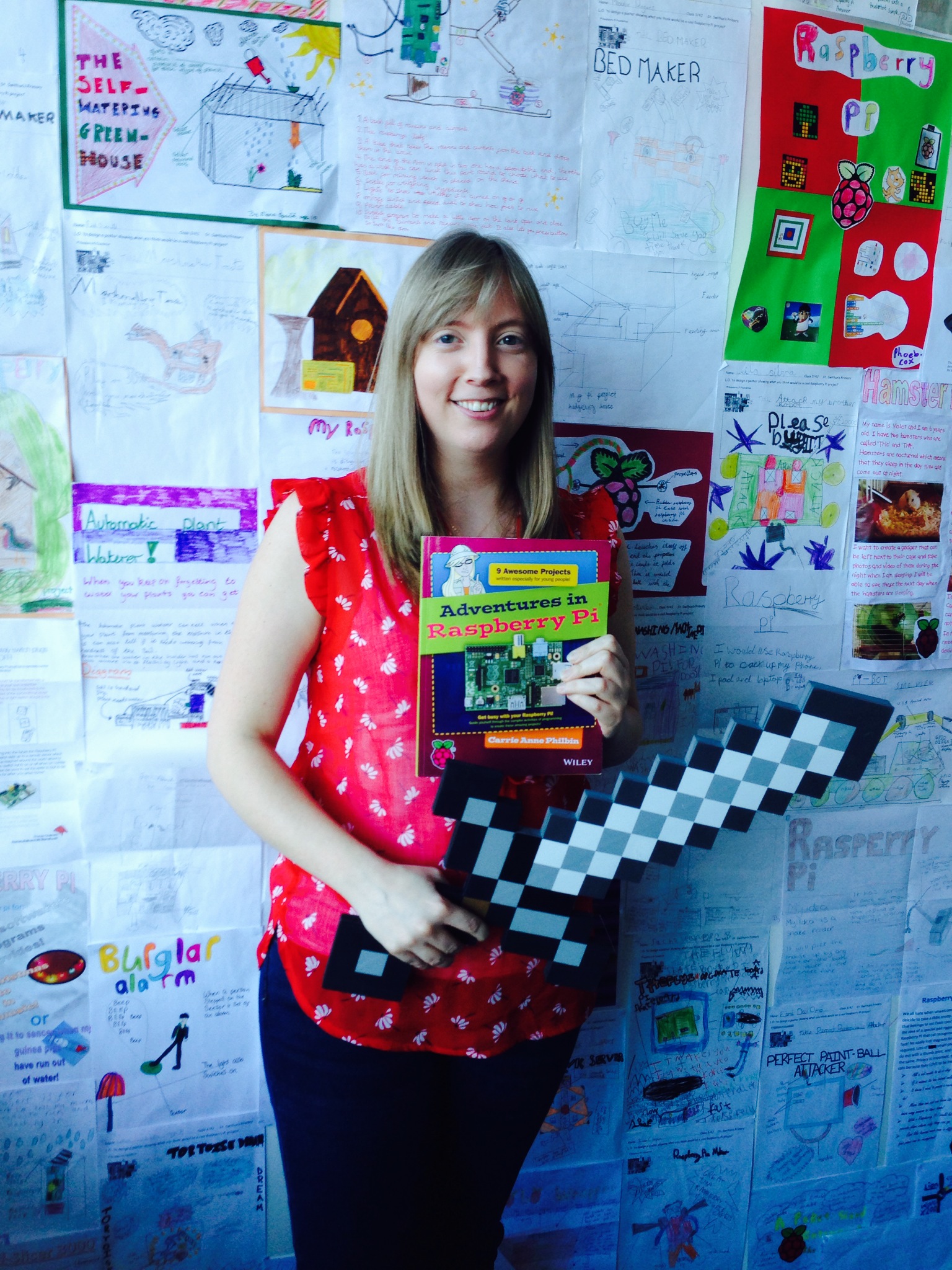 Shortly after taking this picture, Carrie Anne tried to saw Ben’s ear off. We wanted to make Adventures in Raspberry Pi easier for schools to buy (at full price, with shipping, a classroom set can be expensive). So we’ve bought a pallet full here at Pi Towers so we can sell them to you at a much reduced price compared to other vendors (we’ve reduced the margin we take by selling these to almost nothing), with very low shipping costs for bulk orders. If you only buy one book, shipping is £4 (which works out even cheaper than buying it on Amazon if you have Amazon Prime): but it becomes an amazing bargain when you buy more than one, with P&P at only £6 for between 2 and 10 books, so if you’re ordering them for a class or club, or for all your tiny relatives, then you end up paying much less. Here’s a table of prices:
We are also celebrating the addition of Pimoroni’s PiHUB to the Swag Store – it’s a really handy, super-reliable, powered USB hub for your Pi that works with every USB device we’ve tested on it. If you would like to win a bundle including one of five copies of Adventures in Raspberry Pi, some Raspberry Pi stickers and your very own PiHUB, please leave a comment below telling us what you would like to see us stock in the Swag Store. We’ll pick the five ideas that made us laugh the most or that made little lightbulbs go off in our heads as the winners. The competition is open worldwide to people of all ages, and closes on February 26. Make sure that you use a genuine email address when you comment so we can get in touch with you if you win. Here is a bonus video of Carrie Anne at the last Cambridge Raspberry Jam. She’s planning on visiting Alex from RasPi.TV with the Minecraft sword unless he adds the bit where she later got the highest score of the day… (If you’d like a go yourself, you can buy the Seven Segments of Pi kit you need to make this and other games, which comes with some great tutorial materials, from Cyntech. Some soldering required.) |
Samsung Reveals KitKat Upgrade Plans, Roll Out Starts Todat
| Samsung has announced several of its smartphone and tablet devices will be joining the KitKat party beginning today. Unfortunately, there is still some question about when the update will happen for which particular devices, and it’s expected to be a few months before the update goes into effect for all devices. The tablet devices that will be getting the latest Android version include the Galaxy Note 10.1 2014 Edition, Galaxy Note 10.1, all three size versions (7, 8, and 10.1 inch) of Galaxy Tab 3, and Galaxy Note 8.0. The smartphones that will be getting Android KitKat include Note 3 and Note 2 devices, the entire Galaxy S4 line, Galaxy S3 (both the standard and mini versions), the Galaxy Mega 6.3, and Galaxy Light. As for the benefit of the update, users can look forward to an enhanced messaging experience brought about by the new Hangout app, an enhanced UI with the introduction of new icons, and the usual performance upgrade. Google Mobile Service (GSM) apps get an upgrade in KitKat, which lets users automatically back up photos and videos. Users will also be able to open, view, rename, and share Google Docs and files after the upgrade.
Samsung Reveals KitKat Upgrade Plans, Roll Out Starts Todat is a post from: Good e-Reader |

Ice-T is All Praise For Dungeons and Dragons
| To all those who believe Ice-T has had a tough time recording Dungeons and Dragons audiobook, given the wide ranging expletives he used to describe the experience, the rapper has now stated he actually enjoyed his stint as the story narrator. The fantasy novel surrounds the activities of the dark elf Drizzt Do’Urden, a talking sword, along with three women. The legendary rapper had earlier expressed amazement at the storyline and their activities, singling out the sword for special treatment for its audible qualities. The rapper wasn’t even aware he was being arranged for lending his voice to the Dungeons and Dragons storyline for the audiobook company Audible. I want to give a special shoutout to all the Dungeons & Dragons people…y’all have been phenomenal. “I have nothing against dungeons and dragons, geeks, or nerds I told you I just hate dumb [expletive].” “What wouldn’t Ice-T like about a dungeon…or a motherfuckin’ dragon? That shit sounds dope to me,” said Ice-T.
Ice-T is All Praise For Dungeons and Dragons is a post from: Good e-Reader |

Commentary – If I was in Charge of the Sony e-Reader or Reader Store
| Sony has been selling e-readers since 2006 and only saw 300,000 units being sold until 2008. Everything changed when Amazon got into the eBook and e-reader market and the industry took notice. This increased the visibility of the Sony brand and they sold 800,000 units in 2010, just before the market peaked in 2011. Sony has seen diminished sales since their peak and they have been on the downward trend ever since. In 2011, Sony accounted for 28% of all e-readers sold in Canada. In 2012, its presence diminished to 18% and in 2013 dropped down to 12%. Last year proved to be the beginning of the end for Sony, as they abandoned the USA market and instead are focusing on Canada, UK, Europe and Australia. A few weeks ago Sony announced that they were closing down their Reader Store and all books would be transferred over to Kobo. All future e-readers, phones and tablets sold in North America would have the Kobo app loaded on it and Sony would cut a piece of commission for every title sold. Kobo is also paying Sony a licensing fee to have their bookstore replace the one that Sony has been running for a very long time. Can Sony be saved? They have the financial resources to make it happen, here is my plan to save the Reader Store and bring their e-Readers back into prominence. Saving the Reader Store The Sony Reader Store has been operating for a very longtime. It wasn’t really a viable bookstore until 2008 when they abandoned their proprietary LRF format and switched to EPUB. This attracted Publishers and self-publishing platforms such as Smashwords to easily contribute content in a universally accepted format. The Reader Store really expanded their reach in the last three years when it expanded into UK, Japan, Germany, Austria, Canada, and Australia, and opened up shop in France, Italy, and Spain in 2012. They have great market position in countries where the digital book selling market is not absolutely corner-stoned. Natascha Helbig is the director of the Sony Reader Store in the US and Canada. She was instrumental in solidifying publisher relations and launching their bookclub, book discovery tools and infographs. When the bookstore first started rolling out these features, she told me in an exclusive interview that "We always look for new and exciting ways for our customers to discover new books and authors, and to learn more about the authors they love. The Sony Readers Book Club was a great experience which brought us closer together with our customers and allowed us to all participate in a reading experience together. We had hundreds of applications for the club and our online chats generated millions of impressions. The book club was a great way to discover new authors and titles and facilitate lively discussions amongst our customers and authors, and those are themes you will continue to see at Reader Store." The Sony Reader Store right now is in big trouble. The fact that commissions from Kobo book sales makes financial sense and licensing fees outweigh the revenue earned from Reader Store book sales speaks volumes. If I was in charge of the Reader Store, I would first bring back their bookclub. They started to do it every month, but after six books decided to abandon the project. Considering it was basically being run through their blog, makes sense on why things fell apart. Bookclubs are instrumental in bridging the community and starting a book culture at Sony. This is what they are sorely missing, anyone can sell books, but if you don’t have a community, you are nothing. I would save the Sony Book clubs by implementing a Netflix of eBooks type of subscription system. You would pay $29.99 a year and get access to a new front-list title every single month. The exact title would be determinate on user voting, to insure that the one title that was available, was voted on by the majority of people participating in the book-club. The actual titles available for vote, would be curated by someone at Sony, to insure they can give the titles away and insure the author was available for a Q/A. Instead of relying on Facebook for community discussion I would iron out a deal with Goodreads to have a special Sony Book Club discussion center. This could be accessed via the web and a new bookclub app I would have the boys in IT make. This bookclub app would be available for Android, where they could subscribe, talk and read, the iOS app would just have the social aspect, since Sony can’t sell books on Apple. Finally, I would insure the Author would participate in a live Spreecast, where they could appear on web-cam, answer peoples live questions and talk about the book. Sony continues to see moderate success over in Europe and Australia. I would continue to operate normally in this markets, but I would expand into the rising markets, where no one controls the digital ecosystem yet and Sony can leverage their strong brand. Brazil, Latin America, South Africa are the easiest markets to break into, due to the political climate and the strong reader base. It is important to not be complacent in the few markets you operate under and continuously have to expand into other markets. This keeps the brand fresh and brings new ideas to the table from local agents and publishers who are feeding Sony books to sell. It would also stimulate hardware sales, selling e-readers for less than the competition. Website owners may be oblivious to this fact, but the Reader Store has a commission program. They pay bloggers, website owners and authors 6% of any eBook they sell via people clicking on banner adverts. The problem is, there is no information on this at all on the Reader Store website. This is no links to the program or easy enrollment options. Obviously, having other people promote your brand is the easiest way to advertise. I would revise this section, allow people to customize banners on any book they want and pay people out at the $100 threshold once a month. Sony Needs to lower their prices on their eBooks. Often, they are double the cost of Amazon and basically on par with Apple. The average price of a fiction bestseller at Amazon is $9.99 and at Sony it is $15. Sony needs to sell books at the exact price as Amazon does for key markets in Europe. This it the only way they can promote themselves as being a true Amazon alternative, which is what allowed Kobo to get so strong, so quickly. In the end, the Reader store needs to lower eBook prices, build community, open a proper subscription based book club, expand into foreign markets and leverage their name brand as a primary mover of growth. Sadly, the Reader Store team is tiny, there is less then 8 full time people running the show, a few interns and that’s it. The Sony e-Reader Regains its Prominence Sony has close to 11 e-readers in their product portfolio and has been a solid brand since 2006. When the company first started releasing e-readers they basically had no competition. Within four years they had hundreds of competitors, and they were caught unprepared for how fast the industry had grown in the few short years. In the past, Sony would always release three new e-readers a year and for the last three years has only issued one. Sony also relies on 3rd parties for content, which often shoots them in the foot. They had an agreement with Google to hustle books directly with their PRS-T1 e-reader, but when Google changed their system and amalgamated everything into Google Play, it disallowed anyone with a Sony to buy books from the Play Store. Imagine having a new Sony e-Reader, using the device for the first time, and clicking on Google Books only to see error messages. The PRS-T2 did a little bit better of a job with Evernote and Overdrive Library lending. The PRS-T3 was a let down and was not even marketed in the US, Sony had abandoned the market completely. The truth behind the decline in Sony e-reader sales, starts with the executive team. This actually hinders growth. The first thing I would do if I ran the hardware division is fire people like Stephanie Lang, head of group IT division of Sony France. She was instrumental in the e-reader designs and said that front-lite screens were a dead technology, instead she developed reading lights for the PRS-T3. Reading lights people, in 2014. Kindle, Kobo, Barnes and Noble all have close to three generations of illuminated screens, to allow you to read in the dark, and Sony bets on reading lights. You wonder why the e-reader brand is failing? It is because you have idiots like Stephanie that are oblivious to market trends and fail to see the virtues of forward thinking technology. I am surprised each new e-reader did not ship with a candlestick and a note saying “happy reading – the future is now.” To turn around the Sony hardware division I would hire Bill Saperstein, who was the VP of Nook. He has experience in running a modern hardware company and Sony could get a breath of fresh air in the executive ranks. Sony needs to think in terms of being a startup. Pressing reset on the e-Reader hardware and starting new. Here is the plan. Sony and e-Ink worked together in 2013 to develop Mobius technology. Mobius displays can weigh less than 50% of an equivalent glass based TFT and they can be cut to any specific size. This is what I would incorporate into the Sony PRS-T4 and also front-lit technology. Most people aren’t aware of this, but Sony e-Readers run Android. I would make deals with companies like Instapaper and load their rss/read it later service on it. This would be my counter to Kobo and Pocket. The Sony 13.3 is the best e-reader I have seen in my entire life. It weighs almost half of the Kindle DX and other large screen e-readers. It has amazing resolution and was primarily designed for reading and editing PDF Files. No e-reader in the world gave you the robust level of reading and clarity as this reader gave me. Where is it now? Wallowing in obscurity at Sony Japan, in their business unit. Customers could not even buy these if they wanted to. There are rumors that it crossing over to the USA in April 2014, but at a $1200 price tag. Obviously, this would be the next great product. I would charge $500 for it and bill it as the best PDF e-reader in the world. I would market the hell out of this and use this as the flagship device, that schools, education and anyone who needs PDF Files for their work. Why Sony is sleeping on this e-reader, when it still has tremendous buzz surrounding it, does not make any sense to me. Finally, as I stated above all modern Sony e-Readers run Android. I would put our own Good e-Reader APP Store on it, and design it that the only apps to install would be e-reading, comic book apps, newspaper and magazine apps and small productivity apps, such as Dropbox. No Android e-reader has a small app market built right into it. This is what is needed for Sony to distinguish themselves from the competition. Give customers a greater choice, give them more freedom, give them modern hardware, give them a reason to buy one. The company mantra should be – we empower readers. Wrap Up I have looked at the major changes I would implement if I ran either the Reader Store or the hardware division. Sony, seems too complacent and does not have strong motivation to do well in the market. Everyone working there in the executive ranks are there for a paycheck. They wake up in the morning, talk to publishers, get more books, and have them added to the site. They certainly aren’t issuing firmware updates, doing research and development or staying current. They certainly are not innovative anymore and have lost the will to live. Sony right now is like a death row inmate, you don’t know when execution time is, but you get into a daily pattern of pseudo-zombie living. Sony is an e-Reader brand that is dying. The writing is on the wall and the company will ultimately abandon their own store and line of e-readers within a year. Europe will follow North America’s suit, once they get a few paychecks from Kobo. Kobo will then take over their entire digital ecosystem and Sony will just make tablets and phones. Honestly, it is not that hard to turn things around. e-Readers are a low-cost gateway to expand with. It is hard to enter Brazil with a $700 tablet or phone, but relatively easy with a $100 e-reader. This is how the e-reader division should be organized. It is a gateway to success and open with Android to allow people to install their favorite reading apps, local newspaper apps or local news apps. You then release the 13.3 inch device to a very niche market, that is positively starving for something like this. I wish I could just save Sony. I have been following the e-reader industry since 2008, I have a very unique perspective on how the worldwide market works for eBooks and e-Readers. I talk to hundreds of start-ups a year and travel all over the world looking at the latest tech. You get to a point, where you can see who will do well and who will wallow away and fade. Unless Sony hires some new key executives and changes their approach for selling e-readers, eBooks, newspapers and magazines, they are doomed. Commentary – If I was in Charge of the Sony e-Reader or Reader Store is a post from: Good e-Reader |


Tuesday, February 18, 2014
New Update to Wattpad’s iOS, Android Apps Makes Stories Portable
|
"At Wattpad, we're making it easy for people to access millions of free stories on their mobile devices," said Allen Lau, co-founder and CEO of Wattpad, in a press release. "With the latest update, it doesn't matter where you live, what device you use, or even if you're connected to the internet, you can still find a great story to read on Wattpad." Two other exciting features of the update include the Archive for Android capability and the Inline Commenting option. Archiving allows readers to move older stories to their archives and enjoy faster loading of new content, while the Inline feature lets users actually comment at specific points in the story. This a feature that both authors and readers have sought for some time, as it allows fans to make remarks, point out inconsistencies or errors in a helpful way, and generally interact more fully with the story. Other options in the update include reading recommendations and the ability to create mobile reading lists, two features that will enhance the portability characteristic of the reading experience. The app update is available now through users’ own app suppliers. A free Wattpad account is needed to take advantage of these features.
New Update to Wattpad’s iOS, Android Apps Makes Stories Portable is a post from: Good e-Reader |

New iWatch Concept Video Incorporating Curved Display Appears Online
| A new concept video providing us a glimpse of what the rumored Apple iWatch will be like has come online. The first thing that strikes is that the supposed iWatch is unlike any other smartwatch that we have come to see so far. Rather, it's more akin to a wearable band or a bracelet sort of thing with a curved display. Not that it looks any bit odd with the design theme it incorporates. On the contrary, the iWatch looks even more futuristic than any of its peers. Further, a curved display also seems to be more befitting a smartwatch than perhaps a smartphone or a tablet. Overall, the design looks slick and smart even though it shares quite some similarity with the Nike+ Fuelband. The concept iWatch as depicted in the video shows the date and time along with a lot of other notifications in a horizontally tiled manner. There is also the likelihood of the Healthbook fitness tracking app that the iWatch can feature, one that could be part of iOS 8. Another purported app that has been making some noise off late is the one that will be able to predict heart attacks, something that could prove to be a game changer if designed well enough. Overall, we have seen quite a few smartwatch concepts so far though none have made quite the kind of splash that they might have expected. Maybe, that is left to Apple to do, something of the sort that the Cupertino company has done in the past with the iPhone and iPad in the smartphone and tablet segments respectively. As for the iWatch concept, it has been designed be Fuse Chicken, a startup based in Cleveland 'currently funding a magnetic charging cable and dock for iPhone.' via techcrunch
New iWatch Concept Video Incorporating Curved Display Appears Online is a post from: Good e-Reader |

Nuts and bolts: Merging your lending models in Marketplace

There is the option of taking the time to shop lending models separately, but Marketplace makes it easy for you to search within specific lending models with the improved Basic Search function. So in essence, you can select which lending model you would like to search under and merge your lending model preferences. If you have more questions about metered access titles or merging your lending model preferences please contact your Collection Development Specialist or contact us at collectionteam@overdrive.com.
Laura Guldeman is a Collection Development Analyst at OverDrive.
 |

New Whitepaper Advises Academic Publishers to Think Outside the Book
 Photo courtesy of velositor,com A new report, issued today by global publishing adviser Ixxus, aims to help academic publishers organize their move to a more digitally focused landscape. The sixteen-page whitepaper, called “Thinking Outside the Books: Reinventing Educational Publishing for the Digital Age” and accessible HERE, stems from ongoing relationships with some of the largest names in academic publishing, such as Pearson, Cambridge University Press, and Cengage Learning. According to a statement by Steve Odart, CEO and co-founder of Ixxus, in a press release announcing the publication of the report, “This whitepaper visualizes some of the obstacles and challenges which educational publishers may find themselves facing in the transition towards digital. We’re seeing more and more companies moving towards digital-first strategies, but often they don’t realize that this means changing their entire organizational mind-set and thinking about content in a completely different way.” Some of the most important data in the report addresses the speed with which digital publishing is having an impact on educational markets, the transition from creating whole textbooks to smaller content-based “chunks” of material, the impact of MOOCs on the digital textbook market, and more. “The key factors which we see impacting on the digital textbook market and the educational publishing sector as a whole are the increasing speed of the move to digital as efficacy studies and technological advances enable take-up of suitable devices and solutions,’ said Kate Worlock, Lead Analyst for Education & Training at information analytics firm Outsell. Academic publishers and educators alike have felt the frustration of having viable technology and device penetration available, but have faced slow adoption from some institutions, especially at the public school level.
New Whitepaper Advises Academic Publishers to Think Outside the Book is a post from: Good e-Reader |
The MagPi – Kickstart the Volume 2 Binder for 432 pages of Pi goodness!
| The MagPi magazine is the single thing to have come out of the Raspberry Pi community that I’m proudest of, in a sort of godmotherly way – we at the Raspberry Pi Foundation do not have any association with The MagPi besides thinking it’s the best thing since sliced maltloaf. They’ve got a new Kickstarter running. The MagPi is a monthly free download, full of projects, tutorials, reviews and interviews about the Raspberry Pi. The magazine is staffed entirely by volunteers, and it’s just entering its third year of publication. Last year, the MagPi team served up a Kickstarter to bring the magazine to print, which proved really successful: print copies go down especially well if you’re using the magazine for reference or working through the tutorials. That Kickstarter meant that you could get hold of all of the first year’s magazine in a print version, with a handsome binder to put everything in. We have a couple of the first year’s binders filled with magazines in the office: the Pi Towers team finds the MagPi a really useful resource. Many people have asked for another binder for the second year’s print copies, having accumulated a heap of them at home. So Team MagPi are running a short-duration Kickstarter to fund manufacture of a binder for Vol 2 (i.e. every edition of The MagPi that came out in 2013). They’re keeping it to a two-week funding run because financing a binder costs them much less than last year’s bid to pay for printing what had been a virtual magazine. You can pledge at different levels, so you can fund anything from a sticker, an empty Vol 2 binder for yourself, a Vol 2 binder with all of last year’s magazines inside, or both volumes – complete, of course, with binders. The MagPi team don’t make a penny for themselves out of this: the project has always been run on a strictly voluntary basis, and it amazes us to see how the magazine continues to evolve, given that it’s run on a shoestring. They say:
You can back this project by clicking here, or on any of the images in this post. Good luck, MagPi people – it goes without saying, but we think you’re brilliant!
|


Daily Deals & Freebies – February 18 – Back in Action
| Kindle Daily Deals Collateral Damage by H. Terrell Griffin The quiet beauty of Longboat Key is shattered when a young groom is shot to death on the beach the day after his wedding. His father is an old army buddy of Matt Royal, and Matt tries to soften the anguish of his friend by finding […] |
Recorded Books and Zinio Double Down on Libraries
| Recorded Books started out in 1979, heavily investing themselves into the library space. They currently have a catalog of 13,500 audiobook titles that they market to libraries and retail customers. They also own a UK audiobook company which helps contribute further assets. Recently, the company was sold to Wasserstein & Co to help with the cash flow. Really, what this mean for the future of Zinio and Recorded Books? Recorded Books helped digital magazine subscription service Zinio enter the library space. Zinio has really just focused on selling magazines directly to customers, but this is often a fickle business proposition. Recorded Books basically leveraged their existing base of library contacts to help market hundreds of magazines, in addition to their audiobooks and 100,000 eBooks, via the OneClickDigital platform. The deal with Wasserstein was made to tap into a serious cashflow to help the company compete against Overdrive, 3M Cloud Library and Axis360. Recorded Books needed to refinance to expand their reach and help market their services. They sorely need it, as Overdrive has usurped their position in the marketplace by offering everything Recorded Books does, but providing a very slick UI and backend tools for libraries to manage and purchase collections. In order for Recorded Books to be a viable business proposition going forward they will have to establish more relations with publishers to enhance their eBook catalog. During the last few months they got Random House as a partner and hope to woo the other publishers who deal with the competition. They also need to expand their distribution for movies and streaming video to market to libraries. Recorded Books and key Zinio executives formed a relationship with IndieFlix, which is a subscription based video streaming service. It basically showcases documentaries and indie films, which is quite different from mainstream catalogs offered by Overdrive. Past and present employees of Zinio and Recorded Books sit on the board of directors at IndieFlix and hope to help their business grow and also get their videos into the Recorded Books platform. Zinio is a company in a state of flux and the future looks uncertain. They used to do brisk business in the Apple App Store when the iPad originally came out. They remained in the top ten for a number of years until Apple launched their own Newsstand. Within a few years Amazon, Google, Apple, Rogers Media, Magzter and PressReader all started offering competitive digital magazine subscription platforms. Zinio has seen diminished market share because of this and now relies on Recorded Books to distribute their catalog of content to libraries and schools. In 2012, at the height of the downward trend, Zinio explored the option of selling itself, but decided to weather the storm. Recorded Books in the near future will be able to offer libraries a very compelling package of content, that only Overdrive can match. They have audiobooks, eBooks and magazines. Video is the only thing they are missing, as well as a more intuitive set of tools that ties into libraries ILS systems. The much needed cash injection should keep them going into the near-future, but they really need to do some key things to stay profitable. Recorded Books and Zinio Double Down on Libraries is a post from: Good e-Reader |

Readium for Chrome Receives Major Upgrade
| The Readium project originally started in 2012 and was originally billed to be an open source EPUB 3 engine. It is basically a set of reading tools for the development of iOS, Android and Chrome e-Reading apps. There are major players involved in the development of mobile and web-friendly SDK tools, such as Adobe, will be contributing a full-featured EPUB 3 rendering engine optimized for native apps on tablets and other mobile devices. The IDPF owned Readium Project has released an upgrade for Chrome today, that dramatically enhances the UI. There is new settings that will allow you to change background to such options as “Vancouver Mist.” The scrolling feature to turn the pages have been suspended and now you have to use the left and right arrow keys to flip a page. One of the big benefits about this reading app is that you can import ePub books from your local computer, from a zip file or from a link in the web. This is very useful for people who have Chromebooks and want to import books into the reader via Google Drive. This reading app is quasi-ok with no big compelling features. It should only be used if you basically pirate books from the internet or are in development of ePub 3 books. The Kindle Cloud Reader, Kobo Cloud Reader and Overdrive Read are light years better than this app, which is sad, because its developed by the standardization body that is in charge of the evolution of ePub. Readium for Chrome Receives Major Upgrade is a post from: Good e-Reader |
