| E-Paper has transcended e-readers into other practical uses, such as digital signage and smartwatches. Wearable tech is something most companies are getting into because the industry is going to hit 62 billion by 2018. Samsung, Sony and Qualcomm are bluechip companies heavily invested in the wearable tech space, and many startups are getting into it for the first time. Today, we look at three different screen technologies currently being employed in smartwatches. Pebble uses a e-Paper display, Sony uses an LCD and Seiko is using an e-Ink screen. The Seiko watch is not a true smartwatch, but we are hearing rumors of E Ink developing screen technology for companies to develop commercially viable products. The Seiko is basically a proof of concept that e Ink can be used quite well in the wearable tech space and just needs refinement before it is ready for the prime time. In the video below, Michael and Peter of Good e-Reader give you a sense on how all of these watches perform in real world conditions. You can get a sense of their limitations and the things they pull off really well.
Video: Pebble, Sony and Seiko Screen Technology is a post from: E-Reader News |
Monday, February 17, 2014
Video: Pebble, Sony and Seiko Screen Technology


Alcatel One Touch Idol X Review
| Alcatel is moving into Canada and has secured a relationship with Bell and a number of other carriers. This gives an alternative to the majority of new phones being sold here, such as Apple, Samsung, and Sony. The Alcatel One Touch Idol X is a premier phone, that borrows classical elementals from many of their competitors, giving you a solid phone, at a good price. The Alcatel One Touch Idol X features a five inch display with a resolution of 1080 x 1920 pixels. Underneath the hood is a 1.5GHz quad-core processor with 2BG RAM and 16GB of internal storage. It has a 13.1 MP rear facing camera and a 2 MP front facing one. The speakers are actually very solid, even though its on the rear of the phone. Rarely do speakers actually sound good, when a phone is laying on its back, but this does well. This phone is much slimmer than the competition and is lighter. It is a joy to hold in your hand or to play games. The resolution is super crisp, whether you are watching movies or using apps. Alcatel has struck a winning blow with the Idol X. It may have its faults, but between the gorgeous screen, satisfactory camera and effective multimedia functions, it has enough on its side to please buyers who want something close to a high-end phone without the high price tag.
Alcatel One Touch Idol X Review is a post from: E-Reader News |

Kobo’s Global Content Revenue Increasing Rapidly
| Kobo is seeing tremendous growth on the international stage with its e-reader and eBook ecosystem. The Rakuten owned company has increased their 4th quarter 2013 revenue by over 44% year on year. The online customer base has also dramatically increased from 12 million in 2012 to 18 million in 2013. The international strategy Kobo is employing is paying off with more users in more countries signing up and purchasing eBooks. The Canadian based company is accessible in over 190 different countries and has close to five million titles in their library. When Rakuten purchased Kobo in 2011, the writing was on the wall that there would be a management change. This is primarily due to the Japanese culture of not having western people as the CEO or in key leadership roles. A few weeks ago Michael Serbinis stepped down as the CEO of Kobo and has been supplanted by Takahito "Taka" Aiki. Taka is basically a turnaround specialist, who is put in charge of companies to increase their revenue stream. According to the most recent Kobo shareholder report Aiki was running Fusion Inc. He took it from being a black hole to earning 12 million dollars a few years later. Kobo is a profitable company, but missed opportunities in key markets, such as China, Russia and the US. Kobo's Global Content Revenue Increasing Rapidly is a post from: E-Reader News |

New Rowling Title “The Silkworm” Continues Gilbraith Series
|
But now that the author is openly writing as Robert Gilbraith, published by Little, Brown, and Co., she’s free to share details of the new title, The Silkworm, which will be the second book that features her character, Private Investigator Cormoran Strike. According to a release from the publisher, “When novelist Owen Quine goes missing, his wife calls in private detective Cormoran Strike. At first, Mrs. Quine just thinks her husband has gone off by himself for a few days (as he has done before) and she wants Strike to find him and bring him home. But as Strike investigates, it becomes clear that there is more to Quine’s disappearance than his wife realises. The novelist has just completed a manuscript featuring poisonous pen-portraits of almost everyone he knows. If the novel were to be published, it would ruin lives: meaning that there are a lot of people who might want him silenced.” Rowling has remained in the headlines for a variety of publishing projects, notable this series under her pen name and her recent statement concerning the ending of her much acclaimed book series. She is yet another author who has released details of a pending and long-awaited title, as Stephen King has also announced the upcoming publication of two books this year.
New Rowling Title “The Silkworm” Continues Gilbraith Series is a post from: E-Reader News |

Sony Rumored to Launch Xperia Tablet Z2 During MWC 2014
| Sony has announced they are quitting the PC business to focus more on tablet and smartphone devices, and we could see the first example of such an endeavor during the upcoming MWC event. For the event, Sony is rumored to be readying the launch of the Zperia Z2 device, a successor to the highly acclaimed Xperia Z1 that Sony launched in May 2013. The Japanese conglomerate has also been rumored to be developing a next gen tablet code named Castor. The Castor was further associated with specs such as a quad-core Snapdragon 800 SoC and so on. Interestingly, the latest leak by evleaks says the Xperia Z2 is likely to be powered by a quad core Snapdragon 800 SoC rated at 2.3 GHz. The chip will have at its disposal an impressive 3 GB RAM, along with 16 GB of internal storage. The latter will be boosted further by a SD card slot. Upfront, it will have the same 10.1 inch Triluminos screen with a resolution of 1920 x 1200 pixels, already available with the current gen Xperia Tablet Z. This translates to a pixel density of 224 ppi. (Just for comparison's sake, the iPad Air boasts of a pixel density of 264 ppi.) However, the biggest improvement with the upcoming Xperia Tablet Z2 – if rumors are indeed true – is that it will sport an even slimmer profile at 6.4 mm. The current Tablet Z already boasts of being the slimmest at 6.9 mm. The qualities of the upcoming Tablet Z2 include water and dust proof features, along with an 8- and 2-megapixel camera along the rear and front respectively, as well as a 600 mAh battery. Finally, it’s expected to have the Android 4.4 KitKat operating system. Industry watches can expect more during the MWC that will kick off in Barcelona next week.
Sony Rumored to Launch Xperia Tablet Z2 During MWC 2014 is a post from: E-Reader News |

eBook Review: The Goldfinch by Donna Tartt
|
Donna Tartt’s book The Goldfinch, has over 4K reviews on Amazon, and the ratings are fairly well divided among each of the different ratings. Sadly, comments among the three-, two-, and one-star reviews tend to run along a common vein: the book just didn’t live up to the hype from the industry. And truthfully, it takes a really special work of literature to maintain the drama and lure throughout well over 700 pages. The word I would actually use is “exhausting.” While Tartt crafted very compelling characters and a story line that gripped readers, the pivotal painting on which so much of the story relies actually disappears for hundreds of pages at a time, only to be casually mentioned later. The real problem for me was the style of editing. To go so far (as some reviewers did) and say that the book was wholly unedited would be horrifically unfair, but there may have been too much liberty taken with the writing style, allowing a fragmented and disjointed style to run roughshod over what is a compelling story. The very eloquent passages, unfortunately, only serve to make it seem like the editing wasn’t completed by the same person throughout the manuscript. Possibly the worst flaw was the utter lack of redemption, the void of any quality that makes up for the suffering. While not every book requires its happily ever after, some sort of light at the end of the tunnel would have been helpful. The Goldfinch is available from major book retailers.
eBook Review: The Goldfinch by Donna Tartt is a post from: E-Reader News |

Windows 8 Articles in OverDrive Help
| Windows 8 and 8.1 are gaining popularity. Currently, around 10% of internet users have one or the other, and as new computers are released with that operating system that percentage is climbing. We've covered Windows 8 here on the blogs before, including tech tips and reviews of devices that run Windows 8. However, not everyone has access to a device running Windows 8 in order to try it out. Fortunately, there are plenty of articles on OverDrive Help to assist Windows 8 users. Here, we spotlight some of the most useful ones. What is Windows 8? To start with, Windows 8 has two different user interfaces (UIs) in one operating system. In desktop mode, it works mostly like its familiar predecessor, Windows 7. Windows 8 also has another UI up its sleeve: Metro. This colorful tiled interface is meant for touchscreen computers, tablets, and phones. Much like Apple's App Store and the Google Play Store, apps come from the Windows Store for use with this new UI. If you need to go from one UI to the other, there are a few ways to switch between Desktop Mode and Metro UI. To read more, OverDrive Help has several great articles to get you familiar with Windows 8:
The article also explains how to tell which version of Windows 8 you're running. In addition, it clarifies the difference between the classic desktop version of OverDrive Media Console for Windows (which can open WMA, WMV, and MP3 titles) vs. OverDrive Media Console for Windows 8 (the app for Metro that can open MP3 and EPUB titles).
OverDrive Media Console for Windows (Desktop Version)  Let's say a Windows 8 user is most comfortable with the classic desktop version of OverDrive Media Console (OMC) for Windows. Provided they're not running Windows RT (as described in How OverDrive Media Console works in Windows 8), they're in luck! They can download WMA, WMV, and MP3 titles, just like users running OverDrive Media Console for Windows on previous operating systems. Here are some useful Help articles:
OverDrive Media Console for Windows 8 (Metro App)  Maybe the Windows 8 user has Windows RT, or maybe they just like using Metro apps. With the OverDrive Media Console for Windows 8 app, they can download EPUB and MP3 titles directly. The following articles will get a user up and running in no time: These are only a handful of the many comprehensive solutions available in OverDrive Help. As always, if you have any specific questions, feel free to contact Support Services via the Support tab in Marketplace!
Jenny Norton is a Support Services Specialist at OverDrive.
 |
Parents’ and grandparents’ best loved children’s books to share with their kids
 Our school partners tell us that parents are often as excited at the availability of eBooks for their children as the kids are. So, we thought it might be nice to make a list of some of the children's books that parents have loved, so that when they search your collection while sitting with their child, they'll be able to share the excitement they felt when they first discovered these books as children. Some of these titles may have first been popular with your students' grandparents, who shared them with their children, who may pass them down to the children in your classes. So here's a list of some of the best loved children's books of the past, now available to schools in the eBook format.
Louisa May Alcott – Little Women series L. Frank Baum – The Wizard of Oz series Judy Blume – Are You There God, It's Me, Margaret and Then Again, Maybe I Won't Frances Hodgson Burnett – The Secret Garden Beverly Cleary – Ramona series Norton Juster – The Phantom Tollbooth Madeline L'Engle – A Wrinkle in Time C. S. Lewis – The Lion, the Witch, and the Wardrobe and the rest of the Narnia series Maud Hart Lovelace – Betsy and Tacy series Scott O'Dell – Island of the Blue Dolphins Anna Sewell – Black Beauty J. R. R. Tolkien – The Hobbit Gertrude Chandler Warner – The Boxcar Children series
To access a handy list of these books all ready to order, please click on the following links: Parents' Favorite Kids' Books 1 Copy/1 User Parents' Favorite Kids' Books Metered Access
*Geographic or other restrictions may apply to some titles.
Cindy Orr is a Digital Collection Advisor at OverDrive.
 |
Vernier sensors and the Wolfram Language
| Here’s another guest post from Allison at Wolfram Research. Today we’re looking at how to interface external sensors from Vernier Software & Technology to the Pi using the Wolfram Language. Even though we only released the Wolfram Language on the Raspberry Pi a few months ago, Bob LeSuer is already a power user. He’s an Associate Professor of Chemistry at Chicago State University and is naturally a big proponent of incorporating technology into his teaching. In his lab classes, he uses instruments from Vernier, a company that creates a wide array of sensors for collecting data, from accelerometers and barometers to CO2 and pH sensors. But what particularly piqued our interest was that Bob came up with the idea to connect these sensors to the Raspberry Pi with the Wolfram Language! So of course we had to share. Equipment you will need:
First, download the Vernier Software Development Kit for Linux and follow the instructions for unpacking the file. A few additional lines of code will need to be added to get it to run on the Pi. In config.in, add:
And to Makefile.am, add:
The following C code and MathLink template were used to create the functions getLibVersion, getDeviceInfo, and getSimpleMeasurements, which can be used in Mathematica. Download the two files and compile them with the following command:
Make sure the GoIO library is linked and that the /usr/include/GoIO directory is included in the search path. And now, switching to the Wolfram Language, you can dynamically update the readings from your sensor with the following code:
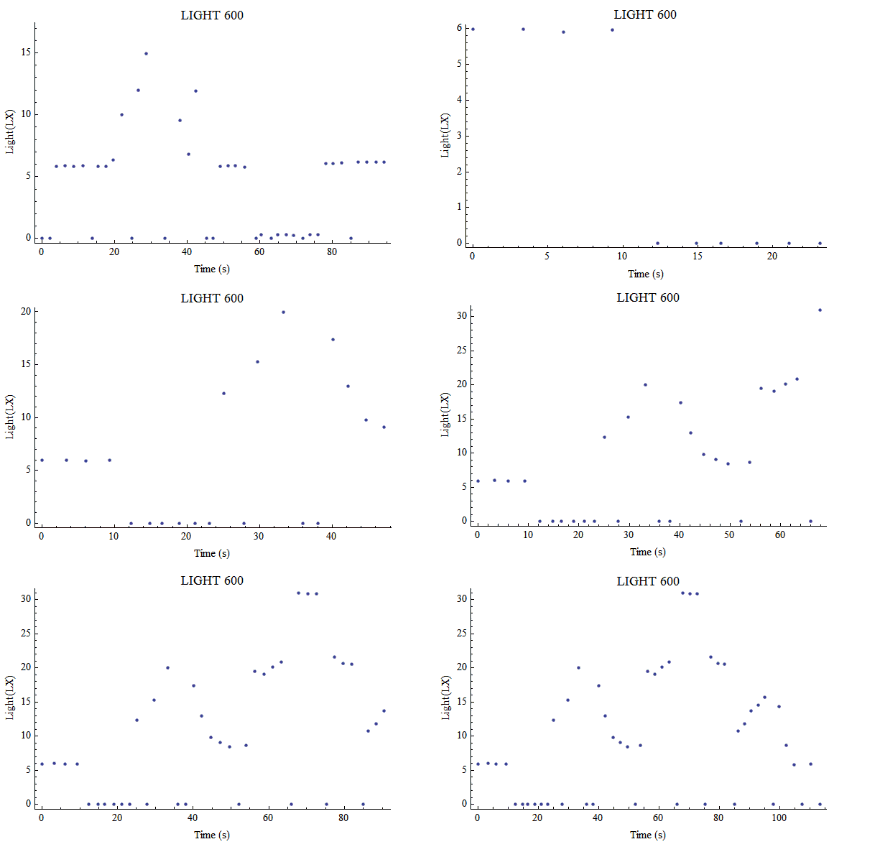
The code will even continuously update with the appropriate readings as you swap sensors! Similarly, you can make a plot update in real time, as shown below using a light sensor:
And this is just the start! There are an infinite number of ways now for this data to be analyzed and optimized with the Wolfram Language. You tell us—where would you go from here? Bob's web page also has some more great ideas for using the Wolfram Language and the Raspberry Pi for experiments (like building a spectrometer using Lego!). |

Death and Destruction: Overused Terms to Describe Publishing
|
First, it’s disrespectful to all the real cases presented in the news daily of actual killing and death. In case anyone has forgotten, we lost a prominent actor to heroin overdose recently, and news surfaced yesterday of a young girl being stoned to death in Syria for having a Facebook account. But more importantly, isn’t everyone tired of reading articles that claim one publishing model is killing another, or that the publishing industry as a whole is on the brink of bloody extinction? Critics and supporters alike have promised consumers that print is dead, ebooks are dying, digital publishing is taking over, self-publishing is killing…but what’s really behind it? Unfortunately, much of the apparent need to dominate comes from insecurities about the state of the industry. Publishers may feel threatened by the upstart nobodies who put out their own content, but indie authors are still furthering the stigma associated with self-publishing by clinging to the need to prove their worth instead of relying on the pride that comes from accomplishment. But as new surveys have revealed, writers are still writing, publishers are still publishing, and consumers are still buying books. The only thing we can say for certain is that the publishing industry in all of its forms is changing, and there’s no evidence at all that that’s a bad thing.
Death and Destruction: Overused Terms to Describe Publishing is a post from: E-Reader News |

eBook Review: Take a Chance by Abbi Glines
|
Self-published sensation turned traditionally published romance/erotic romance author Abbi Glines has created a side story in the book Take A Chance that pulls several characters from an existing series of hers and offers up some insight into their relationship. This new adult title, though, falls into the trap that has plagued a number of other titles in this genre. While the NA category was originally created by authors to give an edgier sense of realism to young adult and to differentiate between titles that are decidedly for preteens and teens and those that are intended for a more mature audience, it’s disturbing that the genre has been hijacked into erotica featuring people who may very well have not been old enough to vote in the last Presidential election. Characters in this book and many others being released recently–even by major publishing houses–feature some entirely too descriptive sex scenes (including unbelievably detailed and awkward “firsts,” usually for the female main character) involving characters who are under twenty-one years of age. Glines’ latest title is no exception. While finally treating her readers to the love story between two side characters, there were tones and details reminiscent of a famous and often talked about book by EL James. However, kudos do go to the author for breaking from tradition and not insisting on the pat formula that so many romance titles fall into. She carved out her own story line and arc, as well as her own unique ending. Take A Chance went on sale yesterday. eBook Review: Take a Chance by Abbi Glines is a post from: E-Reader News |

4% of Readers Read eBooks Exclusively
| eBook reading is on the rise, primarily due to the sheer amount of e-readers and tablets being adopted. The number of adults who have read an eBook in the past year has risen to 28%, up from 23% at the end of 2012. As much as digital reading has increased, print remains the foundation of the vast majority of Americans reading habits. Although there is a crossover of being reading both print and eBooks, only 4% of readers read eBooks exclusively. Borders went bankrupt and Barnes and Noble is closing many locations in the US. Total sales at U.S. bookstores have fallen 22% over the past five years. Things are bleak overseas with Weltbild, the second largest bookstore chain in Germany is going out of business and many in Australia and New Zealand have also disappeared. Amazon is often vilified as being the catalyst of these stores closing and often incurs the most ire. Reading in general is not declining, with 76% of American adults have read at least one book in the last 12 months. The typical adult normally reads 5 books a year and the average is around 12. All of these statistics lend credence to the fact that most readers are agnostic to digital or print. Worldwide, digital reading is accelerating, even though 4% of readers actually do it exclusively. Ebooks made up 17% of sales at Harper Collins unit over the holidays, up from 14% last year and nothing five years ago. Ebooks hit 33% of sales at the Hachette Book Group and 23% at Simon and Schuster. Worldwide, more people are reading eBooks, but they are still buying books at their local bookstore or second hand shop. Bookstores over their lifetime have basically had a monopoly on sales, but the industry has been disrupted by companies like Amazon, Kobo and Sony. This is prompting bookstores to free up bookshelves with lifestyle items, such as pillows, wine glasses and candles. No major bookstore, other than Barnes and Noble has actually made their own digital system. This is actually a bad thing, because bookstores aren’t substituting lost sales with digital ones. 4% of Readers Read eBooks Exclusively is a post from: E-Reader News |

Saturday, February 15, 2014
Transparency: Author HM Ward Discusses eBook Sales and Pricing
|
Now, another author has stepped up and released a detailed explanation of her experience with traditional publishing deals. Having to still rely on educated speculation regarding sales figures, author HM Ward surmised that the top selling titles on Kindle at any given time are probably selling between 5,000 and 10,000 titles each day. According to her average of 7,000 titles at the fairly standard pricing of $2.99, Ward indicates that a bestselling author would net about $100,000 per week of top sales, making a traditional book deal a fairly poor financial choice. Of course, as Howey’s explanation points out, not every author will by a top grossing writer like he and Ward. This is the reason that authors need access to accurate sales data from across the industry, not just their own title sales. Without this type of information, it becomes impossible to determine which course is better by genre, reader demographic, and more. Ward takes it a step farther, explaining that transparency around sales data isn’t enough. Authors need to know highly detailed budgets and plans for marketing of any given book before agreeing to sign a contract, a fact that she stood her ground on despite the high-pressure sales pitches and ominous threats to her career that she experienced from some Big Five publishers. Without having clear information on how the publishing house intended to promote her book, Ward opted for the self-publishing and higher royalty route, a choice that has made her an incredibly high ranking author despite having turned down over $1.5 million in advances in the past year alone. Unfortunately, the withholding of information is at best a tired out model from an industry that steadfastly refuses to adapt to the changing industry, and at worst an intentional effort to keep authors ill-informed about their own careers. Whatever the root cause of the issue, authors like Ward and Howey are making it more possible for authors to make sound decisions based on data, not whims.
Transparency: Author HM Ward Discusses eBook Sales and Pricing is a post from: E-Reader News |

Does the Publishing Industry Discriminate?
|
An article by Judith Rosen for Publisher’s Weekly this week indicates that African American bookstores are suffering, even during this month that is so typically a high point for sales due to the attention given the Black History Month. According to the article, the number of black bookstores who were members of the American Booksellers Association has resulted in more than 200 store closings in the last twelve years alone, down to 100 member stores from over 300 in 2002. Rosen pointed to certain economic factors, such as the destruction of major metro neighborhoods that at one time played host to bookstores who stocked black literature. That has been compounded by the loss of platforms like key magazines that at one time promoted black authors’ titles. But while it is the physical bookstores that are suffering, what is the correlation between that and the unequally low number of titles available on Kindle? Are publishers and self-published authors simply not writing and releasing books that speak to a specific market of readers? And if not, why not? One source in the article quite openly stated that black consumers simply don’t read as much, but that is too easy a statement to oversimplify, one that could quite easily be the result of a chicken-and-egg situation. Do publishers not produce as many African American titles because they, too, believe this? Or is the lack of titles that speak to the consumer the reason for this generalization? Recent news from a number of successful authors has made it quite obvious that self-publishing is the great equalizer in the book industry, one that is presumably open to authors from all walks of life. During this month of historical awareness, hopefully more concerted efforts will be made to open the doors of self-publishing to a far underserved group of readers.
Does the Publishing Industry Discriminate? is a post from: E-Reader News |

Tablet Sales Trend Discussed, Phablets Emerge Strong Player
| Despite reports of tablet sales reaching a plateau, a report tabled by NPD Display Search claims demand for tablet devices is expected to scale new heights in the coming years. The report, titled “NPD DisplaySearch Quarterly Mobile PC Shipment and Forecast Report,” claims there will be 315 million tablet devices sold in 2014, while the figure is projected to rise to 455 million by 2017. With that many tablet devices in use, it will translate to almost 75 percent of the mobile computing device segment. "Momentum for the tablet PC market is in full swing as it has become the dominant mobile PC form factor," said Richard Shim, senior analyst at NPD DisplaySearch. "Competition is expected to increase as traditional notebook PC brands, including Lenovo, HP, and Dell update their product portfolios to emphasize tablet PCs. Increased competition will mean more attention on, and development of, various segments of the market, which will ultimately lead to greater choice and devices that better fit the needs of consumers." The constant improvement in technology coupled with a general lowering of cost of tablet devices is being held as the prime factors stimulating growth of the segment. Tablet devices now offer not only enhanced processing power but also improved displays and better battery times to make for a thoroughly enhanced tablet computing experience over what it was even two years ago. Also, the next round of tablet growth is projected to be fueled in those regions where first time buyers will make up a significant proportion. Another interesting development witnessed in the tablet space is the rise in prominence of phablets, or big screen smartphones. These are typically less than 7 inches but have cast a doubt on the usefulness of the 7 inch tablet; possibly, all 7 inch tablets will offer voice calling capability in the future. This has led to the rise of the 8 inch tablet segment which is fast getting populated. Further, another size segment coming up is the one offering 12.2 inch or so of display which is targeted more at the professionals, academics, or artists. These will no doubt be priced more, and is yet in the early stages. The emergence of hybrid tablet/notebook devices will also be keenly watched over time, as these can turn out to be sizable players in the tablet segment, more so given the sharp decline that the notebook segment has witnessed over time.
Tablet Sales Trend Discussed, Phablets Emerge Strong Player is a post from: E-Reader News |

Aquafadas Announces the Launch of its New Cloud Authoring Tool
| Aquafadas has come up with a new cloud based digital publishing platform dubbed Aquafadas Cloud Authoring. This, Aquafadas claims will make it easy for publishers to convert PDF, JPEG, PNG and TIFF files into apps, ePUBs and Web Reader files. The new platform also offers several convenient features and simple production tools like crop and reorder, as well as unique enrichment features like Aquafadas Guided Reading that allows users to have “perfect content flow and optimize reader experience.” The cloud authoring platform also offers a one-click export option that makes for an easy means to distribute the final file output, which can be eBooks, magazines, and newspapers across various hardware platforms which can be tablets, smartphones or the web. “With the massive print-to-digital undertaking happening in the publishing industry, there is an urgent need for a digital publishing solution that automates tedious file conversions as well as simplifies the distribution processes. This is the essence of Aquafadas Cloud Authoring,” comments Thomas Ribreau, technical director at Aquafadas. “Automation, ease of use and speed are the three main ingredients in Cloud Authoring and they serve just about every digital publisher's needs. With Aquafadas Cloud Authoring, you can quickly and easily repurpose your existing content into an app or eBook regardless of your digital publishing technical knowledge. No additional resources or training needed. Aquafadas Cloud Authoring is the perfect solution for monetizing your existing content with high-quality results.” What makes the Aquafadas Cloud Authoring tool really simple to use is that it can be accessed from any web browser, which negates the need for Adobe InDesign or other applications. All that the publishers will be required to do is upload files into Aquafadas Cloud Authoring, “fill out the metadata, organize page layout and add enrichments…before purchasing the final product license, users can preview five pages of the document for free.” As Ribreau puts it, the Aquafadas Cloud Authoring tool can also prove handy for complex digital publishing projects as well. “With a bit of help from Aquafadas, publishers can to tap into Cloud Authoring's workflow engine to facilitate complex jobs such as batch-converting thousands of files or constructing template-driven publications in a matter of minutes, sometimes even seconds,” explained Ribreau. As for pricing, the Aquafadas Cloud Authoring can be had for a starting price of $130 for every file export. The pricing though is based on the type of licenses purchased. Catch up with the official PR below:
Aquafadas Announces the Launch of its New Cloud Authoring Tool is a post from: E-Reader News |

National Book Trust to Enter Digital Publishing, Start eBook Store
| National Book Trust, the premier organization in India that oversees promotion and publication of affordable books, has announced it will be making the transition to digital publishing soon. NBT further revealed it will also be launching an ebook store, details of which will be made available during the upcoming New Delhi World Book Fair. The first ebook that the National Book Trust will launch will be Swami Vivekananda- The Eternal Inspiration for the Youth. The book, penned by Professor Sandipan Sen, will be launched on February 17. NBT also stated it will have 500 titles available for download and can be read on iOS, Android, and Kindle devices or other computing platforms such as desktop PCs. The books will be in English, Hindi, and several other Indian regional languages. The latter bit is important considering the multilingual county that India is and it is imperative that ebooks be published in the popular languages for them to succeed.
National Book Trust to Enter Digital Publishing, Start eBook Store is a post from: E-Reader News |

Amazon on a Hiring Spree for Liquavista Engineers
| Amazon purchased Liquavista from Samsung in 2013 and the intention behind the deal was to offer a new breed of color e-readers.There is active development at Amazon right now that will give us a six inch screen, with the same resolution as the existing Kindles, but with a full color screen. One of the big benefits of this screen technology is that it doesn’t draw much power. We might see a new Kindle by the end of the year with a Liquavista screen, according to recent job postings by Amazon. Currently, Amazon is hiring for; Operations Program Manager (Asia based), Process Quality Engineer, Product Test Engineer, Process Development Engineer, Product Development Manager. These are obviously all senior level positions and the job descriptions mention working on multiple products at once. This leads me to believe that we will not likely see just one new Kindle this year adopting this technology, but a few. One interesting note is some of the positions entail working directly with the boys over at Lab126. This is the research and development arm of the company, who basically designed every single Kindle ever made. It will be interesting to see what Amazon does with the e-reader space with this screen technology. Obviously, color e-ink did not live up to the hype, because it could only display about a thousand colors, which made everything look washed out. If you look at the prototype Kindle screen below, you can get a sense of how content would look on a six inch e-reader.
Amazon on a Hiring Spree for Liquavista Engineers is a post from: E-Reader News |

iPad 2 Likely Headed to the Chopping Block
| It is time we bid adieu to the iPad 2. The second gen iPad that was launched in March 2011 was kept alive to tempt those who preferred a cheaper alternative to the more current models. However, with it being priced the same as the iPad Mini, Apple it seems is finally contemplating giving the ageing model a final bow. The iPad 2 was available only in the base 16 GB Wi-Fi only version and is priced $399, the same as the starting iPad Mini version. However, with sales diminishing – only 5 percent iPad buyers opted for the iPad 2 during the last holiday season – it perhaps is the right time to retire the model once and for ever. Nevertheless, it was really surprising the iPad 2 survived this long, three years since first launched which is quite a long when devices get antiquated in just a year. It has a user base of 38 percent even in the face of its more illustrious stable mates such as the iPad Air and iPad Mini. Also, the fact that it offered a low res display and an A5 chip did not deter buyers to opt for this model. Also, it was the first iPad model to come with a magnetic Smart Cover and was significantly lighter and thinner than the first gen iPad. Another first that can be associated with the iPad 2 is its incorporation of the face time camera that allowed users to make video calls with the device while also coming in the while color option on top of the traditional black. However, now that users can have the iPad Mini with retina display for the same price as the iPad 2, there has been a marked decrease in demand for the latter, something that should be weighing heavily in the decision to brings the curtains down on the second gen iPad. Or maybe Apple could price it even lower and position it to take on the huge army of low cost Android tablets.
iPad 2 Likely Headed to the Chopping Block is a post from: E-Reader News |

Jayme Gisbourne’s Porta-Pi
| Last Friday night I spotted a tweet with a picture of a Raspberry Pi running on a screen and mini keyboard concealed within a small hinged enclosure: I thought it was great! Then the next morning I spotted the very same box while wandering around the Cambridge Raspberry Jam – and was pleased to be able to see it for real – especially impressed when I discovered the maker behind the project was a 14 year old school boy. Jayme Gisbourne is a very bright and forward thinking fourteen year old. Over to Jayme… My name is Jayme Gisbourne. I first got into the Raspberry Pi world by not knowing what I was doing. I wanted to change one of my GCSE options to computer science (I want to be a Physics Engineer so I thought this would help with the engineering side of the job). It was too late to change options as a year had already passed since everyone started the GCSE and they thought I wouldn’t be able to catch up. In order to prove my self I wanted to start from extra curricular activities, e.g. coding clubs. My mum’s work friend is wedded to David Whale (A STEM ambassador, software engineer and a extreme coder) he managed to get me tickets into the Raspberry Jam convention in May 2013. I entered a competition, it was a quiz about the Raspberry Pi. I have had been picking up information all day about the Pi so I could show the computer science teacher what I had learnt and maybe he would allow me to join the class. With that information I won the quiz and a Maplin Raspberry Pi starter kit containing everything that I would need to use the Pi. Later that week I was accepted in to the GCSE computer science course and within weeks I caught up with the rest of the class. During the Raspberry Jam convention I met Sukkin Pang from SK pang Electronics which was also an old friend of my mum’s. He was presenting his Portable Pi and I was intrigued with the engineering side of the design. He used a laser cut base instead of a foldable case like mine. I would recommend that you check out SK Pang Electronics - they have a wide range of stock at reasonable prices (and no, he is not paying me to advertise him!). Since my introduction to the Raspberry Pi, it has taken my STEM interests so much further. I have been coding games like Space Invaders, a flashing LED game, etc… The Raspberry Pi has opened so many doors for me, I went on school trips to STEM meetings to show off my Pi, met so many STEM ambassadors and Raspberry Pi enthusiasts. The Raspberry Pi has made it easy for me to promote our schools Raspberry Pi club to other schools and Raspberry Pi clubs. The Raspberry Pi has also brought me into the STEM world. Without the Pi I wouldn’t know what I would be doing, the Pi has really improved my life educationally and throughout the STEM world. My biggest wish is to own and use a 3D printer, but they are way out of my ‘pocket money budget’. I could make so many more Raspberry Pi projects with one! Parts list:
Tools/Equipment list: If you are 3D printing obviously a 3D printer is needed, if you are using acrylic use a laser cutter or hack saw (make sure the hack saw blade has fine teeth, at least 18 teeth per inch).
It is advised that you have at least a basic knowledge of circuits and engineering, the wrong connection of wires could break your LCD screen or Pi also acrylic/Perspex is extremely brittle and it scratches easily so be careful. In the instructions I will show you how to make it out of acrylic/Perspex. Instructions: 1) First shorten the USB to mini USB cable so the overall length is approximately 3 inches. Solder the wire back together, leave the solder exposed, you will need this in the next step. 2) Get the LCD screen and follow the power cable past the fuse, past the power connector and solder the positive wire to the positive wire on the USB to mini USB power cable do the same with the negative wire to the negative wire on the USB to mini USB power cable: If you have correctly followed the instructions you have now completed the USB to mini USB power cable. Now cover the exposed solder joints with electrical tape, be sure that the negative and positives do not touch! Now we need to make the LCD screen with a 12 volt input run off a 5 volt input by bypassing the voltage regulator. 3) Remove the back plate from the LCD screen be careful not to damage the circuit board. Cut the positive wire (near the power connector) leaving some space to strip the wire, connect the now striped positive wire to the second terminal on the first capacitor. The next steps are really important! 4) BEFORE SOLDERING CHECK THE CIRCUIT IS CORRECT AND THE CURRENT PASSES THROUGH. TO CHECK IT USE A CONTINUITY TESTER TO SEE IF IT PASSES A CURRENT, IF IT DOES – TURN ON THE BATTERY AND CONNECT THE WIRE WE JUST MADE TO THE BATTERY, TOUCH THE POSITIVE WIRE (THE WIRE YOU JUST STRIPED) TO THE TERMINAL THAT PASSED THE CURRENT AND CHECK THE LCD SCREEN WORKS WITH A 5 VOLT INPUT. IMG_0002 It should look like this picture above. Now you have a portable Raspberry Pi! 5) For the case I transferred the now portable Pi (with out the screen, that’s something different, we will come to that later) on to a piece of paper. I found the most compact configuration and drew a box around it. Do this to all three dimensions. Use scissors to cut out the box that you have just drew on. Now you can use this as a template to cut all of the sides. Each dimension (height, width, length) you will need to cut out two of each except for the bottom panel (length) you will need four of them (we will need the other two later for step 9). 6) If you are using a hacksaw- create square angles with the engineers square mark the acrylic/Perspex with a scribe/scriber, if you want you could rub permanent marker ink into the scribed line so it is easier to see. 7) Now take one of the four bottom panels and using the Dremel cut off wheels, sanding drums and milling bits cut a hole for the mini wireless keyboard to fit in. Once in use the epoxy resin to keep the keyboard in place. *BEFORE ASSEMBLING ALWAYS FILE THE ACRYLIC/PERSPEX. USE THE DRAW FILING TECHNIQUE FOR THE SIDES OF THE ACRYLIC/PERSPEX!!!* 9) Now to make the top half follow step 5) you don’t need to make the top and bottom panels because you cut two extra for this step. To cut out the hole for the screen follow step 7). Use the protective 1mm thick plastic screen from the original LCD housing and push it off from the back. Place the screen over the now installed LCD screen in the case. 10) Now assemble the Pi using the correct adhesives. 11) Using paint, paint the hinges to match the case and Pi. Using epoxy resin to stick on the hinges to the case connecting the upper part to the lower part.        So there you have it – Porta-Pi! Stories like this make us very proud of the opportunities made for young people to become makers and engineers through Pi projects, as well as a gateway to STEM activity and career forming. Thanks to Jayme for providing instructions for us to share (we love sharing!), and thanks to David Whale and all others involved in guiding Jayme through his new passion. Here’s a picture I took at the Jam:  Jayme holds his Porta-Pi – and there’s Alex from RasPi.TV for scale |