| Spirit of Optimism Alternate history Technology misplaced in time Age of invention Mad scientist philosopher Automaton Science fiction Clockwork
Steampunk is a sub-genre and the newest literary child of science fiction. The term steampunk originated in the late 1980's when K.W. Jeter, author of Morlock Night, wrote a letter to Locus, a science fiction magazine. In his letter, Jeter shows his desire to select an appropriate word to describe his writing and the stories of others which were set in alternate past, but contained fantastical and futuristic inventions. "Personally, I think Victorian fantasies are going to be the next big thing, as long as we can come up with a fitting collective term… Something based on the appropriate technology of the era; like 'steam-punks', perhaps."- K.W. Jeter. So whether you are new to the genre or consider yourself a member of the modern steampunk culture take a moment to peruse our collection of classic and contemporary titles.
For Juvenile/Young Adult Steampunkers:
The Clockwork Angel, Infernal Devices Series, Book 1 (Cassandra Clare) Audiobook: London 1878: Sixteen year old Tessa Gray finds herself in a world of vampires, werewolves, and shape-shifters while on a journey to find her lost brother. Awards:Children's Choices Selection and Teen's Top Ten.
Airborn: Matt Cruse Series, Book 1 (Kenneth Oppel) eBook: Oppel's story of Matt Cruse and his wild adventures aboard a huge airship earned him literary recognition in 2005. Award: Printz Honor Award.
Fever Crumb, Predator Cities Series, Book 1 (Phillip Reeve) Audiobook. Fever Crumb is a beautiful orphan with a mysterious past and the only female apprentice in the Order of Engineers. Awards: Booklist Top Ten Science Fiction/Fantasy Novels for Youth and Amazing Audiobooks for Young Adults.
Renee Lienhard is a Collection Development Analyst with OverDrive
 |
Tuesday, August 27, 2013
STEAMPUNK: Stories That Play With History (Part one)
 Steampunk!: An Anthology of Fantastically Rich and Strange Stories
 Magic Under Glass
Le French Book: “There Is No Paper Versus Digital War”
| Digital-first publisher Le French Book doesn’t really have a stake in the digital-vs-print book battle, as its primary focus is simply to ensure that contemporary French new releases are translated and made available in markets outside the country. But with a new print acquisition, The Paris Lawyer, the publisher is ensuring that titles reach non-French speaking audiences everywhere, regardless of the format readers prefer. "Our goal is to expand a book's reach, not choose between different formats,” said Le French Book’s co-founder and CTO Fabrice Neuman in a press release today. “A book is a book is a book, whatever form and shape it can take. We don't want to segregate readers. We want to provide everyone with entertaining reads." The publisher is returning to its roots by securing the print distribution rights to the first title it released, The Paris Lawyer. "It's a great book to experience France with both suspense and mystery and it's a meditation on the nature of love and whether we can ever escape the past and reinvent ourselves. This gives it a universal quality," said founder Anne Trager says. "It's been well received as an e-book and our goal is to get it into the hands of more readers." The title has already enjoyed success both within the country and outside of its original market, and has been available as an ebook for some time. The title is available through all major ebook distribution channels and for library lending through OverDrive’s partner libraries.
Le French Book: “There Is No Paper Versus Digital War” is a post from: E-Reader News |

New Video from JK Rowling to Celebrate Harry Potter Anniversary, Language Releases
| Can you believe it’s been fifteen years since the US release of the first book in the global phenomenon that became Harry Potter? Here, author JK Rowling speaks on the book series in a never before seen interview. This video was released today, along with the news that the ebooks of the popular series are now available in even more foreign language translations, and that the Pottermore website is also now compatible in Portuguese.
New Video from JK Rowling to Celebrate Harry Potter Anniversary, Language Releases is a post from: E-Reader News |

Amazon is Running Out of Kindle Paperwhites – $139 Model Gone Now Too
| Yesterday I reported about how Amazon had suddenly stopped selling the $119 Kindle Paperwhite with Special Offers, that it was only available used and there was no mention of a return date when it would be back in stock. Now the $139 non-ad Kindle Paperwhite is gone too. It disappeared yesterday evening, less than 24 […] |
Babbage’s big jump: the aftermath
| If you were following the live feed and our live tweets on Saturday, you’ll know that Babbage the bear’s attempt to beat Felix Baumgartner’s stratospheric parachute jump with a couple of Raspberry Pis was a bit of a curate’s egg. It was a very blustery, cloudy day at the launch site, and while Babbage made it into the stratosphere (beating the world record – also held by Dave Akerman, who was behind this weekend’s launches – for highest pictures transmitted live from an amateur device), he did not separate from his platform properly, so rather than leaping into the void, he plummeted, platform and all, when the balloon burst at 41.109km, and fell to earth under the tatters of the balloon. We were able to use GPS to work out where he had landed (in the middle of a barley field somewhere in rural Berkshire), and retrieved him. Here are some pictures from Saturday (thanks to Anthony Stirk for the pictures which I didn’t take – you can tell which ones they are, because I’m in them): 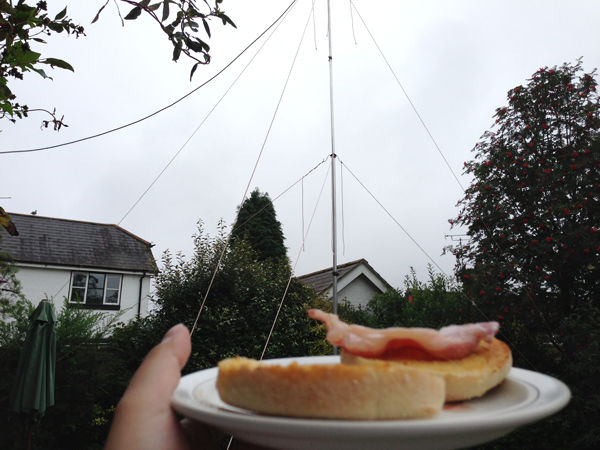 The day opened with a bacon muffin. And a radio mast.  It was a VERY blustery morning. Here Dave struggles manfully against the wind, which is trying to blow our balloon into a bramble patch just after filling, before the payload had been attached.  Despite planning every minuscule detail, Dave forgot to make a capsule for Babbage’s parachute. Fortunately, there was an empty Smarties tube in the back of our car. Dave recorded a time-lapse video of the preparations for launch (and selected a doozy of a frame for the still you can see now – not impressed, Dave): 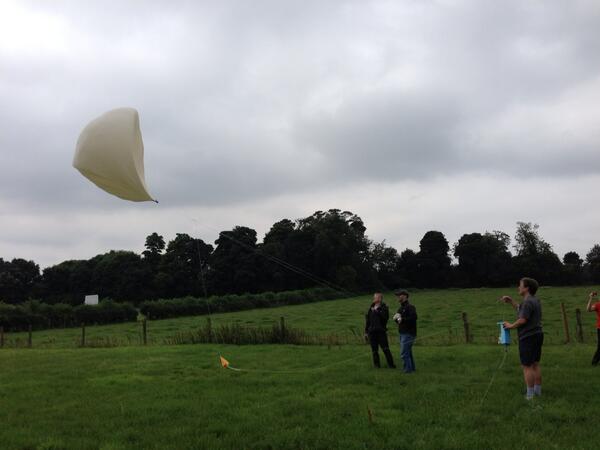 We ended up using three lines to stabilise the balloon for launch. 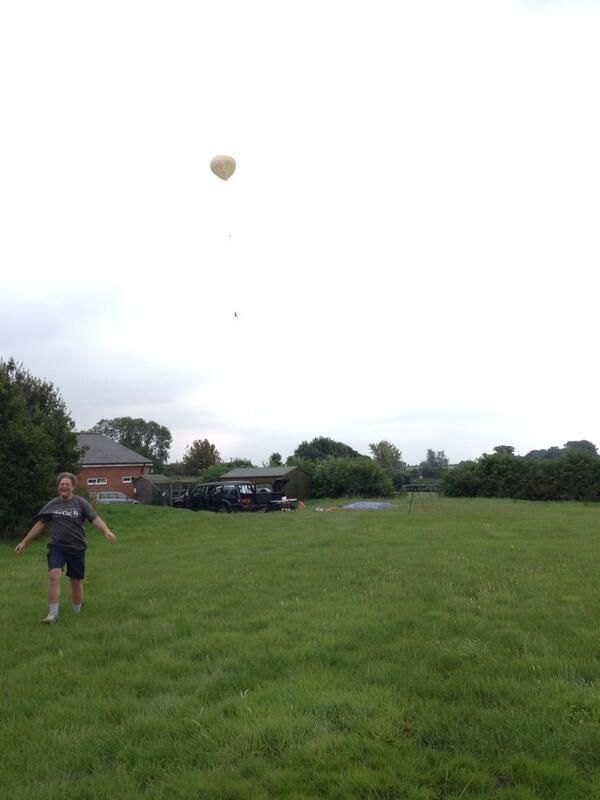 Babbage got away safely. Dave does a happy dance of glee. Here’s the launch in all its very windy glory: We retreated to Mission Control (Dave’s house) to monitor the flight. 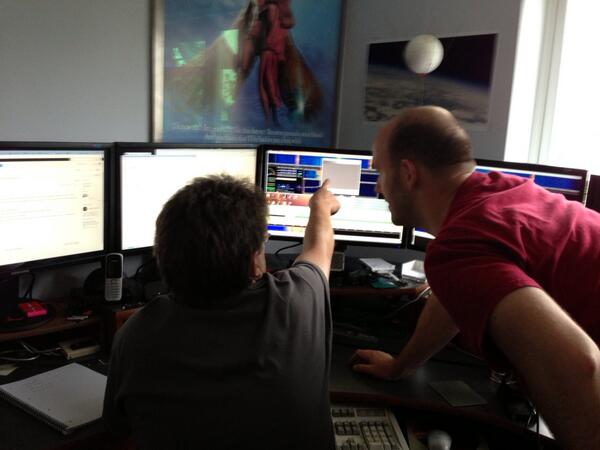 Back to Mission Control (Dave’s house) to watch data coming back from the payload.  Both the capsule and Babbage himself were equipped with Raspberry Pi camera boards. While waiting for the balloon to burst, we were able to watch images like this streaming back from the stratosphere. Dave’s currently uploading all the pictures taken from both parts of the payload to Flickr. An hour’s driving towards a GPS location and a half-hour’s scramble through hedges and fields later…  We had to climb through a few thickets full of brambles and nettles from the car before we could get to the barley field where Babbage landed. Dave went to get the wreckage alone so we didn’t disturb the farmer’s crop. As you can see, the separation hadn’t worked – all the bits of the payload are still attached to each other.  And this resistor is why. A program trips in the Pi at 39km up and sends current through it, which is meant to heat the whole assemblage up and melt the nylon cord. It has 5 seconds to get from -50C to +200C – which wasn’t enough at 39km up. As you can see, no melting occurred. For the next launch, Dave added more batteries, which worked like a charm.  Back at the car. If Eben had hair, it’d look like he’d just crawled through a bush too. (Mine looks like I’ve just crawled through a bush because I’ve just crawled through a bush.) So Dave, dissatisfied with the performance of that 5p resistor, decided to launch again on the Bank Holiday Monday. (We didn’t join in this time, largely because it’d have meant another drive of some hundreds of miles.) And this time, the separation worked like a charm. Dave’s second attempt on Monday ended up being covered by the BBC, the Independent and the Register, so you can read all about it there. He’ll be being interviewed on BBC Radio Berkshire this evening from 4.30pm for a few minutes – and the BBC is also sending someone from Click (the radio edition) to chat to him later on today. He’ll also be updating his own site with a report on the flight later on – check back soon! If you want a Babbage of your very own, whether you want to send him into near-space, or whether you just fancy something to cuddle, you can buy him at the Swag Store. All profits on Pi merchandise go straight back into funding the Raspberry Pi Foundation’s educational work. And Babbage is just the right size to be hollowed out and filled with a Pi, batteries and a camera board, and just the right weight to be put under a balloon and sent into the stratosphere to take some amazing pictures. |

Monday, August 26, 2013
Helicon Books Announces New Social DRM for eBooks
| Helicon Books, an ebook technology and services company from Israel, announces a new service for publishers: Social DRM. Social DRM is a solution for publishers who wish to protect their ebooks and prevent copyright violation at reasonable prices. The new Social DRM platform is going to be announced at the Frankfurt Bookfair in Germany in October and Good e-Reader will be live on the scene. The essence of this technology is that it stamps the book with the buyer’s name. The visual information can appear in text or an image, according to the publisher’s needs. One creative way to present Social DRM is through a personal dedication from the buyer to someone he wishes to give the ebook. The Social DRM is also hidden inside each chapter in the ebook. This hidden information can only be recognized by a software. Social DRM intends to prevent end customers' use of an ebook in an illegal manner. When the digital book is personalized and stamped with the customer’s name. This will discourage people from uploading their eBooks to torrent and file sharing websites. What is the difference between watermarking and social DRM? Not much, Helicon is hyping the fact their technology is less obtrusive and their books are easier to share among users. They know people want to loan books out to their friends and Social DRM does not detract from the reading experience. Helicon Books Announces New Social DRM for eBooks is a post from: E-Reader News |

Now You Can Buy Back Issues of Shonen Jump
| Viz’s digital magazine Shonen Jump carries a variety of popular manga series—Naruto, Bleach, One Piece—as well as some lesser-known titles such as Nisekoi and One Punch Man, in weekly (or sometimes monthly) episodes the same week they come out in Japan. Since the collected print volumes lag behind the digital serials, that can make jumping in a bit of a challenge. Until now: Viz has just announced that it will make the last three month’s worth of back issues of Shonen Jump available at the regular price of 99 cents per issue. The back issues can only be purchased on their Vizmanga.com website, but once you buy them, you can read them on any device that supports Shonen Jump. Also, as they announced earlier this summer, Viz is making Shonen Jump available in the UK, Ireland, Austraila, New Zealand and South Africa. They posted an article today with pricing and other information, including where you can get it: For now, readers outside North America can purchase it via the iTunes Newsstand app or the Viz iOS or Android apps—not through the website, which means they won’t be able to get to those back issues just yet. But maybe soon… Now You Can Buy Back Issues of Shonen Jump is a post from: E-Reader News |

Comparing Reading Features on Kindle Fire and Kindle Android App – A List of Differences
| One question that comes up frequently here on The eBook Reader.com is about the differences between the Kindle Fire HD and Kindle for Android app when it comes to reading features. I notice people questioning the differences when trying to decide between the Kindle Fire and some other Android tablet like the Google Nexus 7 […] |
Children and Audiobooks: Clear Educational, Enjoyment Benefits
 Photo courtesy of kidsintrance.com When ebooks first evolved into the digital editions that readers consume today, children were often left out of the mix. Parents weren’t eager to put expensive devices into the hands of young readers, and a cycle ensued as publishers didn’t create an abundance of content in the children’s publishing sphere. Now that the original stigma against children’s ebooks is dissolving, parents and educators are looking at new ways that children can best utilize literacy materials, including audiobooks. While children’s publishing has long used read-alongs, those colorful story books that came with an accompanying cassette or CD, a new push for children to enhance their literacy and vocabulary skills through strictly audiobook stands to help readers make strides in fluency, comprehension, and thematic recognition. A post by children’s publisher Scholastic outlines some of the benefits to children’s audiobooks, most notably perhaps being the erased stigma of a student reader having to use lower-level texts; once a student is listening to an audiobook, his peers have no way of knowing what he’s reading and if that book is far easier than books read by the rest of the class. Whereas as a struggling reader might have shunned all efforts at reading due to having to demonstrate his lack of ability for his classmates, now he’s encouraged to read under the anonymity provided by audiobooks. For the complete post by Scholastic on the benefits of audiobook use by children, click HERE.
Children and Audiobooks: Clear Educational, Enjoyment Benefits is a post from: E-Reader News |
OverDrive end user survey results – Spring 2013
| Earlier this year, OverDrive surveyed 70,000 end users around the world to learn how they interact with their library's digital collection. This survey offers insight into who eBook users are and how they are using digital titles. At Digipalooza, OverDrive shared the survey results and we're excited to share them with those who couldn't attend Digipalooza. Here are some key data points that we learned:
Thank you to everyone who participated and stay tuned for another survey next year!
Adam Sockel is a Marketing Communications Specialist with OverDrive  |

Back to School Tablet Buying Guide
| It is that time of the year again when parents and students buy their supplies for the upcoming school year. With tablets being in vogue, these no doubt have superseded laptop and notebook devices as the preferred choice of mobile computing devices. However, with tablet devices that are to be used by the student community, it is perhaps those that come with an attached keyboard that might be better suited. The description of some of the tablet devices (both standalone as well as those with an attached keypad) can help consumers make a choice that fits their educational needs. For the Budget-Conscious Segment: Google Nexus 7 The new Nexus 7 is thinner, lighter, and a more powerful (.5GHz Qualcomm Snapdragon S4 Pro CPU/2 GB RAM) device than the original Nexus 7. The 7 inch display is brighter and more spectacular (1,920 x 1,200 display) than before. On-board storage can be either 16 or 32 GB, with Android 4.3 Jelly Bean providing the OS support. It is at a convenient $230 starting price. The reason why it's mentioned here is that it is compact, handy, portable, and powerful, while still being quite cheap. Kindle Fire HD 7 The Kindle Fire HD 7 is another tablet that is light on the hands as well as the pocket. The display is among the best out there and is backed by one of the most well stocked web stores, offering one of the best collections of ebooks, which can be important for use in the education environment. However, the tablet is too closely tied to the Amazon store front and this can be its biggest or worst credential depending on which side of the fence you’re on. Prices start at just $160, and are available in memory size options of 16 and 32 GB. For the Mid-Range Segment: Samsung Galaxy Note 8.0 Price might not be the biggest benefit of the Galaxy Note 8.0, though it makes up for that in other areas. These include the S Pen stylus that it comes with it, which will allow for some serious note taking, something that should come extremely handy for students. These notes can also be easily shared or stored in the cloud for later reference. It's thin and light, which along with the size makes it just perfect for stylus operations. With an Exynos 1.6 GHz Quad-Core mated to a 2 GB RAM, users can expect top notch performance. The pixel-rich (1280 x 800) display also makes for easy comprehension. However, it doesn’t come cheap, priced as it is at $400 for the base version. The Note 10.1 version is slightly more bulky and more pricey. Apple iPad/iPad Mini These two tablet devices perhaps have the highest appeal among consumers. To begin with, there are plenty of educational apps, course materials, lectures, magazines, books, and more that can make the Apple tablets great devices. The only factor to consider here is the screen size, available as these are in two size options of 9.7 and 7.9 inch. Also, being Apple devices, factors such as performance and quality should beof little concern. However, with there being a new and improved iPad 5 and iPad Mini 2 coming soon, not everyone might feel comfortable enough to invest in a device that's sure to become outdated soon. The iPad and iPad Mini range start at $499 and $329 respectively. Kindle Fire HD 8.9 Qualities in its favor include a nice 1080p display, decent levels of performance along with the backing of the Amazon store. However, as has already been stated, the last point would mean remaining stuck with only the Amazon app and ebook store. Price starts at $399 and it is available in memory size options of 16 and 32 GB. HP SlateBook X2 Here is a tablet with a nice 1080p display, together with great performance brought about by a Tegra 4 chip which makes for a very compelling choice in the mid-range segment, more so for Android addicts. A strong point with the tablet is its battery life which can easily be the best out there. This is aided by the extended battery life brought about by the separate battery unit attached to the keypad which should allow the students to make the best of the device without running out of charge. The added keypad unit should also appeal to those who have to type a lot. The keypad unit also houses quite a few extra ports which make for additional connectivity options. To be available in both 16, 32 and 64 GB variant, the range starts at a decent $479 for the base version which includes the keypad dock. HP Envy X2 Here is another tablet that is a lot like the SlateBook X2 but runs the Windows 8 operating system. As expected, battery life is big in the Envy X2 thanks to the twin battery units fitted inside the tablet and keypad unit of the device. However, in what can be considered to be the biggest bane of the device, it has an Atom dual core heart which hampers performance. While the tablet would suffice for most operations, performance fans will no doubt be disappointed. The device otherwise is light and quite handy. Onboard storage options include 64 and 128 GB with prices starting at $600. Money is No Object: Surface Pro Here is a tablet that can be as good as any ultrabook out there. Sure, it's a bit heavy both on your arms and your pocket, but it’s able to make up for those with its superb performance thanks to an Intel Core i5 heart and exemplary built quality. The device also includes a stylus and is available in memory size options of 64 and 128 GB. However, the biggest concern with the tablet is its paltry battery life of only about 4 hours. Meanwhile, Microsoft has also been trying to entice the student community with its Surface RT device by offering hefty discounts, though the lack of quality apps seriously inhibits its acceptance among students. Samsung ATIV Smart PC Here is a hybrid tablet device with ultrabook like performance. It can satisfy even the most ardent of performance fans with its 1.8 GHz Intel Core i5-3337U processor and 4 GB of RAM combination. The device includes a stylus while the hard keyboard (unlike the Surface Pro keypad) allows for convenient data entry. However, the device continues to be dogged by battery life issues, which lasts no longer than 7 hours. If that is not enough, it's not cheap either, priced as it is at $1,200 for the base model.
Back to School Tablet Buying Guide is a post from: E-Reader News |

Swedish Company Revolutionizes EU eBook Lending
| As US publishers and libraries still struggle to create a mutually beneficial yet fluid ebook lending model, Swedish company Atingo thinks they have the solution, one that has worked in several thousands public and school libraries in both Sweden and the UK. By recognizing ebooks not as a commodity that can be bought, sold, and consumed, but rather as a service item with pricing structures to go along with it, Atingo feels they have brought a whole new perspective on ebook lending, one that can and should work around the world. According to a guest post by Jonas Lennermo for Publishing Perspectives,”Publishers look at e-lending as a threat to their business, arguing that it might cannibalize print sales or even block the rise of a commercial ebook market altogether. Libraries on the other hand, may lose their role altogether if they lose access to ebooks. The only thing that is bigger than their mutual fear, is the mutual opportunity for collaboration.” Atingo serves as an interface between libraries and publishers, allowing publishers the freedom to price their ebooks as they see fit for library consumption. For their part, libraries know that they are providing up-to-date and sought after digital content to their patrons without having to direct them to a third part site for lending. Where Lennermo’s model might not take hold in markets like that in the US library arena is in his belief that both publishers and libraries are so small that they need each other. While companies like OverDrive have conducted studies that prove the benefits of library lending–especially in terms of book sales, sequel sales, and patron loyalty to authors–the US publishing model has long been criticized as being slow to adapt and reluctantly incorporating new technology. Publishers as of yet are working to adopt ebook lending on a larger scale, but have not wholly embraced it across the board.
Swedish Company Revolutionizes EU eBook Lending is a post from: E-Reader News |

$119 Kindle Paperwhite No Longer Available from Amazon
| Here’s an interesting twist. As of this morning, Amazon is no longer selling the base Kindle Paperwhite, the cheapest model that comes with Special Offers that normally sells for $119. The $139 Wi-Fi Paperwhite without Special Offers is still available, as are both 3G Paperwhites. But what happened to the other one? It might very […] |
Sunday, August 25, 2013
Back to School: Digital Comics for the Common Core
| As students head back for the start of school, teachers and administrators have something new on their minds: The Common Core, a set of educational standards that are being rolled out in 45 states. There’s a lot of debate around the Common Core, but nonetheless, it’s the educational trend du jour and will be with us for a while. Savvy teachers have been using comics and graphic novels in the classroom for a while now, and the folks at Diamond Comics Distributors have come up with a list of comics and graphic novels that tie in to the Common Core. Their list includes a downloadable spreadsheet that gives grade levels and subject tie-ins for each book. Here’s a sampling of what’s available digitally. (Links are for comiXology and Dark Horse Digital, but some of these are available in the Kindle, Nook, Kobo, and iBooks stores as well.) Pre-K through First Grade Power Lunch: First Course Second Grade and Up The Wonderland Alphabet Third Grade and Up Age of Reptiles Omnibus Fourth Grade and Up Chimichanga Fifth Grade and Up Cow Boy: A Boy and His Horse Sixth Grade and Up The Last Dragon Seventh Grade and Up The Adventures of Superhero Girl Ninth Grade and Up Nevsky: Hero of the People Tenth Grade and Up Dotter of Her Father’s Eyes Back to School: Digital Comics for the Common Core is a post from: E-Reader News |

Digital Comics Best-Sellers for August 25th 2013
| It’s time to compare and contrast the digital comics best-seller lists. What will we learn today? 1. Injustice: Gods Among Us #32 DC wins the top ten this week, with six titles, while Marvel has four and Image has that old faithful, The Walking Dead. 1. Injustice: Gods Among Us #32 Well, it looks like the Injustice: Gods Among Us have discovered Kindle; usually only the early issues make the Kindle best-seller list, but this week we’re seeing a good handful of the most recent issues. Batman: The Killing Joke topped the list last week and we see it lingering at number 10 this week, while Batman: The Dark Knight Returns stays solidly in the middle. And eons after it debuted, people are still picking up the first volume of The Walking Dead. Go figure. 1. Injustice: Gods Among Us #32 This is almost exactly the same as last week’s list, except that the issues of Injustice: Gods Among Us are shuffled. iBooks 1. Injustice: Gods Among Us #32 Of the three e-book platforms, this has the most varied top ten list, and it’s hard to imagine a more bizarre juxtaposition than My Little Pony sitting between Batman: The Dark Knight Returns and Watchmen. I guess it just goes to show how eclectic iBooks readers are. One notable book that pops up here and nowhere else is part one of March, the memoir of civil rights pioneer Rep. John Lewis, who is the last surviving speaker from the 1963 March on Washington. It has been getting a lot of attention in the media (deservedly so—it’s an excellent book) and the print edition topped the New York Times graphic books best-seller list, so it’s good to see people are buying it digitally as well. In terms of market share, Marvel is completely absent from the three e-book platforms. In fact, the first Marvel book to appear in the Amazon rankings is at number 25 (they had a few that made the top ten a couple of weeks ago because of deep discounts). Injustice and Batman have a lot to do with this, but it’s sort of amazing that Marvel didn’t crack the top ten for Kindle, Nook, or iBooks this week. This may have to do with comiXology having an exclusive on Marvel single-issue comics, which I assume includes their digital-first comics, while DC is selling their 99-cent Injustice issues by the truckload. Digital Comics Best-Sellers for August 25th 2013 is a post from: E-Reader News |

eBook Review: This Girl by Colleen Hoover
| Verdict: 3 Stars Colleen Hoover’s This Girl (Atria) is book three of her Slammed series, a new adult romance that features Will and Layken. In this book, she wraps up the series by retelling the events of book one and two from Will’s point of view, artfully giving readers a different viewpoint on events that fans may already know. This book was a tough one to rate. Taken just on the merits of the writing style and the quirkiness of the format–every other chapter alternates between playing a scene from the Layken and Will’s past, and a scene from their present–it was a solid read with a lot of entertainment value. Hoover also very masterfully writes a third book in a series without leaving first-time readers in the dark while also not having to resort to lengthy infodumps to keep new readers up to speed. Where the book fell apart for me was in the highly implausible subject matter of a love affair between a high school student and her teacher, albeit a student teacher, but one who happens to live across the street and be friends with her mom. Somehow both Layken’s best friend and her mother know that the teacher is in love with the girl, but that does absolutely nothing to stop the mother from letting her daughter spend the night at the teacher’s house. Yes. Her eighteen-year-old high school senior spends the night at her hot, male teacher’s house, and Mom’s only concern is to call over her shoulder to the teacher, “Make sure you sleep on the couch.” Of course–spoiler alert–he goes straight into the bedroom and curls up in bed with the girl. There were a few other disturbing elements in the story. We do learn at the beginning of the book that Layken and Will are married now, something that Will himself wars over throughout the book as he realizes that it is horribly inappropriate for him to date his high school student, and his internal battle is the full knowledge that it is wrong for someone in his position to be in love with a young girl. Also, there are little dropped hints scattered through the book that actually set off alarm bells for me, like the scene in which Will (the teacher) beats up a male student who he sees making out with a willing Layken. He also makes statements such as “ordering” Layken to wear only what he tells her she will wear on their honeymoon, “allowing” her to bring one outfit, the one she happens to be wearing at the time. Sexy? Romantic? No. Creepy? Domineering? Yes. The stage is nicely set for this to NOT be a romance as Layken’s father had died only months before she met Will. It doesn’t take a psychology degree to figure out that she falls for her male teacher only months after losing her dad, a story element that is decidedly the opposite of romantic. Will there be a fourth book in which Layken grows up a little bit and realizes she was only transferring her feelings of loss onto the nearest father figure in her life? But This Girl is certainly a well-written book, even if the subject matter is a little stomach-churning, and it will be a quick read for devoted fans of the New Adult genre, one that is certainly pushing the boundaries of what’s considered safe, mainstream story lines. This Girl is available now from ebook and print retailers.
eBook Review: This Girl by Colleen Hoover is a post from: E-Reader News |

British Library Partners with NLB Singapore to Digitize Rare Malay Manuscripts
| The British Library has joined hands with the National Library Board in Singapore with the aim of digitizing an extensive collection of materials related to the island state. This includes Malay manuscripts considered to be extremely rare, which includes a Malay letter written in golden ink in 1857 by the ruler of Johor, Temenggung Ibrahim, to Emperor Napoleon III of France. Among the other materials that will also be part of the digitization process include early maps of Singapore, as well as archival material of the British official Sir Thomas Stamford Raffles who is credited with establishing the city of Singapore. "This collaboration allows the National Library to explore the wealth of information in the British Library's Southeast Asian collection, especially materials which are of interest to Singapore. Our users will be able to easily access rarely seen documents relating to the rich history and culture of Singapore and the region. It has also been a most rewarding experience for our staff to have the opportunity to engage with the collection and work with colleagues at the British Library," said Mr. Gene Tan, Director, National Library Singapore. Funding the project will be William and Judith Bollinger, who have donated £125,000 towards the completion of the digitization work over the next five years. The first phase is already underway and is aimed at digitizing the more than one hundred rare Malay manuscripts and letters that date back to the 17th through 19th centuries. All of that will now be accessible in the form of over 16,000 high resolution images from the NLB's BookSGsite as well as the British Library's Digitized Manuscript website. Speaking about the digitization effort now underway, Annabel Gallop, Lead Curator for Southeast Asian Studies at the British Library said, "Thanks to the generosity of the Bollinger family, we will be able to make the British Library's collection of Malay manuscripts available to researchers across the world. It is fantastic to be able to work with colleagues at the National Library Board of Singapore to ensure that all those with an interest in Malay cultural heritage are able to view them. We look forward to working with the NLB as the project progresses.” Meanwhile, the National Library Board in Singapore has announced it is now the host of over three million ebook titles. That is about an eight fold jump from the 400,000 titles it started with back in 2005. That figure should compare favorably with the around 4.9 million physical books, magazines, and other content that the NLB holds in its libraries, which are housed in twenty-six locations around the island. The loan rate of ebooks has also seen a marked rise in recent times, with 4.9 million ebook loans recorded between 2010 and 2011, an increase of 25 percent. Of course, the book count will continue to grow as efforts are already underway to add about 800,000 more titles by end of 2013. A subscriber of the library can now log in to the library site, select a particular title, and click borrow. Users have the option to borrow up to six books for free. The ebooks get returned automatically once the due date is crossed. Patrons also have the option to reserve an ebook if it has already been borrowed by someone else.
British Library Partners with NLB Singapore to Digitize Rare Malay Manuscripts is a post from: E-Reader News |

Vote Pi!
| We’ve been nominated for the People’s Choice Award in next week’s Index Award: Design to Improve Life. The competition makers have encouraged us to share the news with you, and we’d be really grateful if you could visit CNN’s page about the awards and click on the Pi button. The Index Awards are a very big deal for us: they’re the world’s biggest design awards, and we were overwhelmed to be told we were finalists in this year’s event. Although it’s not the prettiest computer ever, the philosophy behind the not-for-profit Raspberry Pi Foundation – a desire to make sure that later generations have the technical skills needed for a successful future, and a desire to see the price of computing and commercial electronic devices fall until they’re accessible to absolutely everyone – is something we’re very proud of. So please vote Pi. Thank you! |

Saturday, August 24, 2013
What’s Wrong with a Little Healthy Book Discussion?
| All we keep hearing from the world of successful, bestselling indie authors is that they owe their success to their fans who are active on social media. Readers have embraced the access they have to their favorite authors, relishing in the Facebook interactions, Twitter chats, live Google Hangouts, and more. So what’s wrong with an author responding to a book review, much as he would respond to a Facebook post? This practice has firmly divided the world of authors and readers, with some authors stating they make it a known practice to respond to reviews, while others state that an author should never delve into discussion of what a reader thinks of his book. This belief has become so entrenched in the book world that it has been blamed for so-called “BBA” status for some authors, otherwise known as Badly Behave Authors. Being labelled as a BBA on the widely used book discovery site Goodreads is enough to make an author the target of violent remarks, smear campaigns, and worse. One of the more well-known authors who makes it her practice to respond is Elle Lothlorien, author of several bestselling titles including the soon-to-be-released Gilding the Lily Pad. Lothlorien, who first wrote about this practice in 2012 for Digital Book World in an article called “When You Wish Upon a Star, You Get the Pointy End (Part 1): Why Authors Should ALWAYS Respond To Negative Reviews,” was surprised by the venomous response to her suggestion that this level of interaction between authors and reviewers is actually good for books. Lothlorien was willing to speak for this article, “Since I am definitely one of the ones they waged a war against (my books are still on, like, twenty ‘blacklists’ on GoodReads, including “Author Behaving Badly” and–my fave–’Never Ever Big Brother’.” “Responding to negative reviews is becoming more mainstream and accepted (dare I say “fashionable?”). It wasn’t until that blog was named to DBW’s “Top 10 Digital Publishing Stories of 2012″ in December that authors started coming out of the wood-works and either admitted that they’d been doing it all along or wanted to know how to do it. In a radio interview on Authors on the Air a few months ago, bestselling author Martin Crosbie openly admitted on live radio that he responded to negative reviews because he read my blog and it made good business sense to him. At the last few conferences I’ve been to, there have either been authors who have openly admitted that they do this (Colleen Oakes, bestselling author of “Elly in Bloom” at the Indie-Pub Extravaganza in Denver) or entire PANELS were conducted on the topic.” And Lothlorien does raise a very valid point with one caveat: the response from the author must be professional. Many of the targets of some of the so-called bullies have made argumentative remarks or have been accused by these bullies of enlisting friends and fans to do this dirty work of calling out a reviewer for a negative review. While reviewers and some of the alleged bullies have made the excellent point that writing is a business and therefore authors are businessmen, then reviewers don’t get to have it both ways. Either authors are responding to their “clients” customer service complaints, or they are artists who should stand back while the world appreciates or criticizes their work, in which case they are not to be expected to behave like businessmen. In either instance, one would hope that all of the remarks from reviewers and authors alike can be made with some measure of dignity, insight, and basic manners.
What’s Wrong with a Little Healthy Book Discussion? is a post from: E-Reader News |

Indie Authors Need to Develop a Thick Skin for Bad eBook Reviews
| Self-Published authors often have to do a great deal more then simply writing and distributing their titles to online bookstores. They often to have to wear the additional hat of a marketer, and hype up their titles via social media and through interacting with their growing fan base. All authors, traditional or indie, have had to deal with negative book reviews and often have to develop a thick skin to not take these reviews personally. In some cases, massive online campaigns are launched by angry people and internet trolls who ruin careers and drive authors away from publishing. Author Matt Haig wrote a wonderful article on the Book Trust website in which he talked about being a thin-skinned writer. He said: "The paradox is that while having a thin skin might make for better writing, it is not good for the process of being published. I have a new book out next week. There will be reviews. The bad ones will trouble me more than they should. Just as that one tiny hair you find in your peanut butter makes you want to throw away the whole jar.” Negative reviews are a fact of life when you are dealing with the internet in general and readers who are hiding behind anonymity. One of the worst things an author can do is engage the obvious comments full of hate, as it leads to the pitchforks coming out. There have been many cases in which an author got very emotional reading comments that transcend an honest review and end up being personal attacks on the author themselves. Recently, author Lauren Howard made the decision to pull her debut novel from publication after a firestorm of hatred–including what she initially claimed to have been rape and death threats on GoodReads. Should authors even bother engaging people who write negative or positive reviews? Professional digital reviewer Denise Enck mentioned, “If someone leaves a good or bad review, don't comment. Reviewers don't like to think that an author is, in effect, hovering over them and passing judgment on their reviews either way. If your readers think you're going to scrutinize and critique what they write, they are going to be less likely to leave a review.” Not interacting with your fans may be painful and may go against your better judgement, but if an author replies to everything, it stinks of desperation. Norm Schriever, who writes for the Huffington Post, commented that “no one is going to love everything – that's impossible (and would make the world damn boring.) That's not your goal. If you try to please everyone you will be miserable. So your job as an author (other than writing the best, most honest book you can) is to find your specific target market and share your work with them as much as possible.” Finally, novelist Paige Weaver has had great success with her novel Promise Me Darkness, but she stopped reading reviews as her book spread online. Here is her simple advice, “My policy is do not read your reviews. Good or bad. I've heard this from other authors so that is my new motto. The first few days after Promise Me Darkness was released, I read all the reviews and they were good, but I knew that the bad ones were coming. Every book has had bad reviews. It is just human nature. We can't all agree on everything. I do not read reviews on Goodreads, Amazon, or anywhere else. I'm too scared. I haven't developed that thick skin so many authors told me I had to have in this business. My hubby and friends tell me what the good reviews say and sometimes they tell me what the bad reviews say if they think it might be helpful for my writing. Knowing there are some bad reviews does hurt, I'll admit, but then I think of that childhood saying – ‘Sticks and stones may break my bones but words will never hurt me.’” A number of authors have written into Good e-Reader over the last few days about the rising online bullying campaign that is being waged against indie authors. My advice is that you are nobody until someone hates you. If you don’t want to hear negative comments about your work, then writing may not be the career for you. Indie Authors Need to Develop a Thick Skin for Bad eBook Reviews is a post from: E-Reader News |
