| The Sony Reader Store obviously has new management and the company has been working very hard lately to add new features to its online bookstore. Recently they have added Discover Map and a revised UK store, with tons of features. Sony, is forming a partnership with iDreambooks to tap into their wellspring of ratings and critic reviews. Kobo and Sony both relied on the GoodReads API to tap into their extensive user reviews and ratings for their eBooks. When Amazon purchased GoodReads a few weeks ago, it put the stores in a uncomfortable position. It is only a matter of time before the public API is pulled and online bookstores will have to either develop their own review system or partner with existing companies. Sony decided to do business with idreambooks, which could be compared to Rotten Tomatoes. The company aggregates critic reviews and provides recommendations based on them. idreambooks was originally founded in March 2012 and launched in July. Their business model centers around the aggregation of literary reviews from publications like the NYTimes and Washington Post and recommends books that were given a positive rating by 70% of critics. It functions a bit like RottenTomatoes or Metacritic in terms of eBooks and mainly focuses on bestsellers or perennial favorites. Currently the company is adding reviews from all top-tier publications going as far back as 2008 in the next couple of weeks. They have thousands available right now, and tend to add more every day. We spoke to a idreambooks spokesman to get a sense on what the deal was about. He said “If you look at the twitter account of NYTimes books, it has around 700k followers and NPR books has round 100k followers. People care about what experts think about new books that are coming out. It is because of this Sony wants to use our ratings and reviews. We don’t have 100% coverage for all the books Sony has in it’s eBook store simply because bestsellers, books from big publishers….or the ‘head’ so to speak…is what gets reviewed in major publications. That’s what we have coverage for and we are expanding coverage for the head as well. They want to use our ratings and reviews to drive book discovery and enhance user experience.” There is no release date in mind, but the deal should be officially announced at the end of the week. I applaud Sony for redoubling their efforts on their Reader Store. There was a time, not too long ago, where their online presence was very stagnant, and they lagged behind every other major company, in terms of innovation. It seems like in the last few months, they have been introducing a copious amount of new enhancements to their site. Currently, Sony is working on the PRS-T3, which should be announced within the next month. Sony Reader Store to Announce New Partnership with idreambooks is a post from: E-Reader News |
Wednesday, April 17, 2013
Sony Reader Store to Announce New Partnership with idreambooks


Tuesday, April 16, 2013
Kindle Comic Creator Makes Comics Into E-Books
| Amazon launched its new Kindle Comic Creator (KC2) last week with a minimum of fanfare, but it could be a game-changer. The software allows users to upload comics, graphic novels, and manga in a variety of formats—PDF, jpg, tiff, png and ppm—and quickly convert them to Kindle e-books. They can also import EPUB and KF8 files that are created in accordance with the Kindle Publishing Guidelines. The software supports facing pages, double-page spreads, and right-to-left page turns (most common in manga), as well as Kindle Panel View, which allows readers to view the comic one panel at a time (in a flow specified by the creator), which makes for an easier read on small devices such as the Kindle Paperwhite and the iPhone and Android apps. The finished product is readable on the Kindle Fire HD, Kindle Fire HD 8.9", Kindle Fire, Kindle Paperwhite, and Kindle Keyboard, as well as the Kindle iPad, iPhone, and Android apps. Once the comic is uploaded and formatted, the author can upload it to the Kindle Store and retire to a small island in the Caribbean with the proceeds… Or not. As with other Kindle books, the author sets the list price and then can choose from two royalty schemes: 35% of the list price on every book sold or 70% of the actual sale price of the book in certain territories (including the U.S.) The catch with the 70% royalty is that Amazon can reduce the selling price to match a competitor’s price for an e-book or print book, or to match their own price for a print book. It’s interesting that Amazon recognizes the general reluctance to pay more for digital than for print. Also note that Amazon takes out the cost of “delivery” before calculating the royalty; that seems to be about six cents per e-book. There are some other caveats as well, and naturally, it’s a good idea to read the terms and conditions carefully before proceeding. Amazon’s program is not unlike comiXology Submit, which allows comics creators to upload their work to the comiXology platform. ComiXology Submit users get a 50% royalty, but that’s net, after Apple’s share (for in-app sales), or other distributor costs, and credit card fees. Brian Cronin took a close look at the terms of comiXology Submit recently at Comic Book Resources, and while the Submit and KC2 programs are quite different, this column does offer some points for prospective KC2 users to think about. Kindle Comic Creator Makes Comics Into E-Books is a post from: E-Reader News |

Kobo Aura HD Review
| The Kobo Aura HD was only announced yesterday and will not be available to purchase until the end of the month. Good e-Reader is proud to give you the first exclusive review of this new electronic reader. The one big hyping factor behind this new model is that it is 6.8 inches, which buckles the trend of your standard six inch reader. The resolution is also the best in the business, putting the Nook HD and Kindle Fire HD 7 to shame. Hardware The Kobo Aura HD features a 6.8 inch touchscreen with a resolution of 1440×1080 with 265 DPI. This e-Reader is seriously the best in the business with its high-definition display. The Kindle Fire HD 7 has 1280 x 800 and the Nook HD has 1440×900. What this means, is that as an e-reader, it actually has better image quality then the majority of mainstream tablets on the market. The Aura HD also has a built in comfort light, which allows you to read in the dark, with its front-lit display. We compared the Kobo Glo and Kobo Aura HD side by side in an upcoming video, and were very surprised on the evolutionary growth of the illuminating screen. The Glo always suffered from a screen that ended up looking more blue then white, the Aura is on par, with the Kindle Paperwhite, in terms of the screen. One of the major advantages of the new display screen Kobo is using, is that unlike the Barnes and Noble Simple Touch with Glowlight and the Amazon Kindle Paperwhite, is that you can turn the illumination completely off. The Kindle and Nook both do not have the ability to totally turn off the glowing feature, you can only turn it down completely, but it is still on. This contributes to your overall battery life. The Aura has a physical switch on the top, that is much like the Glo, it will allow you to totally turn off the light. One of the upgrades on the Aura, is that the power button is now orange and the glowing button is now white. One of the most confusing elements about the Kobo Glo, was that the power button and glow button were side by side and the same color. Many users were confused on what both buttons did, this is a non-issue now. The Kobo Aura HD is using a 1GHZ CPU processor and has 4 GB of internal memory. This is 2 GB more then the Glo offers, and you can expand the memory up to 32 GB via the Micro SD card. Battery life is fairly respectable, and you should garner a solid month of normal use. The Aura has a way different design then prior models of e-Readers that Kobo has released in the past. They have done away with the quilted back and decided to showcase their artistic side. It has slopped grooves on the back, that should make it easier to hold in your hands. I think this design is fresh and makes it stand out in a crowded arena of e-Readers. Overall, I am very impressed with the Kobo Aura HD. It does suffer from WIFI connectivity issues though. It tends to suppress your connection, whenever you are not actively surfing the internet or shopping for books. So if you buy a book and then open the internet browser ten minutes later, you will normally spend around a full minute to scan your WIFI connections and give you access. In most cases, it will not automatically recognize your prior hotspot or WIFI access point, and you must manually visit the settings menu and restart your connection. This makes it a bit tedious to do anything that requires internet, but to be fair, this issue has persisted from the Kobo Touch. In the end, the resolution is amazing and makes reading comics, magazines, newspapers and graphic heavy content a pure joy. It is refreshing to see a unique hardware design, although, it may not appeal to everyone. Software The Kobo Aura HD has revised their main home screen, from all prior releases. In the past, your home comprised of the 4 books you have either loaded on your device or have opened up. The new screen have three main segments that have icons for everything you have done in the last 12 processes. This allows you to have short cuts to your most commonly accessed features, such as the web-browser, custom shelves, Reading Life and eBooks. The Sync feature to fetch new content is now on the main screen too, which is the only element that remains persistent. I actually like the more effective use of screen real estate. Rather then browsing four different sub-menus to access the internet browser, it will appear on your main screen, once you do it once. I really dig the dynamic nature of the new home screen! I like how common tasks and recently accessed elements from games, to comics will appear as virtual shortcuts. One of the drawbacks is you can’t long-press to move them around or save them as persistent pseudo-widgets. That would actually be amazing, if you can organize your home area the way you like, and would not change automatically, unless you wanted it to. Not only has the main screen changed, but most of the UI has undergone subtle enhancements from prior models. The Kobo Glo, had a black area on the bottom of the screen, and when you initiated the scroll bar to find that sweet spot with the illumination levels, the black bar would often show artifacts or ghosting from images. The new UI is completely white and most of the other sub-menus and headings are also pure white, this actually is a small, but noticeable feature. The one thing Kobo does really well, is give you a ton of customization options in the main settings menu. You can set the page refresh rate for e-ink from 1-6 pages and give you the ability to set up the different swiping motions to turn pages. This is optimal for people living in Japan and Asia, where they are used to different ways to turn pages. There is also new games, such as a Words with Friends clone and a few others. Of course, you have your scrapbook to take advantage of the touchscreen and internet browser. There is enough options to get the most out of your e-Reader, but not too many, to confuse your average reader. Kobo has not redone the wheel with this Aura HD e-Reader and it maintains most of the core features customers are used to. Reading Life remains on this model, which earns you awards for reading and statistics reading your reading habits. The Aura is a culmination of all of the companies experiences with making devices during the last four years. It is the most polished e-Reader they have ever released and they take some risks in the way the menus and hardware are designed. Reading Experience Kobo does the best job out of any e-Reader company in the world to appeal to newbies and hardcore users alike. Their interface is simple enough that people new to the e-Reader scene can intuitively use it right away, but packs a number of advanced features underneath the hoods to appeal to the type of person that uses Calibre or wants to load in their own fonts. The Aura HD will allow you to read most eBooks in PDF and EPUB format, and will even allow you to load in books you have purchased from other online bookstores. You will have to setup your Adobe Digital Editions account in order to this, but we will show you how, in an upcoming video tutorial. One of the other big formats is CBR and CBZ, these are the most popular format for comic books, and will allow you read them. Obviously, the Aura HD is designed to be a pure e-Reader with minimal distractions. Kobo does the best job in the world of allowing you to customize the font-type, line-spacing, margins and text justification. Most e-Readers have a small list of seven font sizes and font types. Kobo has introduced the slider bar, which really gives you more freedom to find that sweet spot. When we spoke with Kobo last year, they said there is over 1.3 million different combinations you can tweak. If these options are not enough, you can hit the advanced settings and also adjust a number of other options, such as weight and saturation. It actually gives you a before and after scenario, so you can see how it looks right now, and how it would look if you saved your settings. This is one of the best features Kobo has ever introduced. When you are reading a book, you have a number of options you can employ. It is quite easy to long-press on a word and get an instant definition of it. If you speak another language, you can look the word up in Japanese, Italian, German, Dutch and many more. When long-pressing a word, you get a anchor, that will allow you to select a single word, sentence or entire paragraph. You can then highlight it, or add a note. When you add a note, you can use the shiny new keyboard Kobo has introduced! The new keyboard is light years better then the one used on the Glo. The most notable addition is the line of numbers above your alpha keyboard. Since there is Facebook and a web-browser, entering passwords would be something you will be doing often. These days, most passwords are a combination of letters and numbers, and this keyboard makes it easier then ever before. When it comes to larger screen e-Readers, people want to read PDF files. As old as the format is, it is still one of the most popular ones in the world, and everything from comics to newspapers and magazines are easily found in this format. The Aura HD uses the same PDF rendering engine as the Glo uses. You cannot pinch and zoom, like you can in the Sony PRS-T2, but you do have a virtual scrolling and zoom platform. You can scroll around each page in the PDF document and in the top left hand corner, see where you are in the document. This helps ground and give you a sense of orientation on where exactly you are. Once you find that sweet spot, you can drag your figure to the right, and turn the page. When you turn the page, all of your zoomed settings are retained. Most e-Readers negate any formatting you have done on a PDF when you do this, this is a useful feature. There is seldom any e-Readers on the market that give you the flexibility in augmenting your reading experience then Kobo. The slider bars give you unparallelled customization options with your fonts, or the comfort light slider. Loading in your own fonts and creating your own custom shelves is a boon. Speaking of custom shelves, when you display your books as cover art, you can actually fit 12 books per page, where the Glo only let you did six. Fitting more content in, is an effective use of screen real-estate, which I am a huge advocate of. Wrap up When it comes to high resolution displays, customers often gravitate towards full color tablets, then they do e-Readers. This has been the growing trend in the last few years, and its completely amazing to see a brand stay loyal and committed to their e-ink line of devices. Simply put, the Kobo Aura HD has the highest resolution out of any six or seven inch tablet or e-Reader in the world. If images and clarity of text matter to you, this is a must purchase. These days, the use of tablets is growing at a rapid pace. People are forgoing a dedicated e-Reader and instead buying an iPad or Android device. When you are reading a book, it is often very distracting to have notifications from emails, messages or gaming updates. We have all been in the position when you are reading a book and something else takes you out of that experience and you get sidetracked. As much as people are proclaiming that e-Readers are on their way out, people want to JUST READ BOOKS! The Aura HD is poised to be released April 29th and will cost a paltry $169.99 in Canada and the US. It is available for pre-order right now via Shop e-Readers and likely will not hit the international markets for a number of weeks or months. Normally new devices are highly available in North America, and then make their way overseas as the demand starts to taper off. One of the drawbacks of the Kobo brand, is that it suffers from retail visibility in the US, but is highly available at indie bookstores participating with the American Booksellers Association. Pros Best Resolution and DPI in the Business Cons WIFI is prone to randomly disconnect Rating: 8.5/10 Kobo Aura HD Review is a post from: E-Reader News |


Welcome to the newest member of the team!
| At 9pm this evening, Helen, who manages the Raspberry Pi Facebook and G+ accounts (when she’s not on maternity leave) gave birth to the first Raspberry Pi project baby. Alexander Joseph Lynn is a new brother for John, and we can’t wait to meet him. Congratulations, Helen, Tom and John – we’re all looking forward to seeing all of you very soon! |
Celebrate National Bookmobile Day
| Tomorrow is National Bookmobile Day. How are you celebrating? We wanted to highlight some milestones and show appreciation for the hard work of hundreds of libraries that have kept OverDrive's Digital Bookmobile going for nearly four years.
If you've had the Digital Bookmobile visit your library, please feel free to share your experience in the comments section. To learn more about the Digital Bookmobile, see our upcoming events, and request the Digital Bookmobile make a stop at your library, visit www.digitalbookmobile.com.
Thanks to all the libraries that have hosted us over the years and helped us generate buzz by promoting in their community, inviting local media to the event and assisting visitors on the Digital Bookmobile.
 Don and Kristijan strike a post at a recent Digital Bookmobile event.
We also send a big thanks to our Dynamic Duo on the road, Don Smith (Truck Driver) and Kristijan Medis (Digital Bookmobile Specialist), for all the hard work you do!
Don’t forget to tell us why your library loves eBooks for a chance to win a prize during National Library Week!
Cassie Renner is a Marketing Specialist at OverDrive.  |

OverDrive Digital Library Champions Contest: Coming Soon!
| Attention OverDrive Partners! Do you excel with eBooks? Are you an audiobook ambassador? An eBook educator? Marketing maven? Promotional powerhouse? If you answered "Yes" to any of these questions or are at least curious as to what I'm talking about… keep reading!
• Inside the Library – How are you making your physical branch aware of your 'Virtual Branch'? Examples could include unique shelving and displays; patron training classes; gadget galleries; staff training; in-library events.  |
New Blackberry Z10 10.0.10.822 Firmware Blocks Sideloading Apps
|
Normally, whenever a new version of an OS comes out, it is a cause for celebration. It often packs in new features and enhancements that makes peoples day! Unfortunately, if you are a fan of loading in your own BAR files, that are not available on Blackberry World, I would avoid this update at all costs. Remember, you can download over 3,000 Playbook and BB10 Apps, such as Comixology, Kobo, Marvel Comics and thousands of games at the Good e-Reader APP Store. New Blackberry Z10 10.0.10.822 Firmware Blocks Sideloading Apps is a post from: E-Reader News |
 There is a combination of leaked firmware and overseas firmware updates for the
 Huffington Post video segment on the Pi (and Eben!)
| When Eben was at PyCon last month, he spent some time with the Huffington Post. Here’s the video that resulted from that. If you’re having trouble watching it here (there are some geographical restrictions, it seems), head over to Huffington Post to view it there. |
The Pi balloon: a Swiss mystery
| If you’ve been wondering what happened to PIE, the Raspberry Pi camera-equipped balloon Dave Akerman launched on Saturday (with considerable hinderance from me, Eben and JamesH), Dave’s blogged about the launch and its aftermath. Most exciting of all, for us, was the new record Dave bagged with this balloon: it went even higher than his original Pi in the Sky attempt, and, at 40.35km (that’s a kilometer higher than Felix Baumgartner’s jump last year), now holds the record for the highest pictures transmitted in real time from an amateur device.  Eben, holding AVA, got an unfair head start when we launched by being nearly a foot taller than me (holding PIE). When I was a very little girl, I was given one of those mylar helium-filled balloons, and lost it almost immediately. I was comforted by my Dad, who told me a new story every day about the country he calculated the ballon must be flying over. Five-year-old me never imagined that one day, I’d get to send up a globetrotting balloon and be able to track it for real. After flying out across East Anglia, over the North Sea, Netherlands and Germany, PIE ran out of batteries somewhere over Switzerland in the early hours of Sunday morning. Dave believes it probably burst when it reached France later that day and warmed up with the heat of the sun, which will have made the balloon expand and rise. It’s unlikely it’ll be recovered, but we’re hoping some kind soul finds it and responds to the message Dave wrote on the payload. We had a fantastic time following PIE’s adventures, and were particularly tickled when someone in Stuttgart tweeted to let us know that they’d spotted it as it floated near the city!  You can thank Clive for this one. PIE went up with one of our prototype camera boards, which Dave had switched to the auto setting. It performed brilliantly right up until it got into the stratosphere, when it started having trouble with the very pronounced contrast between the darkness of space and the brightness of the sun. This is something we can address in tuning for later flights, but it did produce a rather wonderful artefact which looked for all the world like a giant Raspberry Pi logo in space. (Sheer serendipity: this wasn’t planned.)  I, for one, welcome our new Raspberry Overlords. PIE wasn’t the only balloon launched from that muddy field on Saturday. Anthony Stirk launched AVA, which is the balloon Eben is holding in both pictures above. AVA burst over Austria, and the payload was recovered by a group of local high altitude ballooning (HAB) enthusiasts. And you’d have to be very enthusiastic to go and fetch AVA, because it had landed 1600m up, on the peak of a snowy mountain. The Slovakian team who went up to fetch AVA (equipped with ski poles and a radio antenna) sent back some pictures which were nearly as good as PIE’s pictures from space. Click the photo to visit Anthony’s blog, and to read the whole story.  Slovakian superheroes. From left to right : Peter Vittek, AVA , Radim Mutina (OM2AMR), Juraj Marsalik (OM1AMJ), and behind the camera Brano Janicek. Alex Eames from RasPi.TV edited the long video stream of the couple of hours around the launch down to…just the exciting bit. (There’s no sound; your speakers aren’t broken!) I am running at the end through sheer excitement, not panic. JamesH also took some higher-resolution video of the launch, which I’ll add here when it’s available. I’ll leave you with a picture from Andy Potter, whose message momentarily had me believing that PIE had been spotted from the ground in the Swiss Alps. Thanks to everybody, especially Dave and Anthony, for a great weekend’s ballooning!
|


Fujitsu Demos New Touchscreen Tech To Transfer Data From Real and Virtual Words
| New innovative technology from Fujitsu Technologies allows for just about any object to be used as a touchscreen interface that responds to finger based inputs. It is intuitive without needing any fancy hardware to achieve what it promises. Instead, it’s just a commercial projector combined with a webcam that is strong enough to capture hand motions, though the real magic lies with the image processing software that the system utilizes. The object is mapped to measure its shape, which is then fed to the camera and the projector adjusts its co-ordinates accordingly. This way, when the finger touches the object, the system can synchronize with the finger’s movements. The system adapts to work seamlessly not only for flat surfaces like a sheet of paper, but even for curved surfaces like that of a book. To achieve this, a low res 320 x 180 pixel camera is used to accurately determine the exact position of the fingertip. “Using a low-res webcam gives a fuzzy picture, but the system calculates 3D positions with high precision, by compensating through image processing.” This is particularly important since if the finger is detected even a pixel away, this would translate to the height getting changed by a cm. The technology can be used to extract information from any printed material such as a piece of paper or a book. The material can be text or even images. “For example, we think this system could be used to show detailed information at a travel agent’s counter, or when you need to fill in forms at City Hall.” “We aim to develop a commercial version of this system by fiscal 2014. It’s still at the demonstration level, so it’s not been used in actual settings. Next, we’d like to get people to use it for actual tasks, see what issues arise, and evaluate usability. We want to reflect such feedback in this system.” Fujitsu had earlier wowed visitors at the last edition of MWC event with its innovate virtual keyboard technology. Click on the video below for a better understanding.
Fujitsu Demos New Touchscreen Tech To Transfer Data From Real and Virtual Words is a post from: E-Reader News |

Monday, April 15, 2013
Pinterest Now Being Pre-Loaded on Barnes and Noble Tablets
| Pinterest and Barnes and Noble have signed a new agreement to have the app pre-loaded on any future Nook HD and HD+ tablets that are sold. Any tablets in the stores will be temporarily pulled to load a new firmware update that will give you Pinterest has a native application. Pinterest joins Facebook and Twitter as one of the handful of apps pre-loaded on NOOK devices. Claudia Romanini, who is the vice president of NOOK apps at Barnes & Noble, says that Pinterest has "long been one of" the company's most requested apps, so we're positive that most NOOK users will benefit greatly from the addition of Pinterest. So what exactly is Pinterest? It is basically a cool photo sharing app, that a recent PEW Report said 15% of online adults use it. Kobo has also integrated it into their platform, alongside many other companies. Barnes and Noble is trying to revitalize their digital division during the last few weeks. The company recently launched their revised self-publishing program, Nook Press. UltraViolet is also a growing segment within their new television and movie ecosystem. Pinterest Now Being Pre-Loaded on Barnes and Noble Tablets is a post from: E-Reader News |

Happy National Library Workers Day!
| More than 228 million people used a library card in 2012 (https://www.oclc.org/global-library-statistics.en.html), and each of them has a library worker to thank for that opportunity. Maybe you helped a patron locate a book in the stacks; assisted a student in finding resources for a research paper; hosted a book club discussion; loaded MARC records into your catalog; scanned a library card; selected books for your collection … the list could go on.
In celebration of National Library Workers Day, Team OverDrive extends our sincere recognition and appreciation to library staff across the country for the valuable contributions you make to our communities every day. We are also grateful for the tremendous efforts you've invested in bringing eBooks and digital audiobooks to the forefront. More than 70 million OverDrive digital titles circulated last year, and that feat could not have been reached without your commitment, support, and time. To library workers from Salt Lake City to Dallas to Minneapolis to New York and beyond, we salute and thank you for helping foster literacy—in every format. In honor of your day, we are giving away "eBook Swag Packs" complete with t-shirts, hats, and buttons for library workers to continue helping patrons access eBooks. Tell us in the comments section below why your library loves eBooks and we will choose the top 10 responses and contact the winners by Wednesday, April 24. Enjoy your well-deserved day!
Adam Sockel is a Marketing Specialist at OverDrive  |
Kobo Unveils Kobo Aura HD eBook Reader with Unique Screen (Video)
| Kobo just pulled a surprise move on everybody today by unveiling a new limited edition E Ink ebook reader called the Kobo Aura HD. The most interesting detail about Kobo’s new ereader is the screen, which Kobo is calling ClarityScreen+. First off, the screen is supposed to be more durable than typical E Ink screens. [...] |
Exclusive: Kobo Aura HD e-Reader Announced
| Kobo has announced a new e-reader that will certainly appeal to a wide demographic of users. In a world where the standard electronic book reader is only six inches, the new model bucks the trend with a 6.8 inch HD screen. The Kobo Aura HD features a 6.8 inch e-ink Pearl HD display screen with a resolution of 1440×1080 with 265 DPI. This model is one of the most impressive units on the market and the resolution really sets it apart from the competition. It also sports a front-lit screen, much akin to the Kobo Glo. You will be able to read in the dark and swipe the bar that gives you the ability to customize the illumination levels. Underneath the hood is a Freescale i.MX507 1 GHZ CPU processor and 4 GB of internal storage. The one thing Kobo has done very well is incorporate SD support to enhance the memory even further. You should be able to voraciously read to your heart's content, because the battery life is a very solid 1 month if you read 30 minutes a day. Dimensions are 128.3 mm x 175.7 mm x 11.7 mm (6.97 in x 5.05 in x 0.46 in). One of the big advantages Kobo has over the competition is the expanded font support. There are 10 styles and 24 different font sizes that you can employ to find the sweet spot. If you are an advanced user, you can actually load in your own fonts that come from the internet. There is also a ton of support for different languages, such as English, French, German, Spanish, Dutch, Italian, Brazilian Portuguese, Portuguese, and Japanese. Kobo has one of the largest ebook stores in the world with over 3.4 million titles available. You will have full access to buy content in one click. If you want to load in your own books, you can do it with EPUB, PDF, JPEG, GIF, PNG, TIFF, TXT, HTML, RFT, CBZ, and CBR formats. People who love comics and manga will find that the CBZ and CBR formats play very nicely with the Kobo Aura HD. “To us, the Kobo Aura HD is the Porsche of e-readers and is designed for those in the driver’s seat of their e-reading adventures,” said Wayne White, EVP and General Manager of Devices, Kobo. “It’s fast, powerful, and sleek and pushes the boundaries of e-reading the same way our readers do – together, they’ll know no bounds as they find their next great read.” The device will be available for pre-order tomorrow on the official Kobo website and Shop e-Readers. It will be shipping out and available at the stores on April 25th. The cost is one of the most exciting factors, at a very solid $169.99. Stay tuned to our full hands on review coming in the next 24 hours. Exclusive: Kobo Aura HD e-Reader Announced is a post from: E-Reader News |

Sony Launches Discover Map Feature on Its Reader Store
|
Every month Sony intends on updating its Discover Map with new editions every week. The thoughts behind this is to give people a chance to discover new books and genres they might otherwise miss. Sony summed it up by saying, “The map is all about discovery, so try following the opposite of how you’d usually answer to lead you to a wild-card pick. Nonfiction readers: pick up a fantasy novel. Suspense fiction lovers: slow it down with an epic love story.” Want to give it a try? I assure you it’s very unique, and considering how popular discover maps are in magazines and online, this was a savvy move by Sony. Want to get started? Click HERE to check out the first few maps. Sony Launches Discover Map Feature on Its Reader Store is a post from: E-Reader News |

Simon & Schuster Announces New Library Pilot Program for eBooks
| Simon and Schuster is the only major publisher that has never engaged in providing digital content for libraries. Over the course of the last few years, the American Library Association has been meeting with company representatives to try and sway them over. Today, Simon & Shuster announced a one year pilot program for the New York, Brooklyn, and Queens Public Libraries. The President of the American Library Association, Maureen Sullivan, commented, “"We are pleased Simon & Schuster has recognized the vital roles of libraries in supporting reading in all its formats by announcing a library e-lending pilot in New York City. As we celebrate the 55th annual National Library Week, it is a particularly fortuitous time for the publisher to join its Big Six colleagues by providing access to ebooks through our nation's libraries. We hope that Simon & Schuster will extend its pilot to libraries beyond New York City in the near future. Books and knowledge—in all their forms—are essential. The ALA and our members welcome new and expanded digital access for all." "We have always recognized the important place of libraries in our communities. They play a vital role in fostering and encouraging reading in every strata of our society, and they help to create an audience for our books and authors," said Carolyn Reidy, President and Chief Executive Officer of Simon & Schuster. "We are delighted to partner with these libraries, which have shown an extraordinary willingness to try innovative models with the potential to be a long-term solution for all involved. In making our full list The 3M Cloud Library System has been earmarked to handle the digital distribution for the New York and Brooklyn Public Libraries, while Baker and Taylor will run their Axis 360 program in Queens. What of Overdrive? The company remains the largest force in the library world when it comes to handling the loaning out of digital books and audiobooks. Publishers don’t like the fact that Overdrive deals with Amazon and allows their books to be borrowed on the entire range of Kindle devices, which is why they missed out on the Penguin trial that was announced last June. 3M is really being put on the map with the last few major business deals they have scored with major publishers. The company got in with Penguin last year and ran its trial in New York, which eventually got expanded and now the publishers titles are available in libraries all over the US. Recently, Penguin announced it will offer its entire line of front-list titles, so libraries can have access to the digital editions, the same day the printed counterparts come out. This is worth noting, because S&S is likely going to follow the same pattern. "These pilot programs are a first step for publishers to engage in the library ebook market," said Tom Mercer, marketing manger, 3M Cloud Library. "Through collaborations with publishers, 3M has been able to help expand the overall market, bringing more digital titles to libraries." When it comes to publishers and libraries, the entire process remains convoluted. They can’t seem to agree on a unified distribution strategy and makes the entire process complicated for librarians. Some offer the ebook at three times the amount the paperback costs, while others impose a 26 checkout limit before you have to buy the ebook again. Can you imagine being a librarian and having to deal with different pricing and distribution methods for every month publisher you deal with? I know most that have given up on digital and just went with normal books, because its simpler.The one cool thing Simon and Schuster is doing is giving the ability for patrons to buy the books. Libraries will earn a small commission whenever someone reads and then buys the book, or decides the waiting list is too long and just makes the purchase. Simon & Schuster Announces New Library Pilot Program for eBooks is a post from: E-Reader News |

Much faster USB transfer speeds in the works
PCs and mobile devices connected to peripherals via USB ports will in
the future be able to transfer data at twice the speed possible today.
A new specification that doubles the data transfer over USB to 10 gbps
(gigabits per second) is in the works, said the USB Implementers Forum, a
standards-setting organization that defines specifications for the data
transfer technology. The announcement was made at the Intel Developer
Forum in Beijing.
The speed improvement means users will be able to move gigabytes of data
between PCs and peripherals such as portable hard drives in a matter of
seconds. That is especially useful when transferring large
high-resolution video files.
The new specification is an improvement over the existing USB 3.0, which
can transfer data at 5 gbps. Most PCs today ship with USB 3.0 ports,
while smartphones and tablets have micro-USB ports based on the older
and slower 2.0 specification. Mobile devices are expected to get faster
signalling rates with micro-USB 3.0 ports.
Arrival date uncertain
The speed increase comes on the heels of Intel's announcement this week
that it is doubling the speed of Thunderbolt, an interconnect based on
PCI-Express and DisplayPort that is viewed as a faster alternative to
USB.
By the end of the year, Thunderbolt will boast data transfer rates of 20
gbps, but USB 3.0 has an advantage of wider adoption and backing of
some top hardware makers including Dell, Hewlett-Packard, Intel, and
Microsoft. Intel views USB 3.0 and Thunderbolt as complementary
technologies.
USB-IF did not say when the new specification would be approved and released.
Peripherals based on the new standard will be able to plug into existing
USB 3.0 ports. However, new cables will be needed to handle the faster
speeds.
The last major update
to the USB 3.0 specification in July involved the connector cables
being able to deliver up to 100 watts of power, which could charge
mobile device batteries faster and enable televisions to be powered via a
USB port.
A new specification that doubles the data transfer over USB to 10 gbps (gigabits per second) is in the works, said the USB Implementers Forum, a standards-setting organization that defines specifications for the data transfer technology. The announcement was made at the Intel Developer Forum in Beijing.
The speed improvement means users will be able to move gigabytes of data between PCs and peripherals such as portable hard drives in a matter of seconds. That is especially useful when transferring large high-resolution video files.
The new specification is an improvement over the existing USB 3.0, which can transfer data at 5 gbps. Most PCs today ship with USB 3.0 ports, while smartphones and tablets have micro-USB ports based on the older and slower 2.0 specification. Mobile devices are expected to get faster signalling rates with micro-USB 3.0 ports.
Arrival date uncertain
The speed increase comes on the heels of Intel's announcement this week that it is doubling the speed of Thunderbolt, an interconnect based on PCI-Express and DisplayPort that is viewed as a faster alternative to USB.By the end of the year, Thunderbolt will boast data transfer rates of 20 gbps, but USB 3.0 has an advantage of wider adoption and backing of some top hardware makers including Dell, Hewlett-Packard, Intel, and Microsoft. Intel views USB 3.0 and Thunderbolt as complementary technologies.
USB-IF did not say when the new specification would be approved and released.
Peripherals based on the new standard will be able to plug into existing USB 3.0 ports. However, new cables will be needed to handle the faster speeds.
The last major update to the USB 3.0 specification in July involved the connector cables being able to deliver up to 100 watts of power, which could charge mobile device batteries faster and enable televisions to be powered via a USB port.
What is Your Favorite eBook Font?
| One of the great benefits of reading ebooks over paper books is the amount of control you have over the most important part of a book: the text. You can adjust how small or large it is, and depending on the reading device or app you use, you can often change font type, font weight, [...] |
Ganxy Updates Features to Steamline Sales, Promotion for Authors and Publishers
| A number of companies will be piggybacking off the buzz and attention of this year’s London Book Fair to make important announcements of their own. One such company, Ganxy, will release information on how its unilateral sales platform can help authors and publishers not only with the streamlining that comes from compartmentalizing all of their potential sales channels into one place, but also in terms of providing instant promotional support. Ganxy recently established itself as a simple format in which authors and publishers could easily bundle ebooks or video together for promotional sales purposes, but now the showcase platform will launch a push-button method of allowing rights holders to create single-use coupon codes for easy ebook distribution. “Think about what’s going on in the world of content today. There’s an inability for those who create content to take advantage or extract value from that kind of content in the way that they’d like to,” explained Ganxy’s co-founder Joshua Cohen in an interview with GoodEReader. “It’s very difficult for authors and publishers to give away the content in the way that they’d like to.” Short of creating coupon codes on other platforms that can be passed around without limitation, or requiring authors to email PDF files of their books to reviewers and other recipients, until now there hasn’t been a good streamlined method of releasing professional ebook content to limited users. Ganxy’s announcement today allows for content creators to produce limitless codes for recipients, codes that can be used in a wide variety of promotional ways. Books that are showcased on the Ganxy platform can be given specific download codes, from one copy to an unlimited number of copies, and can also be arranged for user-friendly bulk sales of ebooks. Content holders can use these as promotional giveaways at speaking engagements, can bundle the ebook editions seamlessly with the print editions, can offer them as incentives for signing up on their websites, and much more. Moreover, the Ganxy platform is compatible with a wide variety of devices from different digital reading platforms, virtually eliminating concerns about the device specifics of the ebook recipients. “It’s really hard to give copies of books to a specific number of people. We’ve created an ebook giveaway tool that works in a variety of ways,” continued Cohen. An author can set up an open promotion, which allows the first set number of users to receive the book for free, which is especially useful in promotion of an upcoming book release. Additionally, an author who is appearing at a conference or speaking engagement can generate unlimited single-use codes to pass out that are unique to each single recipient; a book reviewer can be given a single-use code, or hundreds of book bloggers can each be provided with their own specific codes in a matter of minutes as all of these features are nearly instantaneous to generate on an established book account. “We’re essentially saying to authors, ‘We want you to sell your books, but we also want you to have the power to give away your book.’ If you’re an author or publisher who has commerce, you don’t want to be using other tools to give away your books. You want to have one central location where you can sell it from your site or from your Facebook page, but you also want to be able to give it away so you can control what’s going on with your content.”
Ganxy Updates Features to Steamline Sales, Promotion for Authors and Publishers is a post from: E-Reader News |

The Kingdom of Bhutan’s first Pi: a Khan Academy server
| We were chatting to Natasha Lomas from TechCrunch (no relation to our own Pete) last week about the distribution of Raspberry Pis across the world. Here’s the article she wrote about it. We designed the Pi with the explicit goal of getting kids in the UK coding, but the popularity of the platform has spread well beyond that in the year it’s been on sale, which means we have a job ahead of us. Currently the vast majority of the 1.2 million Pis in the wild are in the developed world, but we recognise that there’s demand in the developing world and will be taking someone on full-time to deal with the work required to get more Pis out to less connected areas very soon. There are some significant problems associated with getting the Pi on general sale in some locations, not least the enormous shipping and import tariffs that many countries impose on electronics imports – a Pi will cost you $85 in Brazil, for example, thanks to those tariffs. It’s a big job, but we’re looking forward to getting our teeth into it. But Pis are gradually finding their way to all kinds of far-away places, and I saw some tweets a week or so ago from ThimpuTech, who had got their hands on the Kingdom of Bhutan’s first Raspberry Pi. And now, we’ve found out what’s being done with it – it’s been made into a server for Khan Academy Lite, serving up educational content to a local school. 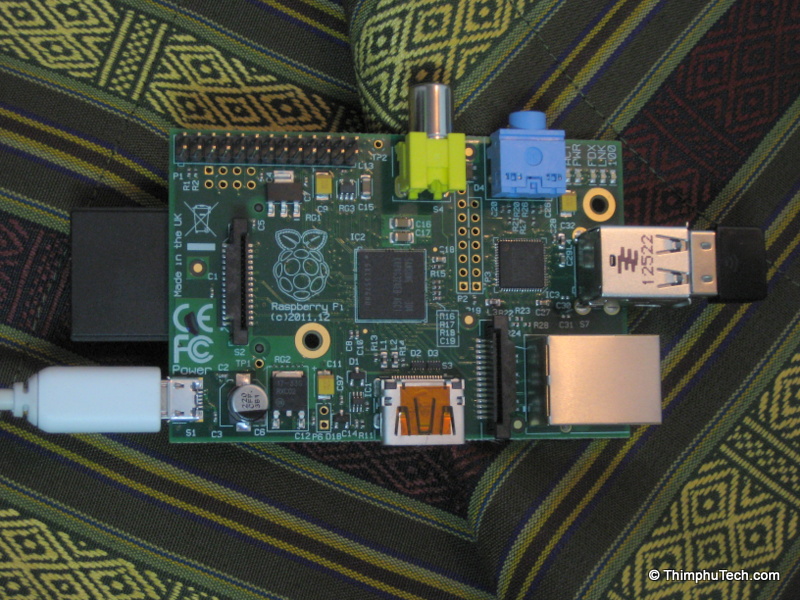 The Kingdom of Bhutan’s first Raspberry Pi Khan Academy Lite is an offline version of Khan Academy‘s superb curriculum of free learning materials; if you haven’t come across Khan Academy before, head over and have a poke around their website when you’ve finished reading this. You’ll be impressed. With the Pi, a 64GB SD card to put all the learning materials on (which actually costs about twice what the Pi you’ll need to run it on does) and a wi-fi dongle, you’ve got a way to bring the MP4 lectures that make up the core of Khan Academy’s material to areas with no internet. Bhutan’s an interesting place to be doing this sort of thing; the internet didn’t come to the country until 1999, and coverage is still very minimal, so an offline solution is vital. 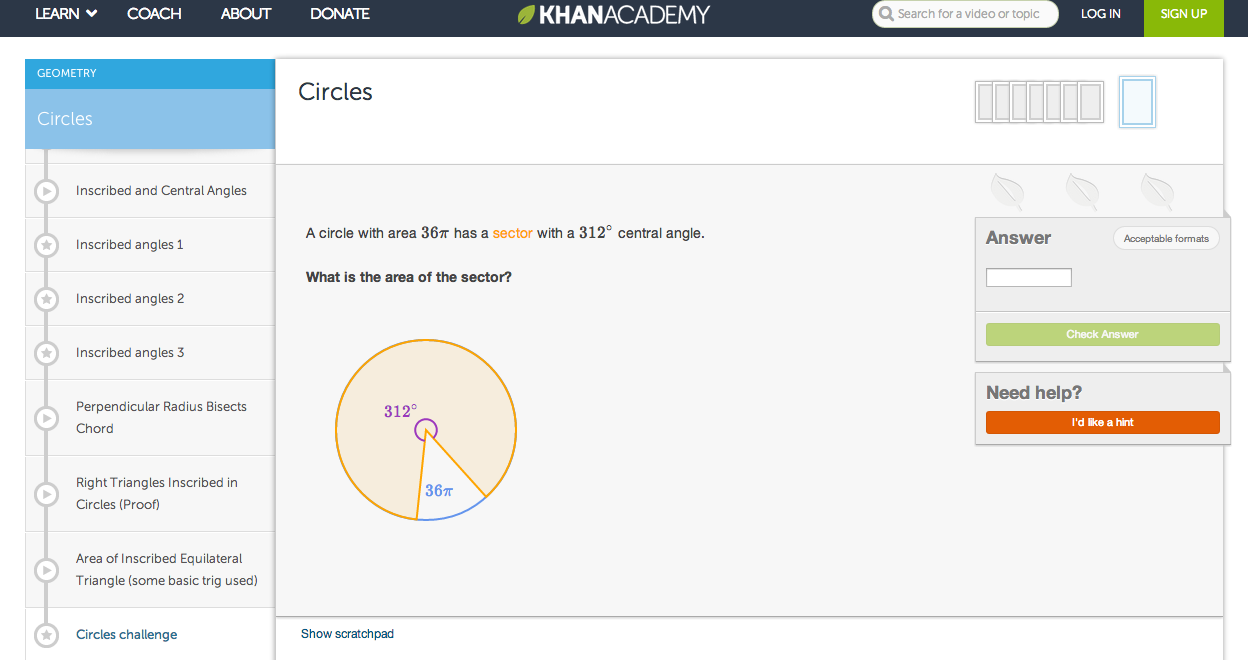 Khan Academy maths exercise What this means is that for an investment of about $99 ($35 for the Pi, $50 for the SD card, $5 for a dongle and another few dollars or so for a box and power supply), schools in Bhutan and all over the world can access world-class learning without needing to be online. We’re really pleased to see the very first Pi in the country being used explicitly to bring educational resources to kids; we’ve been extremely excited about the potential of Khan Academy Lite for a while now, and it’s great to see it in formal use by schools. We hope to hear some more from ThimpuTech soon. |