| Samsung will unwrap its latest blockbuster smartphone, the Galaxy S4, at the Radio City music hall in New York on Thursday evening as the South Korean phonemaker tries to bring the fight to Apple's home market. With Samsung rumoured to have ordered a production run of 100m handsets and research firm Strategy Analytics predicting the S4 will ship 60m units by Christmas, Seoul is going head to head with Silicon Valley for dominance of smartphone sales. The Guardian will be reporting live from the unveiling of Samsung's most hyped handset yet when proceedings begin at 11pm GMT (7pm EST). Expected big features include wireless charging to a screen controlled not just by touch but by eye movements. The Galaxy S4 should outdo the latest iPhone in areas such as photography and processing power, if the leaks are correct, but will still lag behind Apple on the quality of materials and the selection of apps available to the Google Android operating system it uses. Every leaked screenshot so far suggests Samsung will retain the Galaxy's shiny plastic case, leaving Apple, which prefers aluminium, steel and glass, in its own category when it comes to external appearances. The most eyecatching new feature is likely to be an extension of the ability to control the touchscreen using eye movements. A front-facing camera tracks the gaze, which in existing Galaxy phones is already used to stop the screen going dark while pages are being read, and to adjust the picture to the viewer's line of sight. Trademarks called "eye scroll" and "eye pause" were registered by Samsung in Europe in January, suggesting two new functions, and these appeared to be confirmed by screenshots posted to specialist website SamMobile on 6 March. The shots showed a menu of options, including one to "select the speed of scrolling when the device detects that your head is moving up and down", and suggested it would apply to emails and web pages. The menu also stated: "The device pauses videos when it detects your head moving away from the screen." The rear facing camera is reported to be 13 megapixels, compared with the iPhone 5's 8, while the front-facing camera is also higher at 2 megapixels, which should improve the quality of video calls and self-portraits. The S4's screen should be larger too, at nearly 5in (12.7cm) on the diagonal, an inch more than the iPhone 5. Processors with two cores are enough to make Apple's latest phone one of the fastest in the world but the S4 is understood to feature Samsung's eight-core Exynos 5 processor. Like Nokia's flagship Lumia handset, the S4 will, according to South Korean publication DDaily, have the option of being charged wirelessly. Rather than using leads the phone is placed on a charging mat, which is itself is plugged into the mains. The wildest rumour so far, put forward by Patently Apple, which monitors intellectual property filings, is that of a 3D camera for still shots and videos. The US Patent and Trademark Office published a filing last week by Samsung that shows a logo for such a feature. Doubters say 3D images make uncomfortable viewing and have not been popular with buyers of television sets or in the few smartphones that already feature them. Where Apple retains a lead over Samsung is in its apps store. Google's Android software platform, which Samsung uses for the Galaxy devices, has attracted a large number of developers and its store is predicted to be the first to reach 1m apps. But content creators still reserve their best products, such as new games, for iOS software because Apple's customers spend more than Android's. This article originally appeared on guardian.co.uk Please follow SAI on Twitter and Facebook. Join the conversation about this story »             |
Thursday, March 14, 2013
Samsung's Answer To The iPhone 5 Comes Out Today


With Android Management Shakeup, Google Reveals The Broad Sweep Of Its Ambition
| Google’s master plan for mobile is finally coming into focus. The latest development: Andy Rubin, who has run the Android mobile operating system since 2004, even before it was acquired by Google, is stepping down. Taking over Android will be Sundar Pichai, currently the head of Google’s Chrome web browser and Chrome OS project. And here’s where Google shows its hand: Even as he takes on new responsibility for Google’s mobile strategy, Pichai will remain in charge of Chrome. Somewhere in the afterlife, Steve Jobs just yelled, “Boom!” Google is preparing for hybrid, mobile PCsThe distinction between PCs and mobile devices is blurrier than ever, and Google seems to be setting itself up for the moment when Android (for mobile devices) and Chrome (for PCs) become one. In 2011, Google executive chairman Eric Schmidt said that Android and Chrome OS would some day fuse. Android currently runs the majority of smartphones in the world, while Chrome OS is Google’s successful but still nascent attempt to provide people with an alternative to Windows on their notebook and desktop PCs. Putting a single person in charge of both Android and Chrome at once is rather transparently the fastest way to get both projects headed toward some kind of union. Schmidt has also said that Chrome OS is for devices with keyboards, and Android is for devices without. But as the world fills with all manner of hybrid beasts—tablets with keyboards, laptops that convert to tablets, smartphones that become tablets,gigantic smartphones and even notebooks designed to run Windows and Android simultaneously—it’s apparent that these distinctions are, if not exactly meaningless, then at least increasingly unhelpful. People are having fun with and getting work done on whatever device is at hand. Call them mobile PCs. This explains Google’s Chromebook Pixel The baffling, tantalizing Chromebook Pixel.AP/Jeff Chiu Google recently released the Chromebook Pixel, a high-powered laptop that only runs its own Chrome OS. The operating system is good, but it isn’t nearly as capable as Windows or Mac OS X, and its primary talent right now is a great web browsing experience and native integration with Google’s cloud services like Gmail and Drive. In other words, it’s great for cheap laptops, but Chrome OS simply isn’t doing anything taxing enough to warrant all the horsepower and expense of the Chromebook Pixel. Reviewers savaged it accordingly. But now we see where Google is going with all of this. Like the operating system that runs on Apple’s iPhones and iPads, one of the strengths of Android is its enormous library of “native” apps—that is, applications that you download to the device before using. Native applications can do things web-based applications still can’t, like intensive video editing and high-end gaming. Once Google fuses Android and Chrome OS, Chrome will get the huge library of native applications that it currently lacks, and Android could gain the desktop-like features that make Chrome so useful for getting real work done. Some of these advantages are quite simple: Chrome has true “windowing,” which means that the web applications running on it can be run in individual windows instead of browser tabs or, as is common in mobile operating systems, as full-screen apps. But how will Google avoid the Windows 8 trap? Valve CEO Gabe Newell called Windows 8 “this giant sadness.”AP/Elaine Thompson If all this sounds familiar, it’s because the exact same vision animated Microsoft Windows 8, which puts a mobile and tablet-friendly interface alongside regular old Windows. But most people have found that fusion leads to unacceptable compromise. Here’s the key difference for Google, if Chrome and Android merge: Google does not have to support a huge population of existing users of its desktop operating system. Chrome OS is only four years old, and it wasn’t until recently that cheap laptops pre-loaded with Chrome OS made it the least bit mainstream. Microsoft’s strength is also its weakness: Millions of businesses have built applications on top of Windows that Microsoft must support with each successive version of Windows. Google’s primarily obligation, on the other hand, is to the hundreds of millions of people who already use Android, a lightweight, stable, constantly improving operating system that is already close to being capable of allowing users to do “real” work with it. Unburdened by the need for backwards compatibility and empowered by all the lessons tallied so far by the PC industry, Google has the chance to create an operating system that spans all devices and is truly workable—not just a kludge like Windows 8. Android + Chrome OS is a money maker With Google selling hardware like its Nexus 7 tablet more or less at cost, the company remains dependent on advertising.AP/Ahn Young-joon Currently, Google doesn’t charge a licensing fee to the companies, like Samsung, that make billions of dollars selling mobile devices that run Android. Google’s only way to make money directly from Android is through the Google Play store, where it sells apps, and so far the Play store is not a material portion of Google’s income. (Of course, Google-approved versions of Android keep people using Google’s services, where the company can place advertising.) But a fused Android and Chrome OS opens up a number of new potential revenue sources for Google. Foremost among them is simply charging for future Google services. While Gmail might always be free, Google is happy to charge users to store their data. As people move more and more of their lives to the cloud, Google could potentially lock them into life-long subscriptions to its data storage and other services. Google is already accomplishing this at the enterprise level with the per-user subscriptions to a suite of Google apps. Let the age of cloud-based personal computing beginGoogle’s move to fuse Chrome OS and Android is perfectly in line with its identity as an internet company. Chrome OS epitomizes Google’s view that no matter what device you pick up, simply logging in should present you with the same experience, no matter what. Google recognizes that what users want isn’t control but fluidity. People want that moment in the movie Avatar, when a character swipes a document from a flat panel monitor onto his tablet computer, so he can carry it around with him as he walks. We live in an age in which, Google Docs and iCloud and Microsoft Office 365 notwithstanding, the dominant method for sharing data between computers, even computers owned by a single person, is still email. What we could have, instead, is a single unified digital life that is abstracted into the cloud. In this world, every device, no matter its size or capabilities, is simply as a window into our online workspace. A world in which all screens are created equal. Google is trying to realize this vision, but so far its expression—force users into a Chrome OS in which everything is run through the browser—has felt limited. But these are the early days, and the company’s larger ambitions have yet to be realized. The only question is, will it be called Chandroid or Androme? Please follow SAI on Twitter and Facebook. Join the conversation about this story »       |

ebrary Launches International eBook Lending in Germany
|
“With the growing demand for digital content, we are committed to offering content in multiple languages,” said Leslie Lees, vice president of content development for ebrary, in a press release. “Deutsche Sammlung is another step forward in this goal and offers libraries and researchers access to a multi-disciplinary German-language collection that they can combine with Academic Complete, one of the most comprehensive scholarly collections of e-books available.” One of the benefits to libraries that comes from using a subscription model, at least at the onset of ebook lending, is it allows them to track patron usage, user interest, and overall lending data so that they can do a better job of applying their budgets to digital content. The data from a subscription such as this lets them examine where the best applications of future budget dollars can be placed. While the EU continues to do battle over the artificially high VAT (value added tax) rate on ebooks, Europe stands to be the first proving ground for ebook lending. Slow to gain ground in the US due to ongoing conflict between the libraries and the publishers over compensation, ebook lending in Europe would be one way for readers to continue consuming high volumes of digital material–academic texts or popular–as a way to avoid the VAT issue. ebrary is currently working with academic libraries in Germany, but the popularity of ebook lending in the current climate of VAT can easily spark the crossover to public libraries. Once the lending model takes off for EU consumers, hopefully the US will follow suit for its libraries.
ebrary Launches International eBook Lending in Germany is a post from: E-Reader News |

X-rays! (No specs required)
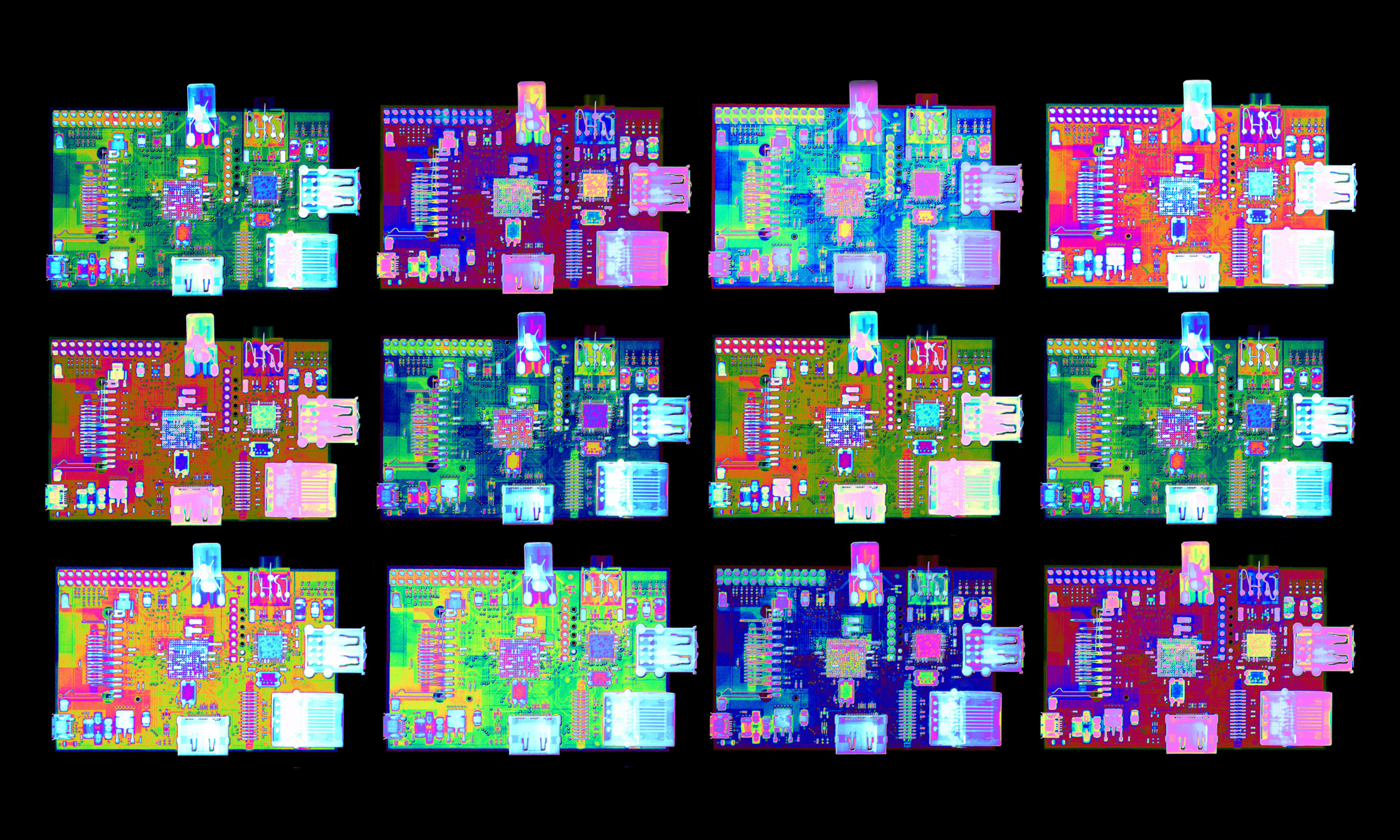
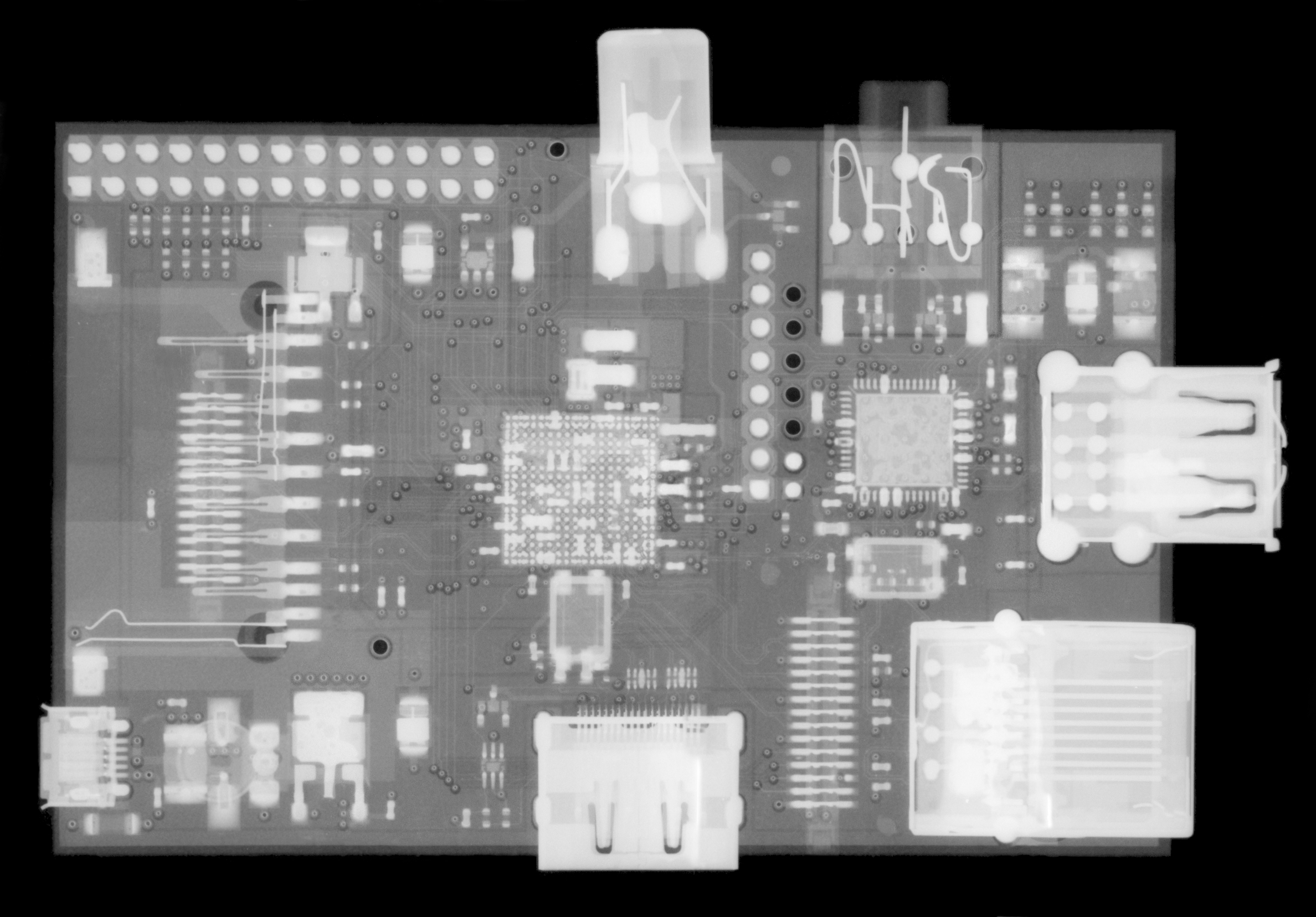
| It’s March 14 (3.14): happy Pi Day, everybody! Steve Purchase, a dentist, found himself alone with a dental X-ray machine and a Raspberry Pi one evening, so he did the obvious thing. I thought the small images he produced were really interesting, and asked him if he could come up with any higher resolution pictures. He went a bit above and beyond on my request.
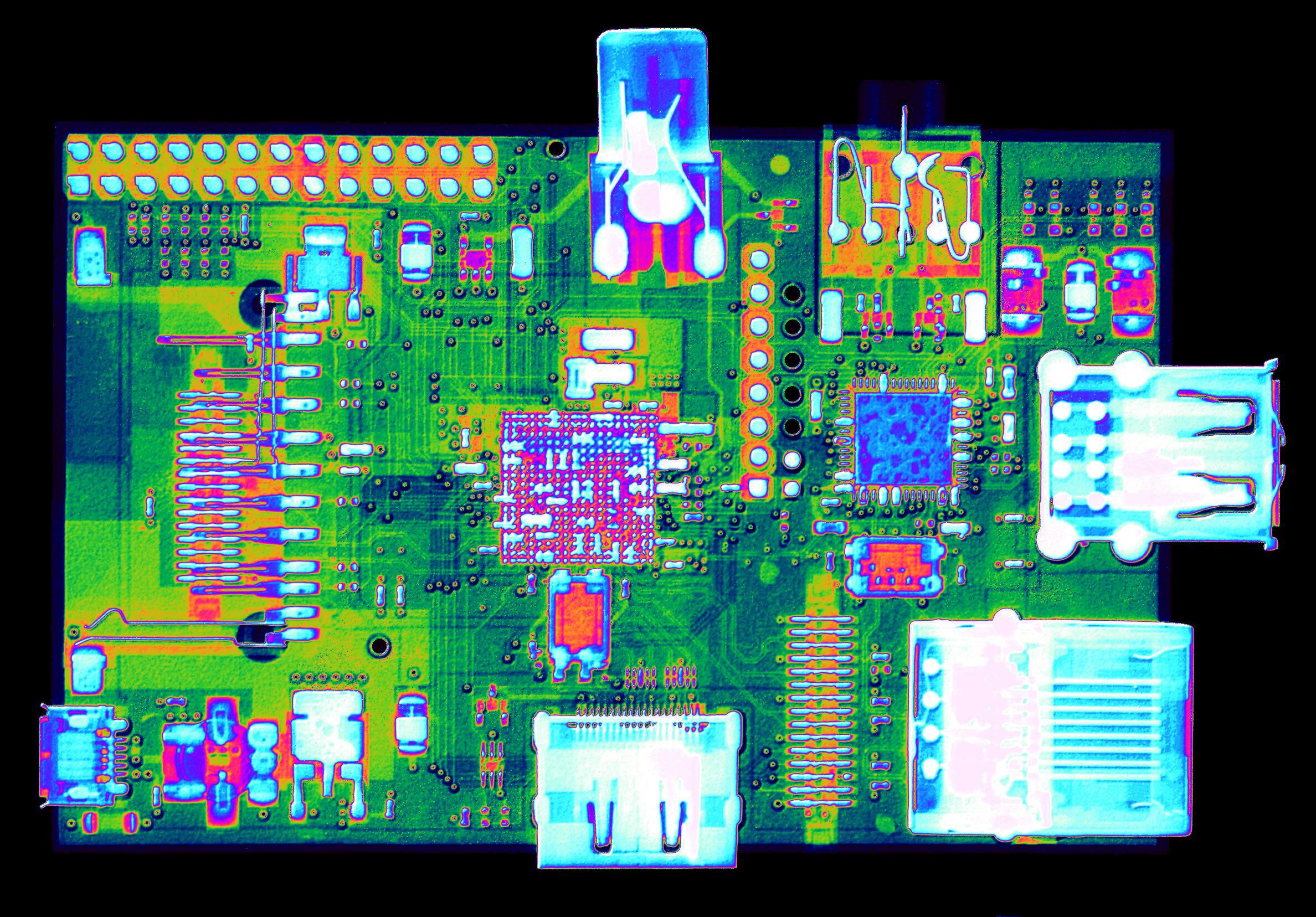
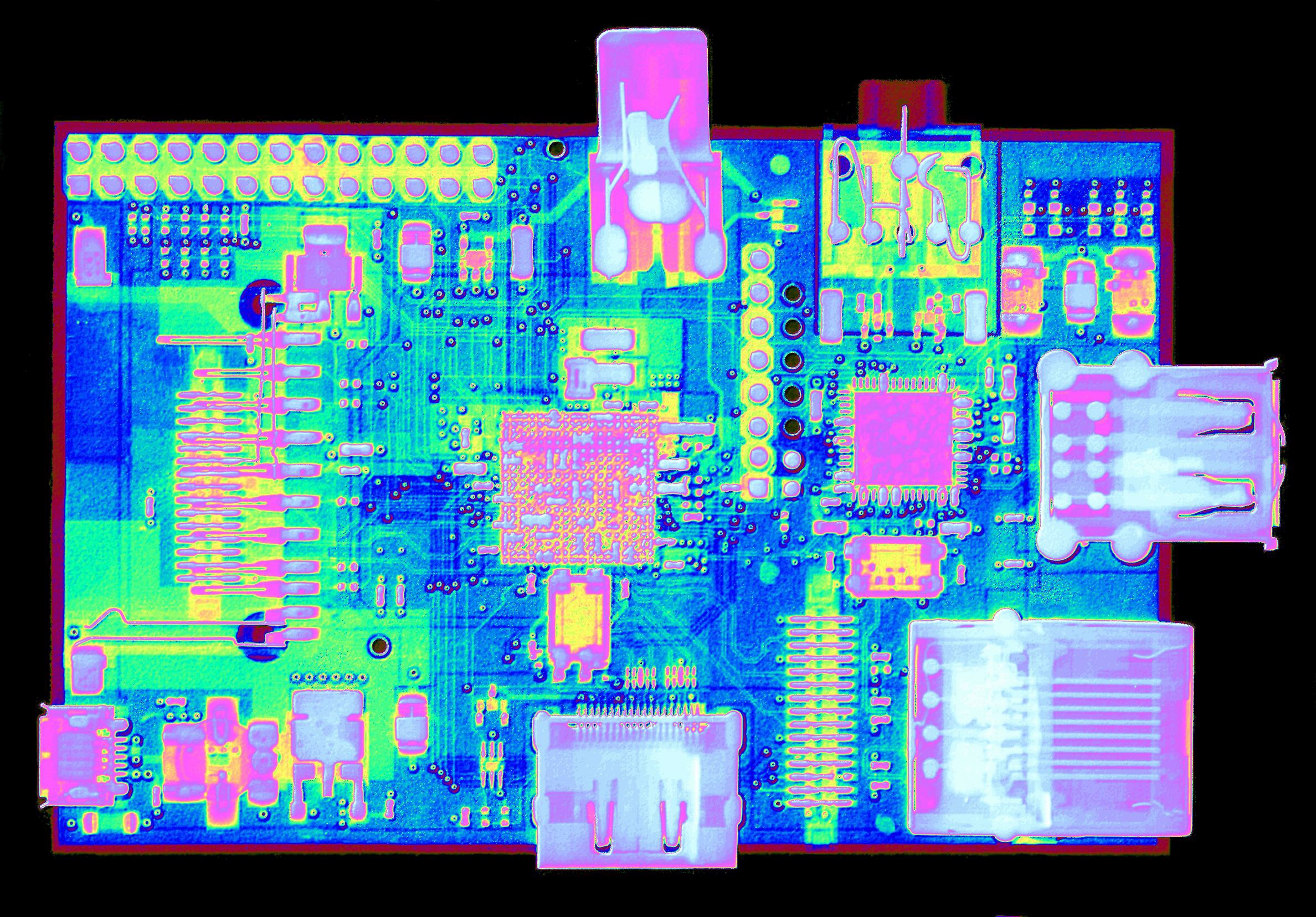
As always, you can click on any of these pictures to enlarge them. These Pis are colourised artificially. The original capture is monochrome: I’ve resized the largest pictures for this page, but you can find a 15MB .png of the monochrome image at Photobucket. The above image of twelve colourised Pis is also available as a larger .png – all the other pictures I’ve used here are the original .jpgs. Different colourisations make different features of the Pi more obvious and easier for the eye to parse: for example, the ball grid array (BGA) assembly of the stacked processor/memory package on package (POP) in the middle of the board is crystal-clear here, with its tiny dots of solder… …while the image below highlights the maze of tracks in all the layers of the board much more efficiently than the b/w original does. We’ll be printing some of these off to stick on the walls at Pi Towers. Thank you very much indeed, Steve. More power to your tartar-scraping elbow, and to that sucky thing that you stick under people’s tongues to get rid of all the spit. |
Wednesday, March 13, 2013
Meet The Redditors Who Rule The Internet
|
The news and entertainment site lets users submit links or text, which get voted up or down by other users. We at Business Insider can attest to the value of getting a link in a prominent place on reddit (aka the front page of the Internet). The craziest thing about this online superpower is that it's powered mostly by anonymous users. The whole thing depends on "karma." Popular posts and comments are upvoted and receive karma, while unpopular ones are downvoted and lose karma. Users with the most karma (especially comment karma) are the superstars of this online community and exert significant power in driving the conversation. We've pulled a popular comment and information when available from the top comment karma holders. Please email Walt and Gus with suggestions and corrections. #17 ImNotJesus ImNotJesus has been a redditor for almost two years and accumulated 363,453 comment karma. He claims to have been employed a suicide hotline. TOP COMMENT: In a thread that asked what movie you could turn around and say the good guy was really the bad guy, ImNotJesus said: Any guy from a romantic comedy that basically stalks the girl and then steals her from her current boyfriend. He then added: #16 pseudolobster A member since October 2010, pseudolobster has accumulated 377,327 comment karma. TOP COMMENT: In a thread featuring this scary photo, pseudolobster commented: #15 se7en_sinner A member since November 2011, se7en_sinner has accumulated 378,028 comment karma. CLASSIC COMMENT: In a thread about a raccoon that a guy mistook for a cat, se7en_sinner posted this image and commented: I found your cat. Karma measured on 3/13/13. See the rest of the story at Business Insider Please follow Business Insider on Twitter and Facebook.       |
 With 400 million uniques in 2012, r
Google Reader is Discontinued
| Google announced today that it is going to discontinue the Google Reader. This is an RSS feed reader that was one of the most beloved because of the community and simplicity of use. It was always very easy for you to access your Google Reader RSS Feeds in any account on a tablet, PC, MAC, at work and at home. The entire project is due to expire in early July. Google Reader initially was developed after the company acquired “Blogger.” The same programming team developed an online reader that anyone could use it. When it debuted in 2006, the internet grew to accept this as the default RSS Reader of choice. Google is seeing increased competition from Pulse, Flipboard and a myriad of other services that has diminished their market share. Google is scaling back on their various web projects and announced 11 others that would be canned within the next few months. This might be good news, because Google Reader had not received any updates in many months and feature/bug requests were all basically ignored. Its better to go out now, then wallow in obscurity. The only positive note, is that rival service Feedly, said they would clone Google Reader and offer it for free. Google Reader is Discontinued is a post from: E-Reader News |
